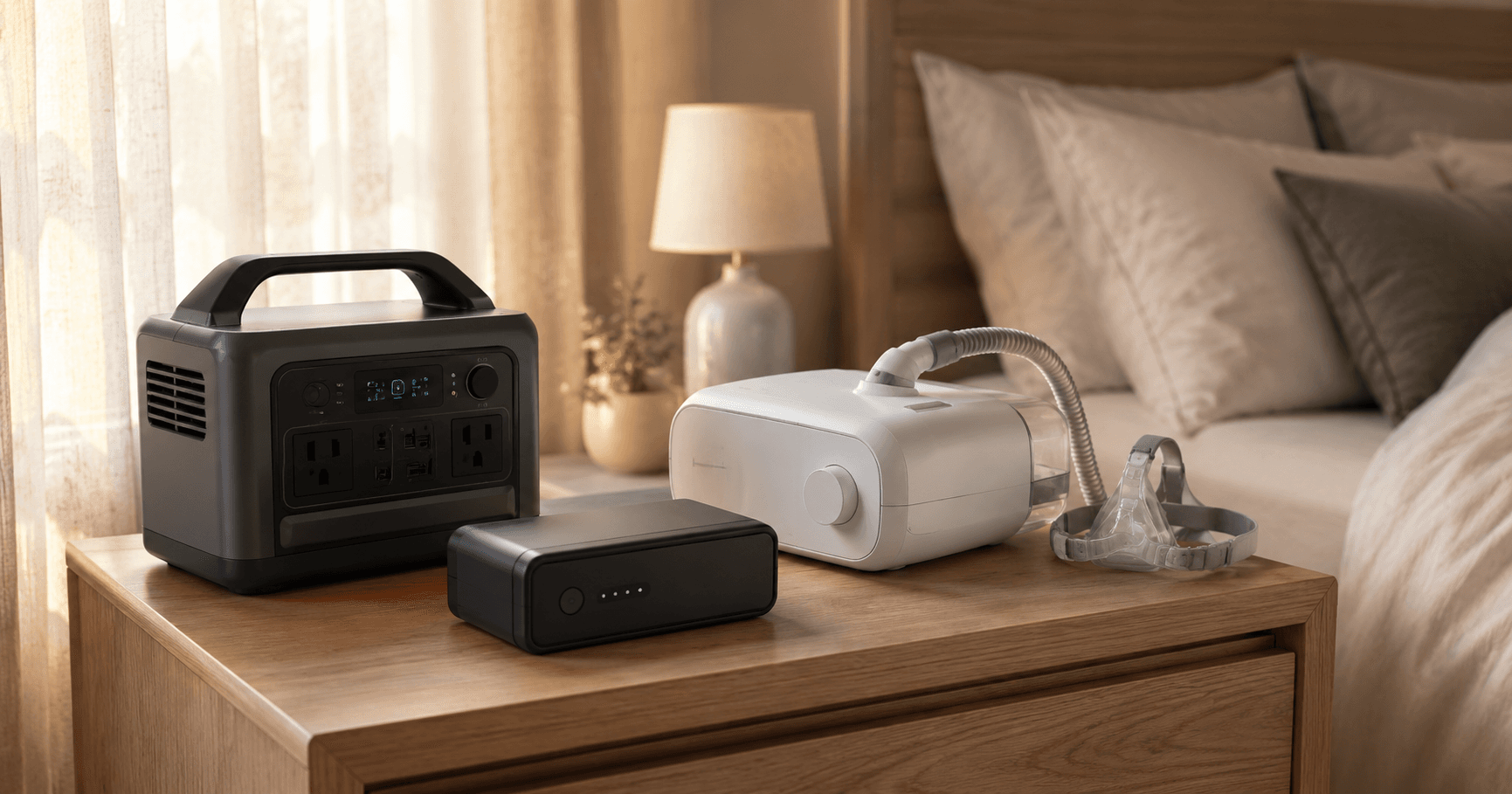
Anker has quietly built one of the strongest portable power station lineups for CPAP users, and most people looking at an Anker SOLIX for CPAP backup have no idea which model actually fits their needs. The lineup spans from a 6-pound DC-only travel unit to a 25-pound multi-night powerhouse — and the runtime differences between them are not just incremental. Picking the wrong model means either overpaying for capacity you will never use or running out of power at 4 AM.
This guide breaks down four Anker SOLIX models head to head with real CPAP runtime estimates, explains the DC adapter efficiency advantage most buyers overlook, and gives you a clear decision framework for choosing the best Anker battery for CPAP backup.
Why Anker SOLIX for CPAP?
Every current Anker power station for CPAP checks the boxes that matter, and a few details set the SOLIX lineup apart from the broader market.
LiFePO4 across the entire lineup. Every current SOLIX model uses lithium iron phosphate cells rated for 3,000 to 4,000+ charge cycles before capacity drops to 80 percent. For a CPAP user cycling their battery several times per month, that translates to a decade or more of reliable service. LiFePO4 is also more thermally stable than the lithium NMC cells found in older power stations — a meaningful safety factor for a device sitting on your nightstand.
Pure sine wave output. All SOLIX AC models produce clean sine wave power identical to your wall outlet. CPAP blower motors and pressure sensors are designed for this waveform. Modified sine wave inverters — the stepped, cheaper alternative — can cause motor noise, inaccurate pressure delivery, and thermal shutdowns in sensitive medical equipment.
10ms UPS switchover on key models. The C300X and C1000 Gen 2 switch to battery power within 10 milliseconds of a wall power outage. That is faster than most dedicated UPS units and well within the tolerance of any CPAP machine. Your therapy continues without interruption — no waking up, no fumbling for a backup power source in the dark.
Ultra-quiet operation. The C300 DC operates at 25 dB — quieter than a whisper. Even the larger AC models with cooling fans run below bedroom-noise thresholds during CPAP-level loads, which rarely exceed 60W and do not trigger aggressive fan ramp-ups.
Fast recharging. The C1000 Gen 2 charges from 0 to 100 percent in about 58 minutes via AC wall power. The C300X reaches full charge in roughly 1.5 hours. Fast recharging matters when you need to top off between consecutive nights of use or before a trip.
Anker SOLIX models compared — specs that matter for CPAP
Not every spec on a power station data sheet matters for CPAP use. Here are the ones that do, laid out side by side across four SOLIX models.
| Feature | C300 DC | C300X | C800 Plus | C1000 Gen 2 |
|---|---|---|---|---|
| Capacity | 288Wh | 288Wh | 768Wh | 1,024Wh |
| Output | DC only | 300W AC + DC | 1,200W AC + DC | 2,000W AC + DC |
| Weight | 6.37 lbs | 9.1 lbs | ~20 lbs | 24.9 lbs |
| Battery | LiFePO4, 3,000+ cycles | LiFePO4 | LiFePO4 | LiFePO4, 4,000+ cycles |
| UPS mode | No | Yes (10ms) | Yes (20ms) | Yes (10ms) |
| Noise | 25 dB | Low | Low | Low |
| Price | $169–249 | $199–299 | ~$549 | $399–499 |
A few things jump out from this table. The C300 DC and C300X share the same 288Wh capacity, but the C300 DC is nearly 3 pounds lighter and $70 to $150 cheaper because it skips the AC inverter entirely. That trade-off is the central decision for portable CPAP users — and we cover it in detail below.
The C1000 Gen 2 stands out on value per watt-hour. At $399 to $499 for 1,024Wh, you pay roughly $0.39 to $0.49 per Wh. The C300X costs $0.69 to $1.04 per Wh. If you need multi-night capacity, the C1000 Gen 2 is the clear winner on economics.
Anker SOLIX C1000 CPAP runtime estimates by model and wattage
Runtime depends on your CPAP machine's actual power draw, which varies based on your pressure setting, whether you use a humidifier, and your mask fit. These estimates use three representative draw levels and account for approximately 85 percent inverter efficiency on AC models. DC output bypasses the inverter entirely, so the C300 DC numbers assume near-100 percent conversion efficiency.
| CPAP draw | C300 DC (288Wh, DC) | C300X (288Wh, AC) | C800 Plus (768Wh, AC) | C1000 Gen 2 (1,024Wh, AC) |
|---|---|---|---|---|
| 25W (no humidifier, low pressure) | 11–12 hrs | 9–10 hrs | 24–26 hrs | 33–35 hrs |
| 40W (no humidifier, moderate–high pressure) | 7–8 hrs | 5–6 hrs | 15–16 hrs | 21–22 hrs |
| 60W (with heated humidifier) | 4–5 hrs | 3–4 hrs | 10–11 hrs | 14–15 hrs |
What these numbers mean in practice
One-night backup without humidifier. Any SOLIX model handles this. Even the smallest units — the C300 DC and C300X — deliver a full night of therapy at typical CPAP draw levels (25 to 40W). For most people running an AirSense 11 or DreamStation 2 without humidification, expect 7 to 12 hours depending on the model and your specific draw.
One-night backup with humidifier. This is where the C300 models hit their limits. At 60W draw, the C300X gives you only 3 to 4 hours — not enough for a full night. The C800 Plus and C1000 Gen 2 handle a humidified night comfortably. If you cannot sleep without your humidifier, skip the 288Wh models for home backup. See our guide on how humidifiers affect battery runtime for strategies to reduce humidifier power draw if you want to stretch a smaller battery.
Multi-night backup. Only the C800 Plus and C1000 Gen 2 deliver multiple nights. The C1000 Gen 2 runs a non-humidified CPAP for two to three full nights on a single charge — genuine extended outage protection. Use our CPAP battery runtime calculator to get personalized runtime estimates based on your specific machine and settings.
The DC adapter advantage
The C300 DC runtime numbers are notably higher than the C300X despite identical 288Wh capacity. The reason is simple: DC output skips the inverter entirely. AC inverters convert stored DC battery power into AC with roughly 85 percent efficiency, meaning 15 percent of your stored energy is lost as heat during conversion. When you use a 12V DC adapter cable to power your CPAP directly from the C300 DC's output, you eliminate that 10 to 15 percent loss.
This matters most with smaller batteries where every watt-hour counts. On a 288Wh unit, 15 percent efficiency loss costs you about 43Wh — enough for an extra 1 to 2 hours of CPAP runtime. If you already own a DC adapter for your CPAP or are willing to buy one ($15 to $30), the C300 DC delivers significantly more runtime per pound and per dollar than the C300X. Our DC power adapter guide covers adapter recommendations by CPAP brand.
C300 DC vs C1000 Gen 2 — which Anker CPAP battery backup do you need?
These two models represent opposite ends of the Anker SOLIX lineup, and the choice between them comes down to how you plan to use your CPAP backup power.
Choose the C300 DC if you need portability
- You travel frequently and want the lightest possible CPAP battery (6.37 lbs)
- You do not use a humidifier or can skip it while traveling
- You already own or are willing to buy a 12V DC adapter for your CPAP
- You need a carry-on-friendly size for air travel
- Your primary concern is one-night backup, not extended outages
- Budget matters — the C300 DC starts at $169
The C300 DC is purpose-built for the portable CPAP use case. It is silent at 25 dB, weighs less than many CPAP machines themselves, and delivers excellent runtime through efficient DC output. The lack of AC outlets is not a limitation if you have the right DC adapter — it is actually an advantage because you skip the inverter and get more runtime from the same battery capacity.

Choose the C1000 Gen 2 if you need home backup
- You want multi-night outage protection (2 to 3 nights without humidifier)
- You use a heated humidifier and need full-night runtime with it
- You want UPS mode with 10ms switchover for seamless outage protection
- You want to plug your CPAP directly into AC without needing a DC adapter
- You live in an area with extended power outages (storms, grid instability)
- You value long-term durability — 4,000+ cycle life
The C1000 Gen 2 is overkill for travel, but it is the right tool for permanent home backup. At 1,024Wh, it delivers the kind of runtime that turns a multi-day power outage from a medical emergency into a non-event. The 10ms UPS mode means you set it up once, plug your CPAP in, and forget about it until the power goes out.
The middle ground: C300X and C800 Plus
The Anker SOLIX C300X CPAP setup makes sense if you want a compact unit with both AC and DC ports plus UPS mode. You sacrifice 3 pounds and $70 to $150 compared to the C300 DC, but you gain AC outlets and automatic outage protection. For users who want one device that works at home and on the road without carrying a separate DC adapter, the C300X is a reasonable compromise.
On Amazon, the model to look for is the standard Anker SOLIX C300: the same 288Wh LiFePO4 design with three pure sine AC outlets (300W), two 140W USB-C ports, a 12V car socket for a CPAP DC converter, and a UPS switchover under 10ms. It weighs 9.1 pounds, recharges to 80 percent in about 50 minutes on AC, and currently sells for $329.99. On an AirSense 11 at 18W, that works out to roughly 11 to 13 hours through the AC outlet, or 13.6 to 14.4 hours via its car socket and a DC converter.

Anker SOLIX C300 Portable Power Station (288Wh LiFePO4, 300W AC)
$329.99
Check price on AmazonThe C800 Plus sits between the C300X and C1000 Gen 2 on capacity (768Wh) but carries a notable drawback for CPAP users: its UPS switchover time is 20ms versus 10ms on the C300X and C1000 Gen 2. While 20ms is still fast enough for most CPAP machines, the 10ms models provide a larger safety margin. At roughly $549, the C800 Plus also sits at an awkward price point — only $170 to $200 less than the C1000 Gen 2, which offers 33 percent more capacity and faster UPS switchover.
How Anker stacks up against Bluetti, EcoFlow, and Jackery
Anker SOLIX does not exist in a vacuum. Here is how it compares against the three other brands CPAP users most frequently consider. For a detailed brand-versus-brand breakdown, see our Jackery vs EcoFlow for CPAP comparison.
Entry-level comparison (under $300)
| Feature | Anker C300 DC | Jackery Explorer 300 | EcoFlow RIVER 2 |
|---|---|---|---|
| Capacity | 288Wh | 292Wh | 256Wh |
| Output | DC only | 300W AC (2 outlets) | 300W AC |
| Battery | LiFePO4, 3,000+ | LiFePO4 | LiFePO4, 3,000+ |
| Weight | 6.37 lbs | 7.5 lbs | 7.7 lbs |
| UPS mode | No | Not listed | Yes (~30ms) |
| Price | $169–249 | ~$259 | $179–239 |
Anker C300 DC wins on: Raw capacity per dollar, runtime efficiency via DC output, and price. At $169 to $249 for 288Wh, it delivers the most watt-hours per dollar in this tier. If you have a DC adapter, it outperforms both competitors on runtime despite similar or lower prices.
Jackery Explorer 300 wins on: Capacity with AC outlets and a trusted, widely used brand. Its 292Wh LiFePO4 pack is the largest in this tier, it covers a full non-humidified night, and its two pure sine AC outlets let you run your CPAP's stock wall adapter with no DC cable, which the C300 DC can't do. At about $259 it costs more than the RIVER 2, and Jackery's Amazon listing doesn't claim a UPS mode, so treat it as a manual-switch backup rather than a bedside UPS.
EcoFlow RIVER 2 wins on: Charging speed. Zero to 80 percent in about one hour is the fastest in this class. It also supports X-Boost for higher-wattage devices, though that is irrelevant for CPAP use.
For cheaper options, check our roundup of the best CPAP power stations under $200.


Mid-range and high-capacity comparison
At the 1,000Wh class, the Anker C1000 Gen 2 competes primarily against the EcoFlow DELTA 3 and BLUETTI Elite 100 V2. The C1000 Gen 2's strongest selling points are its 10ms UPS switchover, 4,000+ cycle life, and aggressive pricing at $399 to $499 — at or below competing 1,000Wh units (the DELTA 3 is about $599 and also claims a sub-10ms UPS). The Elite 100 V2 matches it on cycle life (4,000+) and UPS speed (10ms or less) and adds more AC output (1,800W), but it lists at $899 and only drops to around $499 on sale. The trade-off for all three is weight: 24.9 pounds for the C1000 Gen 2, 25.3 pounds for the Elite 100 V2, and 27.6 pounds for the DELTA 3.
If you need more than two nights with a humidifier, the next step up is the 2kWh class, such as the BLUETTI Elite 200 V2 (2,073.6Wh, about $899, 53.4 pounds), which is not expandable.
Setup tips — getting the most runtime from your Anker and CPAP
The difference between good and great battery runtime often comes down to setup decisions rather than hardware. These tips apply to any Anker SOLIX model.
Use DC output whenever possible. If your CPAP supports a 12V or 24V DC input and you have the adapter cable, plug into the DC outlet instead of AC. You save 10 to 15 percent of your battery capacity by skipping the inverter. On a 288Wh unit, that is an extra hour or more of therapy. Read our DC power adapter guide for adapter recommendations by CPAP brand.
Turn off the humidifier on battery. A heated humidifier can double your CPAP's power draw from 25 to 30W up to 50 to 60W. If your battery is marginal for a full night, disabling the humidifier is the single most effective way to extend runtime. Use a passover humidifier or a standalone room humidifier plugged into wall power as alternatives.
Lower your heated tube temperature. If you cannot give up humidification entirely, reduce the heated tube setting to its minimum. The tube heater draws 10 to 20W on its own — cutting it saves meaningful battery life without completely eliminating moisture delivery.
Disable unnecessary CPAP features. Turn off your CPAP's screen backlight, reduce the ramp time, and disable Wi-Fi or cellular connectivity if your machine supports it. Each feature draws a few watts, and they add up over an 8-hour night.
Keep the battery at room temperature. LiFePO4 cells deliver their rated capacity between 60 and 85 degrees Fahrenheit. Cold environments (below 50F) reduce available capacity by 10 to 20 percent. If you are camping in cold weather, keep the power station inside your tent or sleeping area rather than leaving it in a cold vehicle.
Enable ECO mode on AC models. Anker's ECO mode automatically shuts off AC output when the connected load drops below a threshold. This prevents the inverter from draining power during the low-draw periods between breaths. Check your specific model's ECO threshold — if it is set higher than your CPAP's minimum draw, the station could shut off mid-therapy. Most SOLIX models allow you to adjust or disable the ECO threshold via the app.
Related reading
These guides cover topics that will help you optimize your Anker SOLIX setup for CPAP therapy:
- How humidifiers affect battery runtime — strategies to reduce power draw when using heated humidification
- Calculate your exact runtime — plug in your CPAP model and settings to get personalized runtime estimates
- Bluetti for CPAP — how Bluetti's power stations stack up against Anker for nightly CPAP use
- Best CPAP power stations under $200 — budget-friendly picks ranked by runtime per dollar
- CPAP battery sizing guide — how to calculate the right watt-hour capacity for your needs
What to do next
If you want the most portable Anker SOLIX option for CPAP travel, the C300 DC at $169 to $249 delivers the best runtime per pound and per dollar in the lineup — just make sure you have a compatible DC adapter for your machine. Check our DC power adapter guide to find the right cable for your CPAP brand.
If home backup with automatic outage protection is your priority, the C1000 Gen 2 at $399 to $499 gives you multi-night runtime and 10ms UPS switchover at the best price per watt-hour in the Anker lineup. Set it up once on your nightstand and your CPAP therapy is protected without any action on your part.
For help deciding between Anker and competing brands, our roundup of the best power stations for CPAP ranks top picks with CPAP-specific runtime data and pricing.