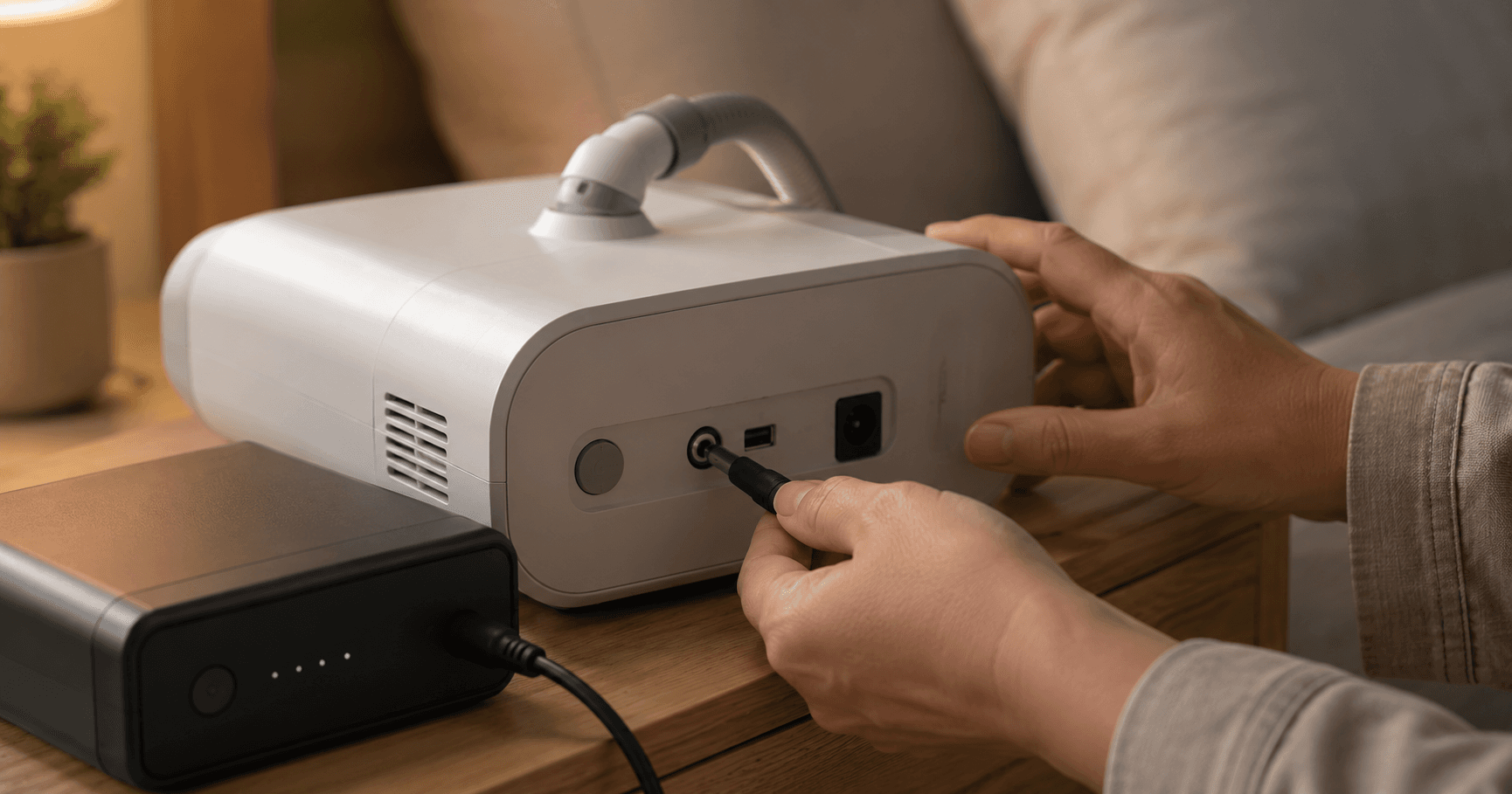
Every CPAP user who relies on battery backup eventually asks the same question: how long will this battery actually last? Manufacturers love to print impressive watt-hour numbers on the box, but translating that into real-world hours of sleep requires a bit of math — and an understanding of where power actually goes.
This guide gives you one reliable formula, walks you through a real calculation step by step, then provides ready-made runtime tables so you can look up your exact setup without touching a calculator.
Prefer an interactive version? Open the CPAP runtime calculator tool →
The simple runtime formula
The core equation is straightforward:
Runtime (hours) = Battery Capacity (Wh) ÷ CPAP Power Draw (W) × Efficiency Factor
That efficiency factor accounts for energy lost during voltage conversion. Here is what to use:
- DC direct connection (12V or 24V cable): Use an efficiency factor of 0.85–0.90. A quality DC cable avoids the double conversion (DC → AC → DC) and keeps losses minimal.
- AC inverter (standard wall plug): Use an efficiency factor of 0.70–0.80. The inverter converts stored DC power to household AC, then your CPAP's internal power supply converts it back to DC. Each step sheds energy as heat.
For a quick mental estimate, just divide watt-hours by watts. But for accurate planning — especially on multi-night trips — always apply the efficiency factor.
What counts as "power draw"
Your CPAP's wattage is not a fixed number. It varies based on:
- Pressure setting: Higher prescribed pressures (15–20 cmH₂O) push more air and draw more watts than lower settings (6–10 cmH₂O).
- Humidification: A heated humidifier adds roughly 10–30 W on top of the base CPAP draw, and a heated tube can add another 5–15 W. This is the single biggest variable.
- Heated tubing: Adds another 10–25 W depending on the temperature setting.
- EPR / pressure relief features: Minimal impact, typically 1–3 W.
- Auto-titrating (APAP) algorithms: Draw fluctuates through the night as the machine adjusts pressure. Use the average, not peak.
For calculation purposes, use the average power draw for your specific combination of settings. The tables below provide tested figures for the most common configurations.
Step-by-step calculation walkthrough
Let's work through a real example. Say you own a ResMed AirSense 11 and a Jackery Explorer 300 Plus (288 Wh capacity), and you want to know if it will last a full night.
Step 1 — Identify your CPAP power draw.
You run the AirSense 11 at a fixed pressure of 12 cmH₂O with the humidifier set to level 3 and heated tubing off. Based on measured data, that setup draws approximately 28 W on average.
Step 2 — Identify your battery capacity.
The Jackery Explorer 300 Plus has a rated capacity of 288 Wh.
Step 3 — Determine your connection method.
You are using the ResMed 24V DC cable to connect directly. Efficiency factor: 0.88.
Step 4 — Plug into the formula.
Runtime = 288 Wh ÷ 28 W × 0.88 = 9.0 hours
That gives you a comfortable full night of sleep with some margin. If you switched to using the AC inverter instead (efficiency factor of 0.75), the same calculation yields:
Runtime = 288 Wh ÷ 28 W × 0.75 = 7.7 hours
You lose over an hour of runtime just from the connection method — a critical difference if you sleep eight hours or more.
Step 5 — Add a safety margin.
Batteries degrade over charge cycles, and ambient temperature affects capacity. In cold weather (below 50°F / 10°C), lithium batteries can lose 10–20% of their rated capacity. For trip planning, multiply your calculated runtime by 0.85 to build in a safety buffer:
9.0 hours × 0.85 = 7.7 hours (safe estimate with DC)
If your required sleep time exceeds this safe estimate, you need a larger battery — or you need to reduce power draw by adjusting your humidifier settings.
Runtime tables by battery and CPAP model


The following tables use measured average power draws and assume a DC direct connection with an efficiency factor of 0.88. For AC inverter use, reduce the listed runtimes by approximately 15–20%.
ResMed AirSense 11
| Battery | Capacity | No Humidifier (18 W) | Humidifier Low (28 W) | Humidifier High (48 W) |
|---|---|---|---|---|
| Medistrom Pilot-24 Lite | 99 Wh | 4.8 hrs | 3.1 hrs | 1.8 hrs |
| Jackery Explorer 300 Plus | 288 Wh | 14.1 hrs | 9.0 hrs | 5.3 hrs |
| EcoFlow River 2 | 256 Wh | 12.5 hrs | 8.0 hrs | 4.7 hrs |
| Bluetti EB3A | 268 Wh | 13.1 hrs | 8.4 hrs | 4.9 hrs |
| EcoFlow DELTA 3 | 1024 Wh | 50.0 hrs | 32.2 hrs | 18.8 hrs |
ResMed AirMini
The AirMini has no heated humidifier — it uses a passive HumidX moisture exchanger that draws no extra power. Unlike a heated humidifier, it never cuts into your runtime, so there's a single runtime column here.
| Battery | Capacity | Runtime (~11 W) |
|---|---|---|
| Medistrom Pilot-24 Lite | 99 Wh | 7.9 hrs |
| EASYLONGER ES270 | 99.9 Wh | 8.0 hrs |
| Jackery Explorer 300 Plus | 288 Wh | 23.0 hrs |
| EcoFlow River 2 | 256 Wh | 20.5 hrs |
Philips DreamStation 2
| Battery | Capacity | No Humidifier (15 W) | Humidifier Low (26 W) | Humidifier High (53 W) |
|---|---|---|---|---|
| Medistrom Pilot-24 Lite | 99 Wh | 5.8 hrs | 3.3 hrs | 1.6 hrs |
| Jackery Explorer 300 Plus | 288 Wh | 16.9 hrs | 9.7 hrs | 4.8 hrs |
| EcoFlow River 2 | 256 Wh | 15.0 hrs | 8.7 hrs | 4.2 hrs |
| Bluetti EB3A | 268 Wh | 15.7 hrs | 9.1 hrs | 4.4 hrs |
The AirMini's low power draw makes it the most battery-friendly CPAP on the market. If you travel frequently and battery runtime is your top priority, see our best battery for AirMini guide.
For DreamStation 2 owners, we have a dedicated best battery for DreamStation 2 breakdown with compatibility notes and DC cable options.
DC vs AC — how your connection method changes runtime
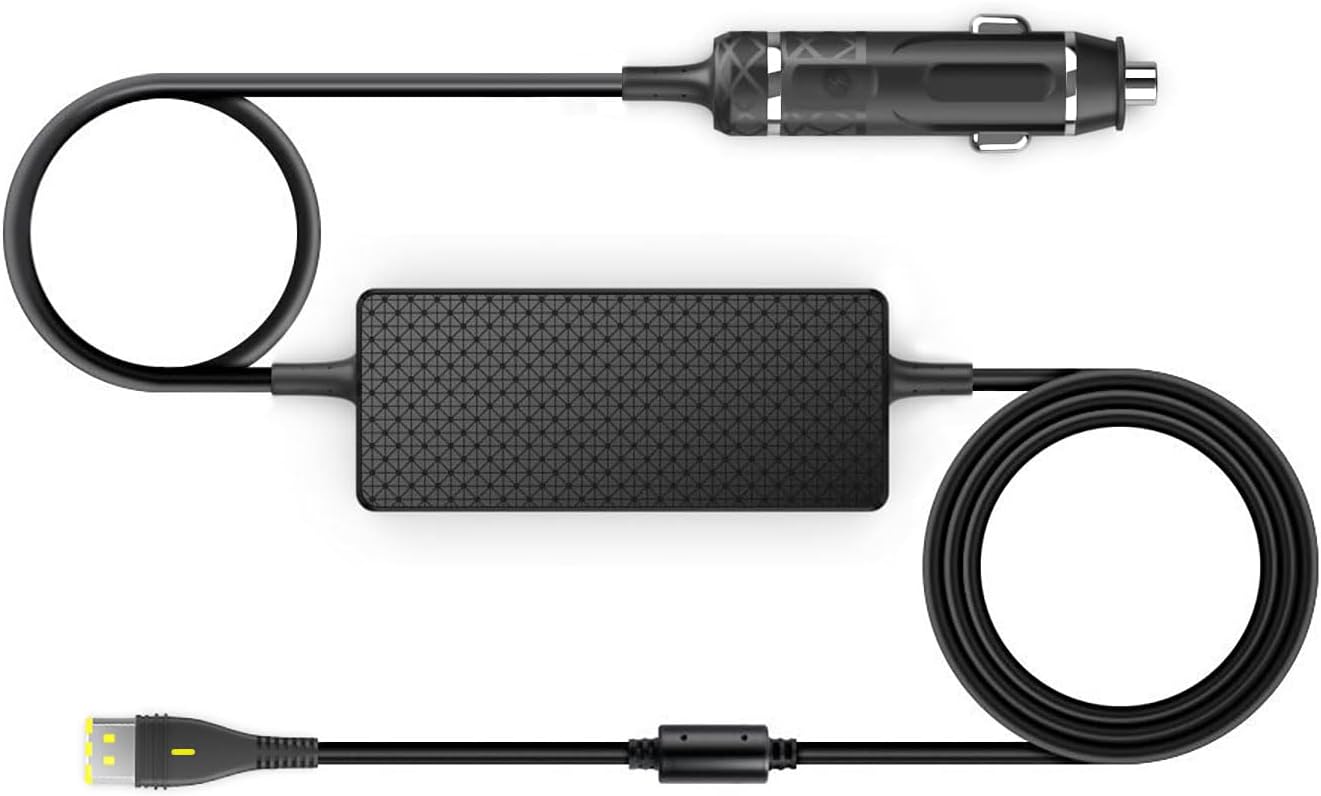
This is the single most impactful upgrade you can make to your battery setup — and it costs under $30.
When you plug your CPAP into a battery's AC outlet (the standard household plug), the power goes through two conversions:
- Battery DC → Inverter AC: The battery's inverter converts its stored 12V/24V DC power into 120V AC. Typical inverter efficiency: 85–90%.
- AC → CPAP internal DC: Your CPAP's power brick converts that 120V AC back down to the 12V or 24V DC the machine actually uses. Typical PSU efficiency: 85–90%.
Combined, you lose 19–36% of your stored energy before it ever reaches the CPAP motor. That is power wasted as heat.
A DC-to-DC cable bypasses both conversions entirely. The battery's stored DC power goes straight to the CPAP at the voltage it needs. You keep 88–92% of the stored energy.
In practical terms, switching from AC to DC on a 240 Wh battery at 28 W draw gains you:
- AC: 240 ÷ 28 × 0.75 = 6.4 hours
- DC: 240 ÷ 28 × 0.88 = 7.5 hours
- Gain: +1.1 hours — that is an extra hour of sleep from the same battery
For a deep dive into which DC cable fits your machine, read our CPAP DC power adapter guide. If you are wondering why your battery already seems to underperform its rated capacity, our CPAP battery not lasting guide walks through every common cause.
Quick-reference sizing chart
Use this chart to find the minimum battery capacity you need based on your CPAP setup and desired runtime. All values assume DC connection and include a 15% safety margin.
For 8 hours of sleep
| CPAP Setup | Min Battery Needed |
|---|---|
| AirMini (HumidX is passive — no extra draw) | 115 Wh |
| AirSense 11 (no humidifier) | 190 Wh |
| AirSense 11 (humidifier low) | 290 Wh |
| AirSense 11 (humidifier high) | 500 Wh |
| DreamStation 2 (no humidifier) | 160 Wh |
| DreamStation 2 (humidifier low) | 270 Wh |
| DreamStation 2 (humidifier high) | 550 Wh |
For multi-night trips (per night)
Multiply the 8-hour figure by the number of nights, then add 10% for battery degradation over the trip (cold mornings, repeated cycling). For a 3-night camping trip with an AirSense 11 on low humidity:
290 Wh × 3 nights × 1.10 = 957 Wh minimum
That puts you squarely in power station territory. A unit like the EcoFlow DELTA 3 (1,024 Wh) would handle this with a small margin, and you can extend further with a solar panel setup.
For a complete packing list and setup walkthrough for overnight trips, our CPAP battery travel checklist covers everything from cables to TSA considerations.
Frequently asked questions
How do I calculate CPAP battery runtime?
Divide the battery's watt-hour (Wh) capacity by your CPAP's average power draw in watts (W), then multiply by an efficiency factor — 0.85–0.90 for a DC direct connection, or 0.70–0.80 for an AC inverter. For example, a 240 Wh battery powering a CPAP that draws 30 W over a DC cable gives you: 240 ÷ 30 × 0.88 = 7.0 hours. Always check your CPAP's actual power draw at your specific pressure and humidifier settings, since these vary significantly between users.
How many watt-hours do I need for one night?
For most CPAP machines without humidification, you need 120–240 Wh to get through an 8-hour night. With a heated humidifier on a moderate setting, plan for 270–500 Wh. The exact number depends on your machine model, pressure setting, and connection method. The AirMini is the most efficient at around 11 W average draw (its HumidX humidification is passive and adds none), while machines like the AirSense 11 with full humidification can pull 48 W or more. Use the sizing chart above to find your specific requirement, and check our battery sizing guide for a more detailed walkthrough.
Does DC vs AC affect runtime?
Yes — and it is the single biggest efficiency gain available to you. Using a DC-to-DC cable eliminates the double power conversion (battery DC → inverter AC → CPAP power supply DC) that wastes 19–36% of your stored energy as heat. Switching from an AC connection to a DC cable typically adds 30–40% more runtime from the exact same battery. On a 240 Wh battery at 28 W draw, that translates to roughly one extra hour of sleep. Every CPAP battery setup should include a DC cable — our DC power adapter guide covers compatibility for every major CPAP model.
Related reading
- CPAP Battery Backup Guide — foundational overview of backup power options for CPAP therapy
- CPAP Battery Sizing Guide — detailed walkthrough for choosing the right capacity battery
- CPAP Humidifier Battery Drain — how humidification settings impact your battery life and what to adjust
What to do next
Now that you know exactly how to calculate runtime for any battery and CPAP combination, it is time to find the right battery for your setup. Head to our best CPAP backup batteries guide for side-by-side comparisons of the top-rated options, complete with pricing, capacity specs, and compatibility notes for every major CPAP model.