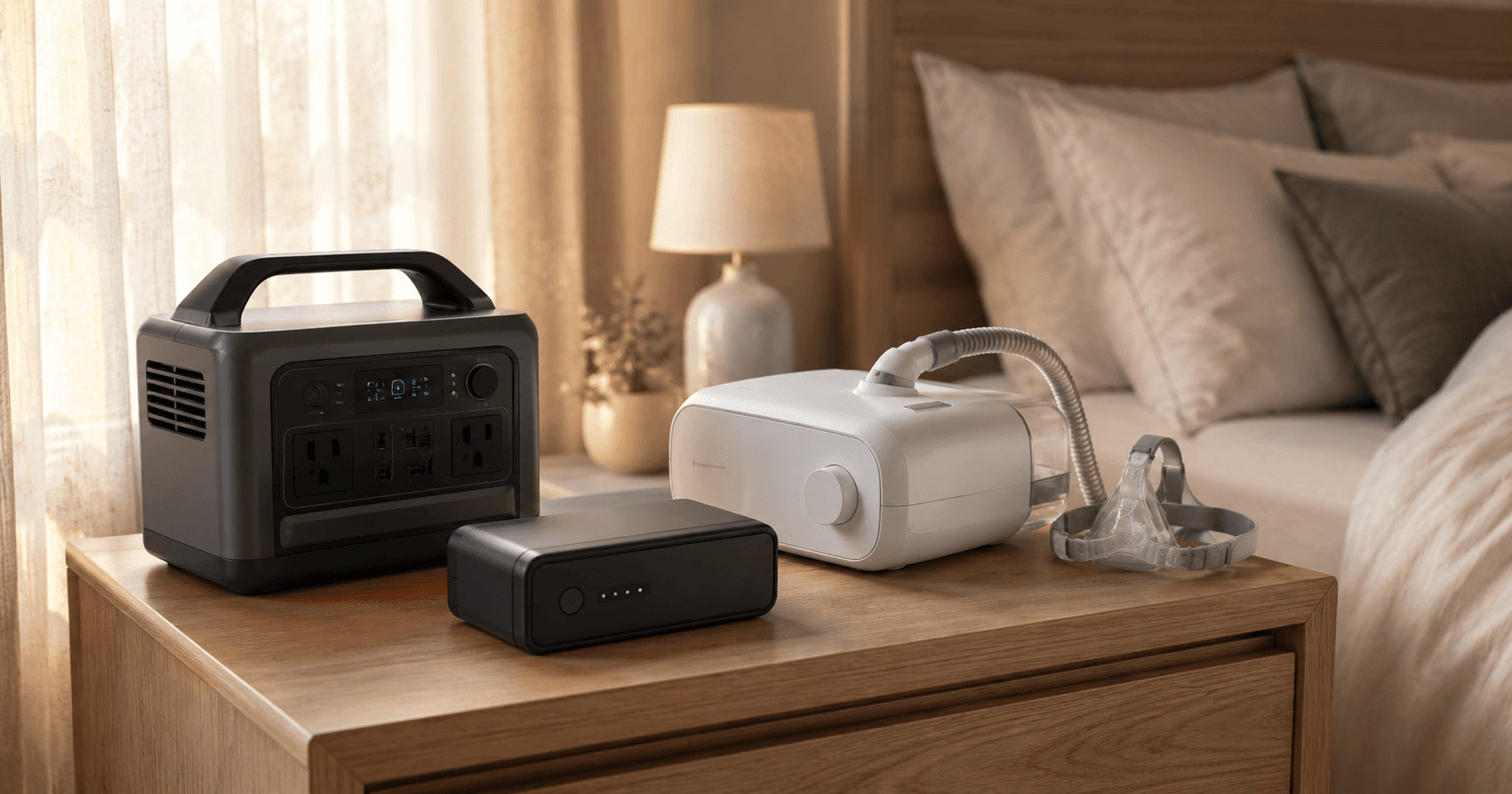
Three types of CPAP backup power
When CPAP users start shopping for backup power, they quickly discover three categories — each with a loyal following and some heated debate. Reddit threads are full of users swearing by one type while others disagree. Let's sort it out.
1. Traditional UPS (Uninterruptible Power Supply)
A UPS is the kind of battery backup you'd find under a desk powering a computer. You plug it into the wall, plug your CPAP into the UPS, and if power fails, the UPS kicks in instantly — often in under 10 milliseconds.
For CPAP users specifically, the Bluetti Elite 30 V2 is a standout bedside option — a 288Wh power station with a 600W AC outlet and 10ms UPS pass-through, so it works with any CPAP, no adapters required, with around 8-10 hours of runtime and instant auto-switchover.

Bluetti Elite 30 V2 Portable Power Station (288Wh, 600W LiFePO4)
$249.99
Check price on AmazonHow it works: Wall power charges the internal battery. When power fails, an inverter converts the battery's DC power to AC power. Your CPAP's power brick then converts that AC back to DC.
The efficiency problem: That DC→AC→DC double conversion wastes 20–40% of the stored energy as heat. A 600 Wh UPS might deliver only 360–480 Wh of useful power to your CPAP.
Typical runtime: 2–5 hours depending on the UPS size and whether you use a humidifier.
Best for: People who already own a UPS, short-duration outages (under 3 hours), and users who want zero-interruption switchover.
2. Dedicated CPAP battery
Purpose-built batteries like the Medistrom Pilot-24 Lite, the EASYLONGER ES270, or the OEM ResMed Power Station II connect directly to your CPAP's DC input — no inverter, no power brick, no wasted energy.
View Medistrom Pilot-24 Lite on Amazon | View EASYLONGER ES270 on Amazon
How it works: A DC-to-DC cable delivers power from the battery to your CPAP at the exact voltage it needs (typically 12V or 24V). No conversion losses.
The efficiency advantage: Near-zero conversion loss means a 97 Wh battery can deliver close to the full 97 Wh to your machine. That same capacity in a UPS would deliver only 58–78 Wh of useful power.
Typical runtime: 8–16 hours without humidifier; 3–6 hours with heated humidifier.
Best for: Travel (especially air travel — most are FAA-approved), users who want maximum runtime per pound, and anyone who uses their CPAP away from home regularly.
3. Portable power station
Portable power stations from brands like Jackery, EcoFlow, and Bluetti sit between a UPS and a dedicated CPAP battery. They offer AC outlets (like a UPS) and often DC outputs too (like a dedicated battery).
View Jackery Explorer 300 on Amazon | View EcoFlow RIVER 2 on Amazon | View Anker SOLIX C300 on Amazon
How it works: Most have a pure sine wave inverter for AC output plus 12V car-style outlets or USB-C PD ports. If you use the AC outlet, you get the same double-conversion loss as a UPS. If you use a DC cable, you get near-zero loss.
The versatility advantage: Unlike a dedicated CPAP battery, a power station can charge phones, run a mini-fridge, power a fan, or handle any other emergency during a long outage.
Typical runtime: 5–20+ hours depending on capacity and whether you use AC or DC output.
Best for: Home power outage preparedness, camping, RV use, and anyone who wants a multi-purpose backup that handles more than just the CPAP.
Head-to-head comparison
| Feature | UPS | CPAP Battery | Power Station |
|---|---|---|---|
| Efficiency | 60–80% | 95–99% | 60–80% (AC) / 95%+ (DC) |
| Auto-switchover | Instant | Manual or pass-through | Some models (UPS mode) |
| Weight (for 8 hrs) | 15–25 lb | 1.4–3 lb | 5–13 lb |
| FAA approved | No | Usually yes | No |
| Powers other devices | Limited | No | Yes |
| Cost for 8 hrs runtime | $80 – $150 | $200 – $350 | $150 – $400 |
| Humidifier support | Yes (shorter runtime) | Limited | Yes (shorter runtime) |
The hidden factor: sine wave quality
CPAP machines with heated humidifiers are sensitive to power quality. Cheap UPS units with modified sine wave output can cause buzzing, overheating, or even damage to your CPAP's power supply.
Always look for pure sine wave output — whether you're buying a UPS or a power station. All major brands (EcoFlow, Jackery, Bluetti, APC Smart-UPS) offer pure sine wave models. Budget "simulated sine wave" units should be avoided.
Dedicated CPAP batteries bypass this issue entirely since they deliver clean DC power directly.
When each option makes sense
Choose a UPS if:
- You already own one or can get one cheaply
- Power outages in your area are brief (under 2–3 hours)
- You want truly seamless, instant switchover
- You don't need portability
Choose a dedicated CPAP battery if:
- You travel frequently, especially by air
- Weight matters — you're backpacking or have limited luggage space
- You only need to power the CPAP (no humidifier or other devices)
- Maximum runtime per dollar is your priority
Choose a power station if:
- You want general-purpose emergency backup for your home
- You go camping or RVing and need to charge multiple devices
- You experience long outages (6+ hours) and want flexibility
- You can use a DC cable for efficient CPAP power but also want AC outlets for other gear
The Reddit verdict
After analyzing hundreds of CPAP user discussions, the community consensus is clear:
- A dedicated CPAP battery wins for travel and pure efficiency
- A power station with a DC cable wins for home backup and camping
- A UPS works in a pinch but is the least efficient option for overnight use
The smartest users often end up with two solutions: a lightweight dedicated battery for travel and a larger power station at home for outages and emergencies.
Our recommendation
For most CPAP users, a mid-range portable power station (250–500 Wh) paired with a DC-direct cable for your specific CPAP model offers the best balance of efficiency, versatility, and value. You get nearly the same efficiency as a dedicated CPAP battery, plus the flexibility to power other devices during an outage.


If you fly frequently, add a dedicated CPAP battery under 100 Wh for FAA compliance.

Related reading
- CPAP Power Outage Guide — deploy your chosen backup
- CPAP Battery Sizing Guide — capacity math for each option
- CPAP Battery Compatibility Guide — DC cables by machine model
- Jackery vs EcoFlow for CPAP — head-to-head on power stations
- Best CPAP Backup Batteries — purpose-built CPAP batteries reviewed
What to do next
Pick the category that matches your primary use case — travel, home outages, or camping — and buy one unit that solves 90% of your scenarios. A lot of users end up owning two (travel battery + home power station), but start with the bigger need first.
- If you fly: grab a sub-100 Wh dedicated CPAP battery
- If outages are your concern: buy a UPS-mode power station with a DC cable
- Either way: order the DC-direct cable for your CPAP to unlock 25%+ more runtime
Affiliate disclosure
This site may include affiliate links. If you buy through links, we may earn a commission at no extra cost to you. We only recommend products we've researched and believe are genuinely useful for CPAP users.