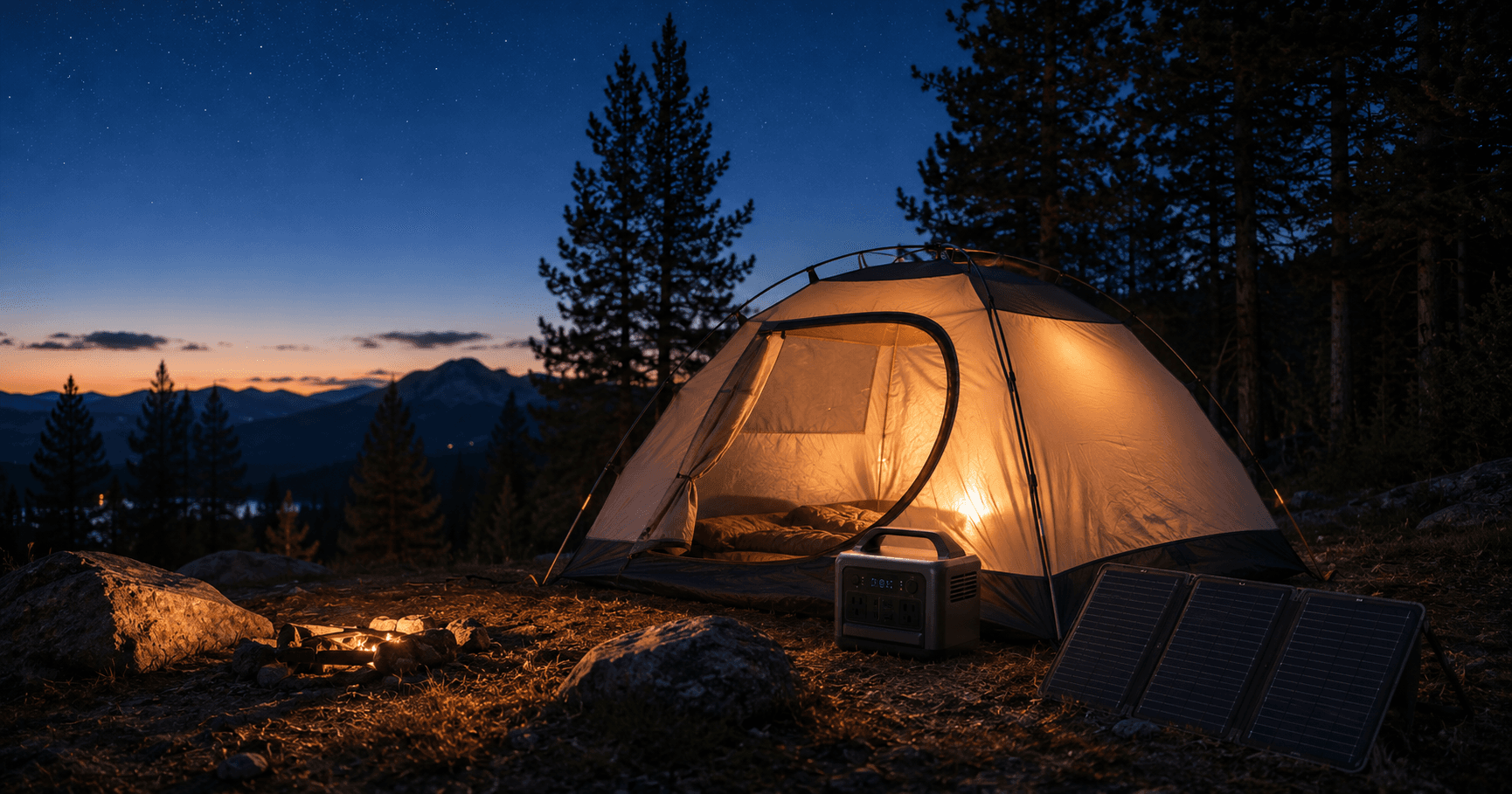
A CPAP battery tent camping setup — a CPAP battery used for tent camping — is a lithium power pack — typically 99 to 288 Wh — that runs a CPAP machine off-grid for one to three nights without an outlet. The right one for backpacking is chosen by watt-hours per pound (Wh/lb), not by total capacity, because every ounce rides on your back. Most "best CPAP battery for camping" lists assume you are rolling a 30-pound LiFePO4 brick out of the back of a truck. If you are hiking to your tent, that math is useless. This guide ranks the eight best lightweight options by Wh/lb so you can stop carrying car-camper gear up a switchback.
In short: the Anker Solix C300 DC wins outright for genuine 2-night hike-in trips (57.6 Wh/lb with DC-out efficiency). For fly-in 1-nighters, the Anker Prime 27,650 and the CPAP-specific EASYLONGER ES270 tie on pure carry math (~77 Wh/lb, FAA-legal). The Medistrom Pilot-24 Lite stays the most foolproof ResMed plug-and-play. Everything heavier than 8 lb belongs in a vehicle, not a backpack.
Why weight per watt-hour matters for tent camping
The single most useful number for a CPAP battery tent camping rig is Wh divided by lb — anything under 30 Wh/lb is dead weight on trail, and anything above 50 Wh/lb is worth its space in your pack. Car campers optimize for capacity. Backpackers optimize for grams. A 22 lb power station with 500 Wh looks great in a spec sheet — and unbearable at mile four of a ridgeline approach.
The rule of thumb backpackers use: your battery should weigh less than 10% of your total loaded pack weight for a 2-3 night trip. On a 35 lb pack that ceiling is 3.5 lb — which immediately rules out every "lightweight" pick in mainstream camping roundups. If you are car camping with a cooler and a folding chair, start with our broader camping guide if you have a vehicle instead. For the full pack-list approach, see our backpacking primer.
The 25 lb Bluetti Elite 100 V2 is where car-camping begins. Past that line, you are no longer hiking — you are unloading.
The 2-night humidifier-off math
Two nights of off-grid CPAP is a 200 Wh problem, not a 100 Wh problem. Here is the arithmetic every backpacker should commit to memory.
The ResMed AirSense 11 draws approximately 13 W with the humidifier and heated tube turned off, versus roughly 51 W with both on — a 4x penalty. See our breakdown of actual wattage by machine for Philips DreamStation and BiPAP numbers. Multiplied across an 8-hour night:
- 8 hrs x 13 W = 104 Wh per night (humidifier off)
- Two nights = 208 Wh of usable capacity needed
A 99 Wh FAA-legal battery delivers roughly 7.6 hours — one full night with a buffer, not two. For genuine 2-night autonomy you need about 200-256 Wh, or you need to carry a second 99 Wh pack. Pressure setting matters too: every +2 cmH2O above 8 adds roughly 1-2 W of draw. Plug your pressure setting into the runtime calculator before you pack.
If you cannot stomach turning the humidifier off, read why the humidifier eats 4x the power — and then pack a second battery.
Best CPAP battery tent camping picks: ranked by Wh per pound
Below is the CPAP battery tent camping ranking that actually matters for hike-in trips: real shipped weight, manufacturer Wh, divided. DC-out batteries (no inverter) punch above their nominal Wh/lb because they skip the ~15% AC inversion loss when paired with a 24 V CPAP cable.
| Product | Weight (lb) | Capacity (Wh) | Wh per lb | Nights @ AirSense 11 (no humidifier, 13 W, 8 hrs) | Best for |
|---|---|---|---|---|---|
| Anker Prime 27,650 mAh 250W | 1.3 | 99.5 | 76.5 | 0.95 nights | Ultralight overnight, FAA-legal carry-on |
| EASYLONGER ES270 | 1.3 | 99.9 | 76.8 | 0.95 nights | CPAP cables included, FAA-legal carry-on |
| RoyPow 86Wh 12V power bank | 1.4 | 86.6 | 61.8 | 0.8 nights | Budget top-up, regulated 12 V socket, no AC |
| Medistrom Pilot-24 Lite | 3.0 | 99 | 33.0 | 0.95 nights | ResMed-only, plug-and-play DC, FAA-legal |
| Anker Solix C300 DC | 5.0 | 288 | 57.6 | ~2.7 nights | Best 2-night carry, DC-out skips inverter losses |
| EcoFlow River 2 | 7.7 | 256 | 33.2 | ~2.4 nights | AC-needed gear + CPAP, drive-to-trailhead trips |
| Anker Solix C300 (AC version) | 9.1 | 288 | 31.6 | ~2.7 nights (DC) | AC outlets + CPAP, drive-to-trailhead; LiFePO4, under-10 ms UPS |
| Bluetti AC2A | 7.9 | 204 | 25.8 | ~1.9 nights | Backup option; fastest AC recharge in class |
The bottom line: the Anker Solix C300 DC is the only option in this list that delivers a true 2-night carry without breaking the 10% pack-weight rule on a 50 lb base load. The Anker Prime and EASYLONGER ES270 are unbeatable for 1-night trips. Everything heavier than 8 lb should be driven, not carried.

Anker Prime Power Bank (27,650mAh, 250W, 140W USB-C PD)
$179.99
Check price on Amazon
EASYLONGER ES270 CPAP Battery (99.9Wh, FAA Carry-On)
$139.99
Check price on Amazon

RoyPow 86.58Wh Power Bank with Regulated 12V Car Socket (30W USB-C PD)
$77.89
Check price on Amazon
A quick note on chemistry: most ultralight picks here use standard Li-ion for energy density, while the Solix C300 DC uses LiFePO4. That matters for shoulder-season trips — see our chemistry trade-off for cold-weather camping. For non-camping travel scenarios, our full battery roundup covers airport and hotel use cases.
Charging in the field (solar vs car ride-in vs none)
For 1-night trips, skip recharging entirely — just carry the fully charged battery. For 3+ nights, a 100 W foldable panel paired with a 256 Wh battery is the sweet spot. Anything less than 60 W of panel is a paperweight when clouds roll in.
Solar panel sizing (the honest math)
A 60-100 W foldable panel weighs 2.5-5 lb and adds 3-5 hours of sit-still daylight to your itinerary. That is real time at camp, not hiking time — plan a layover day or a long lunch on an exposed slab. Under full June sun in the Sierra you can expect roughly 60-75% of a panel's rated output at the battery (the rest is lost to controller efficiency, cable resistance, and off-axis sun). A 100 W panel therefore returns ~60-75 W in practice, which means a 99 Wh battery takes 1.5 to 2 hours of direct sun to top off, and a 288 Wh Solix C300 DC takes 4 to 5 hours. The full math (panel angle, voltage, controller efficiency) lives in our deep dive on solar charging.
Three concrete solar rules for tent campers:
- Aim the panel within 15 degrees of perpendicular to the sun. Off-axis output drops as the cosine of the angle — at 30 degrees off you have already lost 13%.
- Lay the panel flat on a slab, not on your tent fly. Tent fabric flexes with wind, shifts the angle every minute, and shades cells unpredictably.
- Charge before noon. Afternoon clouds are statistically more common in mountain microclimates; the morning window is the reliable one.
Car ride-in: the underrated option
Trailhead car ride-in is the most underrated charging method on this page. A 12 V cigarette adapter recharges most of these batteries in 3-5 hours of driving — so if your trailhead is a 4-hour drive from home, you arrive with a fully topped pack and no solar weight penalty. The Anker Solix C300 DC accepts 12 V input at ~85 W (about 3.5 hours to full from empty), and its AC-outlet sibling, the Solix C300, also accepts car charging (or up to 140 W over USB-C). Bring the OEM cable, not a no-name one — voltage drop on a long thin wire will brown out the battery's input regulator and stall the charge.
Skip solar entirely on these trips
Based on years of backpacker forum reports, solar is the wrong call when: (a) your trip is two nights or fewer, (b) you are camping in tree cover above 60% canopy, or (c) you are on a moving itinerary that does not allow a 3-5 hour stationary window. In those scenarios, a second 99 Wh battery weighs roughly the same as a 60 W panel and gives you guaranteed power instead of probabilistic power.

Anker SOLIX C300 Portable Power Station (288Wh LiFePO4, 300W AC)
$329.99
Check price on AmazonPack list: protecting the battery in a tent
Cold drops lithium capacity 15-30%, and tent condensation kills DC connectors faster than rain does — both are the primary failure modes of any CPAP battery tent camping setup. The single most important rule is to sleep with the battery inside a dry-bag inside your sleeping bag — not under it, where it loses heat to the ground pad.
The eight-rule field kit
- Cold management. Battery in dry-bag, inside sleeping bag, near your torso. Bring it out only when running the CPAP. Below 32 degrees F, expect runtime to drop by a quarter even with a warm-stored battery — that 7.6-hour night becomes ~5.7 hours.
- Waterproofing. Gallon zip-lock plus a silica packet inside the dry-bag. Tent condensation kills DC connectors faster than rain does. Replace the silica packet every trip — they saturate fast in a sealed bag full of human breath.
- Cable routing. Short 12 V DC cable beats long AC extension every time. Tape the barrel connector to the battery with electrical tape to prevent overnight tug-disconnects when you roll over.
- Impact protection. Foam padding around the battery in your pack. Batteries do not mind drops — connectors and screen displays do. The Anker Prime's USB-C ports in particular bend if a heavy item lands on top.
- Heat is the real enemy. Never leave a lithium battery in a sun-baked tent. Internal temps above 140 degrees F push cells into thermal-risk territory and void most warranties. A black-fly tent at noon on an exposed ridge hits this in 30 minutes.
- Pack position. Carry the battery in your main pack body, not in an outside mesh pocket. Outside pockets expose the battery to brush impact, UV, and rain spray. Center it vertically between your sleeping bag (top) and your stove fuel (bottom).
- Pre-trip charge cycle. Charge the battery to 100% within 24 hours of departure, not a week before — Li-ion self-discharge is roughly 2-3% per month at room temp, but accelerates with heat. A battery left in a 90-degree garage can lose 10% before you reach the trailhead.
- Cable backup. Always carry a spare DC barrel cable in your repair kit. They are 0.4 oz, free in spare parts bins, and a frayed cable mid-trip ends therapy. Wrap the spare around your battery with a rubber band.
Total pack weight worked example
A realistic ultralight 2-night tent-camping CPAP kit looks like this:
| Item | Weight (lb) |
|---|---|
| ResMed AirSense 11 (no humidifier installed) | 2.0 |
| Anker Solix C300 DC | 5.0 |
| DC adapter cable + spare | 0.2 |
| Dry-bag, zip-lock, silica | 0.2 |
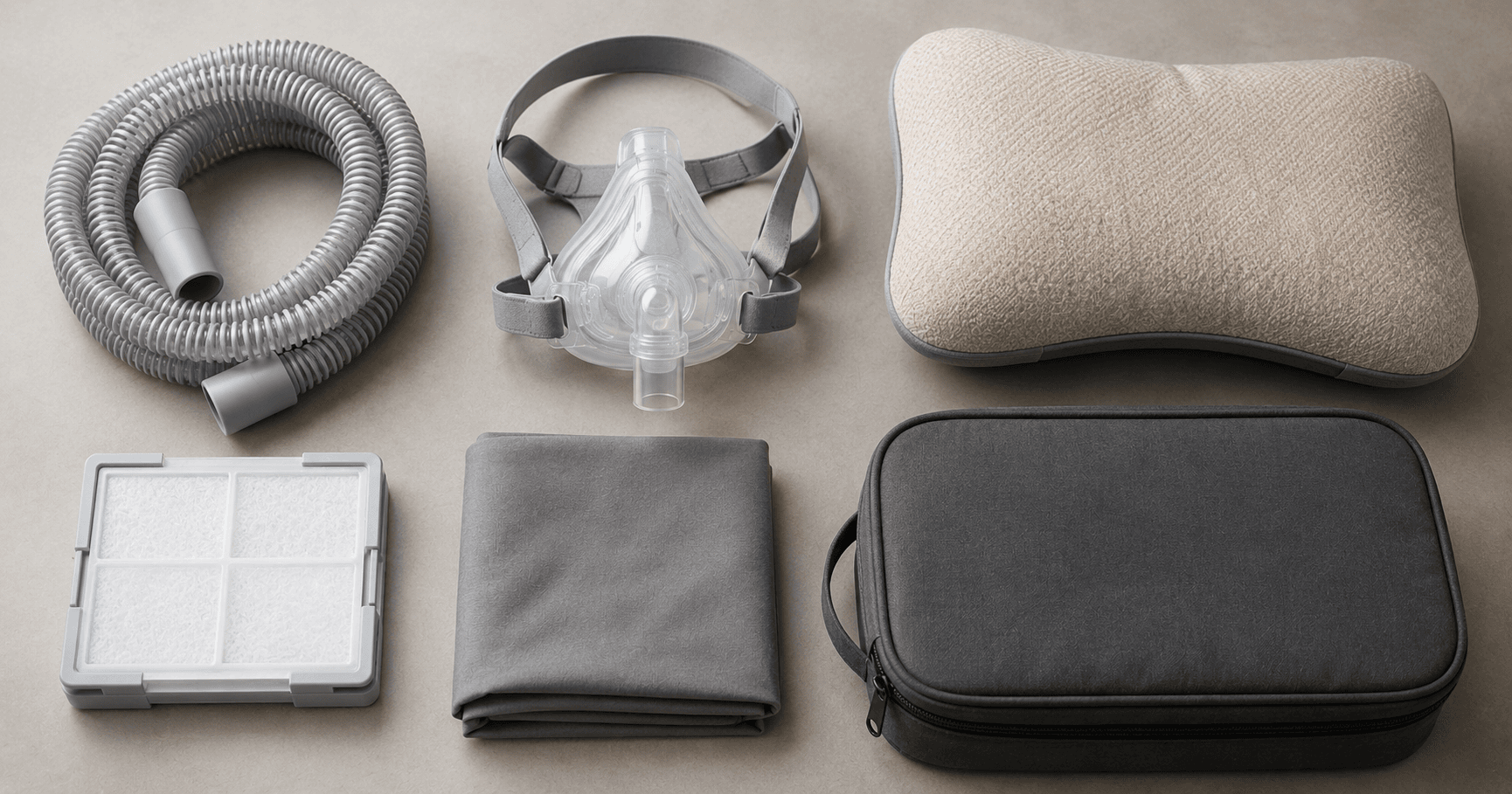
| Mask + tubing | 1.0 |
| CPAP subsystem total | 8.4 lb |
At 8.4 lb of CPAP-specific gear, you are at the limit of what most backpackers will tolerate. Shaving the Solix down to a single 99 Wh Anker Prime (1.3 lb) cuts the subsystem to 4.7 lb but limits you to one humidifier-off night.
FAA 100 Wh limit if you are flying to the trailhead
If you are flying to your trailhead, 160 Wh is the absolute ceiling and 100 Wh is the no-paperwork ceiling. All spare lithium batteries are carry-on only — never checked.
- 0-100 Wh: unlimited, no approval needed. This is why the EASYLONGER ES270, Medistrom Pilot-24 Lite, and Anker Prime 27,650 are the fly-in backpacker's holy trinity (the 86.6 Wh RoyPow power bank also qualifies).
- 101-160 Wh: maximum two, airline approval required. Call 48-72 hours ahead. Few CPAP-specific batteries sit in this band — most are engineered to stay under 100 Wh instead.
- Over 160 Wh: forbidden on passenger aircraft. The EcoFlow River 2, Anker Solix C300 (both versions), and Bluetti AC2A all need to be driven or shipped to the trailhead.
See our full breakdown of TSA and FAA rules in detail for documentation tips and prescription paperwork.
EASYLONGER ES270 CPAP Battery (99.9Wh, FAA Carry-On)
$139.99
Check price on AmazonAnker Prime Power Bank (27,650mAh, 250W, 140W USB-C PD)
$179.99
Check price on AmazonFrequently asked questions
Can I run a CPAP for 2 nights on a 99 Wh battery? No — a 99 Wh battery covers one night, not two. At the AirSense 11's 13 W draw with the humidifier off, 99 Wh delivers roughly 7.6 hours — one full night with a small buffer. For two nights you need about 200 Wh or a second 99 Wh pack.
What is the lightest CPAP battery for backpacking in 2026? The lightest FAA-legal picks are the Anker Prime 27,650 mAh power bank (1.3 lb / 99.5 Wh, 76.5 Wh per pound) and the EASYLONGER ES270 (1.3 lb / 99.9 Wh, about 77 Wh per pound) — effectively tied for the best Wh/lb of any FAA-legal option, well ahead of the Medistrom Pilot-24 Lite.
Will a CPAP battery work in cold tent temperatures? Yes, but cold cuts capacity sharply. Lithium chemistry loses 15-30% capacity below 40 degrees F, so sleep with the battery inside your sleeping bag in a dry-bag. LiFePO4 cells tolerate cold better than standard Li-ion.
Do I need an inverter or can I run my CPAP on DC only? You do not need an inverter. The ResMed AirSense 11 and Philips DreamStation accept 24 V DC directly with the correct cable. Skipping AC inversion saves roughly 15% of capacity — meaningful when every Wh is on your back.
Can I bring a CPAP battery in carry-on luggage? Yes, and you must — checked bags are forbidden for spare lithium. Under 100 Wh: no approval needed. 101-160 Wh: airline approval 48-72 hours ahead, maximum two. Over 160 Wh: forbidden.
Related reading
- CPAP backpacking guide: full pack-list approach
- CPAP camping setup if you have a vehicle
- Broader 2026 camping battery guide
- CPAP power consumption by machine in watts
- CPAP battery runtime calculator
- Solar charging math for CPAP batteries
- LiFePO4 vs Li-ion CPAP battery chemistry
- TSA & FAA rules for flying with CPAP batteries
What to do next
Pick the lightest option that survives your worst night. For a fly-in 1-nighter, that is the Anker Prime 27,650 or the EASYLONGER ES270 at 1.3 lb — toss one in your carry-on and go. For a 2-night hike-in, the Anker Solix C300 DC is the only sub-5 lb option that actually delivers two full humidifier-off nights without rationing. Before you book the trip, run your exact pressure setting through our runtime calculator so you are sizing capacity to your therapy — not to a generic 13 W estimate.