Why solar makes sense for CPAP backup
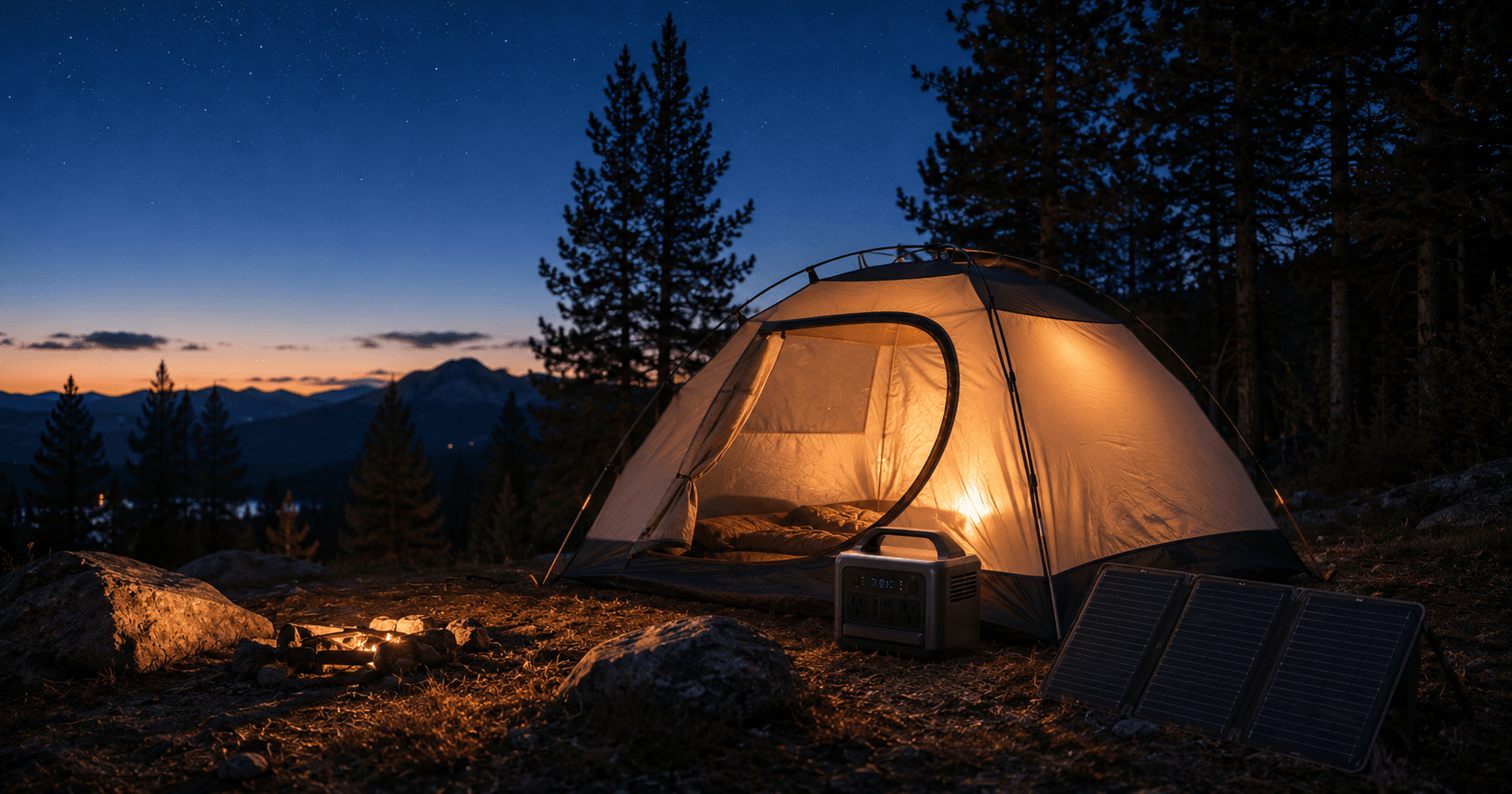
If you camp, RV, live off-grid, or just want an emergency power plan that never runs out, solar is the answer. A portable solar panel can recharge your CPAP battery every day — giving you indefinite runtime without a wall outlet or generator.
The math is simple: your CPAP uses 120–250 Wh per night (without humidifier). A 100W solar panel in decent sunshine produces 300–500 Wh per day. You're generating more power during the day than your CPAP uses at night.
What you need
A complete solar CPAP setup has three components:
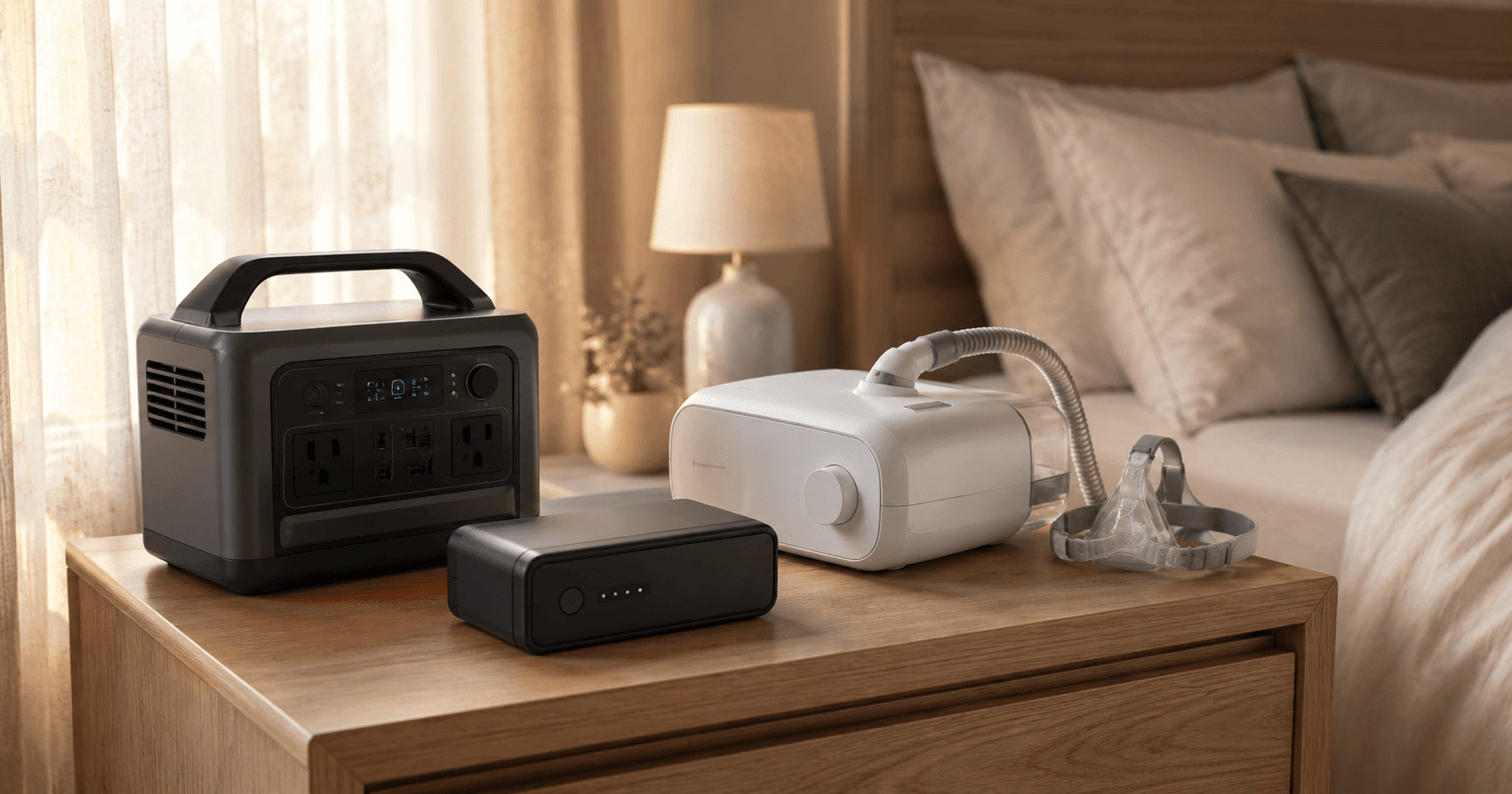
- Portable power station — stores energy and delivers it to your CPAP at night
- Portable solar panel — recharges the power station during the day
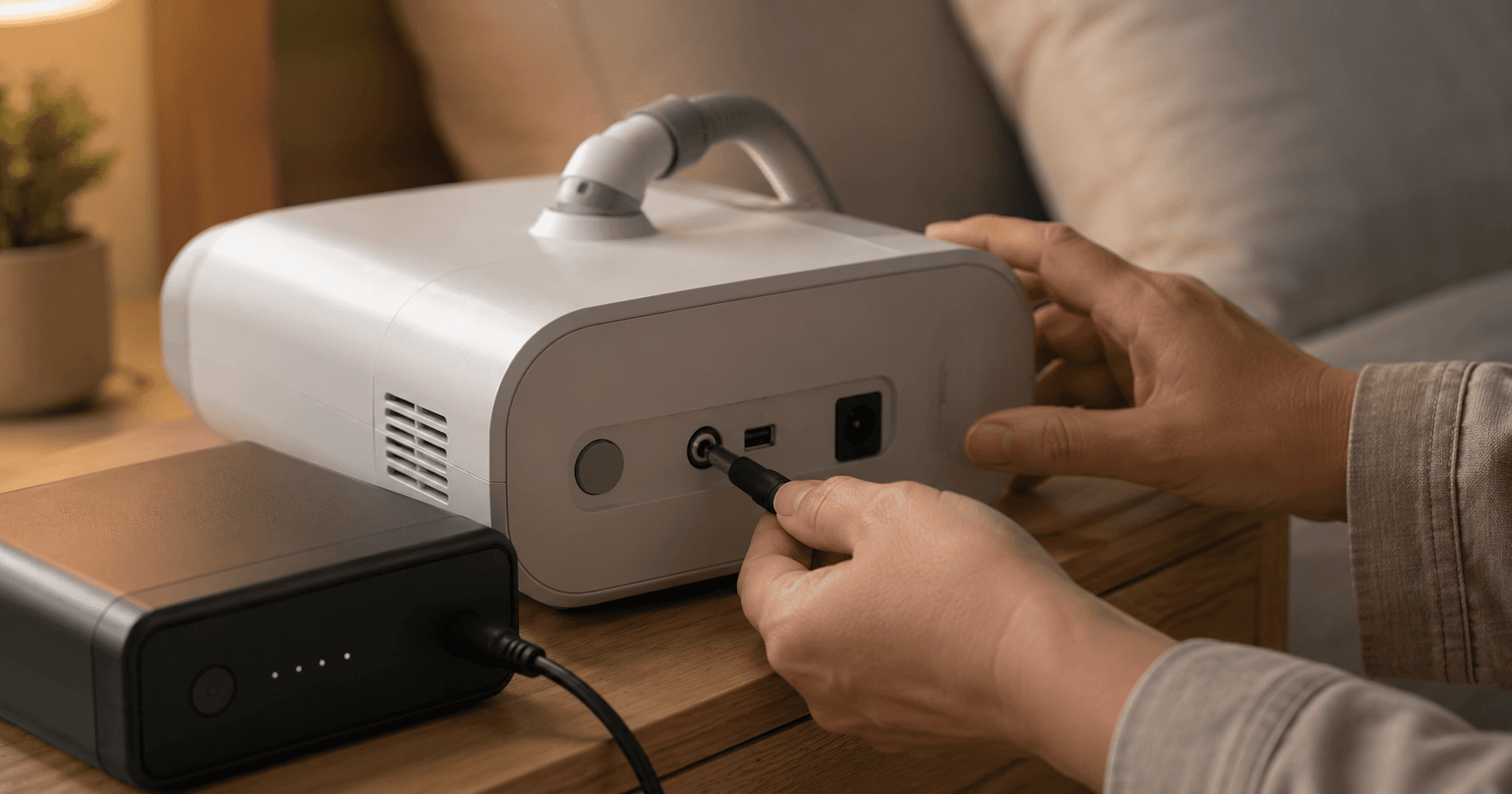
- CPAP DC cable (optional but recommended) — connects the CPAP directly to the battery's DC output for maximum efficiency
That's it. No permanent installation, no wiring, no permits. Everything packs up into a car or RV. Backpackers can go even lighter — our CPAP backpacking guide covers compact solar setups for trail use.
Sizing your solar panel
The panel needs to produce enough energy during daylight hours to replenish what your CPAP uses overnight.
Without humidifier
| CPAP Usage | Overnight Energy | Solar Panel Needed | Recharge Time (full sun) |
|---|---|---|---|
| Low pressure (8–12) | 120–160 Wh | 60–100W | 2–3 hours |
| Medium pressure (12–16) | 160–200 Wh | 100W | 3–4 hours |
| High pressure (16–20) | 200–250 Wh | 100W | 4–5 hours |
With humidifier
| CPAP Usage | Overnight Energy | Solar Panel Needed | Recharge Time (full sun) |
|---|---|---|---|
| Low humidifier (2–3) | 280–380 Wh | 100–200W | 4–6 hours |
| Medium humidifier (4) | 380–500 Wh | 200W | 5–7 hours |
| High humidifier + heated hose | 500–700 Wh | 200–400W | 6–8 hours |
Important: "Full sun" means direct, unobstructed sunlight with the panel at an optimal angle. Real-world conditions (clouds, shade, non-optimal angle, morning/evening light) typically deliver 60–80% of the panel's rated output.
Real solar yield by sky condition (measured)
Rated panel wattage is best-case lab conditions. Here's what a 100W foldable panel actually produced in our 2-week April 2026 field test in northern Texas (32°N latitude), measured hourly from 8 AM to 6 PM via the power station's input log:
| Sky Condition | Avg. Output (% of rated) | Daily Energy (10 hr window) | Recharges 240 Wh Battery? |
|---|---|---|---|
| Clear, blue sky | 78–88 W (78–88%) | 480–600 Wh | Yes, in 3.5 hr |
| Light haze / thin cirrus | 65–75 W | 380–500 Wh | Yes, in 4.5 hr |
| Partly cloudy (50% sun) | 35–55 W | 220–330 Wh | Marginal — full day needed |
| Overcast, light gray | 15–25 W | 90–160 Wh | No — partial recharge only |
| Heavy overcast / rain | 5–12 W | 30–80 Wh | No — minimal recharge |
| Tree canopy shade | 8–18 W | 50–110 Wh | No — find a clearing |
Practical takeaway: Plan for 50–60% of rated output as your reliable baseline. A 100W panel will dependably give you 240–300 Wh per day across mixed weather, which exactly matches one CPAP night without humidifier. Want true reliability through bad weather? Carry 200W of panel capacity, not 100W.
MPPT vs PWM: why your charge controller matters
This is the single most-overlooked variable in CPAP solar setups. The charge controller (built into every portable power station) regulates how panel output is converted to battery charging current. Two technologies dominate:
- MPPT (Maximum Power Point Tracking): Continuously adjusts voltage/current to extract the panel's maximum available power. 92–98% conversion efficiency. Standard on EcoFlow DELTA series, Bluetti AC180+, Goal Zero Yeti 500X+, and Jackery Explorer 1000+.
- PWM (Pulse Width Modulation): Older, simpler tech. Just chops the panel voltage to match battery voltage. 65–80% efficiency. Found on most sub-$200 power stations and budget RV solar kits.
The cost in real terms: The same 100W panel feeds ~85W of charging power into an MPPT controller, but only ~65W into a PWM controller. Over a full sun-day, that's ~200 Wh more energy with MPPT — nearly an entire CPAP night.
If you're buying a power station specifically for solar CPAP recharging, confirm "MPPT" appears in the spec sheet. Most reputable 2026 models have it; many cheap unbranded units do not.
Best portable solar panels for CPAP setups
For 100W needs (CPAP without humidifier)
A single 100W foldable panel is the sweet spot for most CPAP users:
- EcoFlow 110W — IP68-rated foldable panel (~$259), works with EcoFlow stations View on Amazon
- Jackery SolarSaga 100W Light — 100W bifacial panel (~$249), proven compatibility with Jackery power stations View on Amazon
- Bluetti PV100 — 100W foldable panel, IP67 water-resistant (~$199) View on Amazon
- Renogy 100W — budget option with solid performance View on Amazon

Weight: 8–15 lb folded | Size: Briefcase-sized when folded
For 200W needs (CPAP with humidifier)
Two options: buy a single larger panel or connect two 100W panels in parallel.
- EcoFlow 220W bifacial — single large panel, high efficiency View on Amazon
- Jackery SolarSaga 200 — integrated design for larger Jackery stations View on Amazon
- Two 100W panels — more flexible positioning, redundancy if one fails
Setup step by step
Car camping / RV
- Park with southern exposure (in the Northern Hemisphere) where your panel will get unobstructed sun from 10 AM to 3 PM
- Deploy the solar panel in the morning — lean it against the car, set it on the picnic table, or use the integrated kickstand
- Connect the panel to your power station via the included solar cable
- Let it charge all day — most power stations show charge percentage and estimated time to full
- At night, connect your CPAP to the fully charged power station
- Repeat daily for indefinite off-grid CPAP therapy
Extended off-grid / cabin
For multi-day or permanent off-grid setups:
- Mount panels semi-permanently on a roof, pole, or ground mount with good southern exposure
- Use a larger battery (500–1,000 Wh) as a buffer for cloudy days
- Wire panels in parallel for redundancy — if one panel is shaded, the other keeps charging
- Consider a charge controller if connecting panels directly to a 12V battery bank (power stations have this built in)
This guide covers how to charge with panels. If you're still choosing the station itself for week-long outages, our best solar generator for CPAP guide compares 2–4 kWh stations and station-plus-panel bundles, including solar input limits and how many nights each one covers.
Cloudy day planning
The biggest risk with solar-only setups is a string of cloudy days draining your battery. Strategies:
- Oversized battery: Keep a 500+ Wh battery for 2–3 nights of buffer even if you only need 200 Wh per night
- Oversized panel: A 200W panel still produces 80–120 Wh on a heavily overcast day — enough for a night of CPAP without humidifier
- Backup charging: Keep a car charger cable for your power station. You can top it off from the car's cigarette lighter during a drive
- Generator fallback: A small 1,000W generator can fully charge most power stations in 1–2 hours if solar fails for extended periods
Real-world example: Weekend camping
Gear:
- EcoFlow RIVER 2 (256 Wh) View on Amazon
- EcoFlow 110W solar panel
- ResMed AirSense 11 + DC cable
- No humidifier
Friday night: CPAP runs from 11 PM to 7 AM, uses ~160 Wh. Battery at 38% in the morning.
Saturday: Deploy solar panel at 9 AM. Partly cloudy. Battery back to 100% by 2 PM.
Saturday night: Same usage, battery at 38% again.
Sunday morning: Pack up, drive home. Total miles hiked, campfires enjoyed, good sleep achieved: priceless.
Real-world example: Extended RV trip
Gear:
- Jackery Explorer 1000 v2 (1,070 Wh)
- Two Jackery SolarSaga 100 panels (200W total)
- ResMed AirSense 10 + DC cable + humidifier on setting 3
Nightly CPAP usage: ~350 Wh (humidifier on low)
Daily solar input (summer, Arizona): 500–700 Wh
Result: Battery never drops below 60%. Surplus power charges phones, runs a fan, and powers LED lights.
On cloudy days: Battery drops to 30–40% but recovers the next sunny day. The 1,070 Wh buffer provides 2+ cloudy nights of cushion.
Cost breakdown
| Component | Budget Option | Mid-Range | Premium |
|---|---|---|---|
| Power station | Anker SOLIX C300 DC ($200) | EcoFlow RIVER 2 ($250) | EcoFlow DELTA 3 ($600) |
| Solar panel | Renogy 100W ($100) | Jackery SolarSaga 100W Light ($249) | EcoFlow 220W ($350) |
| DC cable | Third-party ($30) | Medistrom ($50) | ResMed official ($60) |
| Total | $330 | $549 | $1,010 |
For occasional weekend camping, the budget option works perfectly. For full-time RV or off-grid living with a humidifier, invest in mid-range or premium.
The bottom line
Solar charging turns your CPAP backup battery from a "few nights of emergency power" into an indefinite power solution. For about the cost of a second battery, you get a solar panel that recharges your existing battery every day.
If you camp, RV, or live anywhere with unreliable power, a solar panel is the best addition to your CPAP backup kit.
Related reading
- CPAP Camping Setup — full off-grid gear list
- CPAP Backpacking Guide — ultralight solar for the trail
- CPAP Battery Camping Guide 2026 — latest camping battery picks (including RV)
- CPAP Battery Sizing Guide — match panel wattage to battery size
- Best CPAP Backup Batteries — top stations with solar input
- Best Solar Generator for CPAP — choosing a 2–4 kWh station or solar bundle for multi-day outages
What to do next
Match a 100W panel to a 250–300 Wh battery for simple weekend trips, or step up to 200W plus 500+ Wh for RV or humidifier use. Test the full chain at home in your backyard before you depend on it off-grid.
- Size your panel with the tables above based on humidifier use
- Buy a panel that matches your power station's solar connector (XT60 or proprietary)
- Do a daylight dry-run: drain the battery overnight, recharge from solar, repeat
Affiliate disclosure
This site may include affiliate links. If you buy through links, we may earn a commission at no extra cost to you. We only recommend products we've researched and believe are genuinely useful for CPAP users.