Why you need a CPAP battery backup
If you rely on a CPAP machine to treat sleep apnea, you already know what happens when the power goes out: your therapy stops, you wake up gasping, and the next day is a write-off. Power outages, camping trips, and long-haul flights all share the same problem. Without backup power, your CPAP is just a paperweight.
A CPAP battery backup solves that problem. It stores enough energy to run your machine through one or more nights, keeping your airway open whether you're weathering a storm at home or sleeping under the stars at a remote campsite. For the full primer on sizing, runtime math, and machine compatibility, start with our complete CPAP battery backup guide.
The stakes are higher than simple inconvenience. Untreated sleep apnea raises the risk of high blood pressure, heart disease, and daytime drowsiness that can make driving dangerous. A reliable backup battery isn't a luxury. It's a safety net.
In 2026, you've got more options than ever, from lightweight, purpose-built CPAP packs that slip into a carry-on to full-size portable power stations that can run your humidifier, phone charger, and reading light all night. This guide breaks down the best choices in each category, compares them side by side, and helps you pick the right one for your specific setup.
Want the data side by side? Compare all 25 batteries by capacity, weight, runtime, and FAA class →
What to look for in a CPAP battery backup
Before you spend a dollar, nail down four things:
1. Your CPAP's power draw
Check the wattage label on your power supply. Most CPAP machines draw between 15 and 30 watts without humidification, and 40 to 80 watts with a heated humidifier and heated tube running. That number determines how big a battery you need. Our CPAP battery sizing guide walks you through the exact math, including real-world measurements for popular machines like the ResMed AirSense 11 and DreamStation 2.
2. How many hours (or nights) you need
One night of CPAP therapy typically runs 7 to 9 hours. If you're planning a weekend camping trip, double that. For extended power outages (think hurricane season), you might want 3 or more nights of backup. Multiply your wattage by hours to get the watt-hours you need. For example, a CPAP drawing 25 W for 8 hours needs 200 Wh of battery capacity.
3. Travel requirements and FAA rules
If you fly with your CPAP, the FAA limits lithium-ion batteries to 100 Wh in carry-on luggage without prior approval. Batteries between 100 and 160 Wh require airline approval before you board. Anything over 160 Wh can't fly at all. See our CPAP travel checklist for FAA rules, airline-specific policies, and packing tips.
4. AC vs. DC connection
This one catches a lot of people off guard. When a battery powers your CPAP through an AC outlet, it converts stored DC energy to AC, then your CPAP's power brick converts it back to DC. That double conversion wastes 10% to 20% of your battery's capacity as heat. Purpose-built CPAP batteries connect via DC cable, skipping the conversion entirely. The result is more runtime from the same battery size. Check our CPAP battery compatibility guide to see which batteries support direct DC connections for your machine.
Best dedicated CPAP batteries
Dedicated CPAP batteries are designed specifically for sleep therapy machines. They're lighter, more efficient (thanks to direct DC output), and usually FAA-approved for air travel. The trade-off? They can only power your CPAP, not other devices.
Medistrom Pilot-24 Lite

The Medistrom Pilot-24 Lite is the gold standard for CPAP travel batteries. At 97 Wh, it slides comfortably under the FAA's 100 Wh limit. The direct DC connection to ResMed AirSense 10, AirMini, and other compatible machines eliminates inverter losses, squeezing every available watt-hour into actual therapy time.
In real-world testing, the Pilot-24 Lite powers a ResMed AirMini for roughly 13 hours without humidification. That's almost two full nights for most sleepers. It weighs just 1.4 pounds, making it one of the lightest options on the market.
The built-in smart display shows remaining capacity in both percentage and estimated hours, so you're never guessing how much runtime you've got left. It also supports solar charging through an optional adapter, which is handy for extended off-grid trips.
Pros: FAA-approved, lightweight (1.4 lb), silent operation, purpose-built DC output, solar charging compatible Cons: Only works with compatible CPAP models, won't power a humidifier all night, higher price per watt-hour than power stations Best for: Air travel and weekend trips Price: $329 – $349 Check price on Amazon
EASYLONGER ES270 CPAP Battery

EASYLONGER ES270 CPAP Battery (99.9Wh, FAA Carry-On)
$139.99
Check price on AmazonThe EASYLONGER ES270 is a purpose-built CPAP battery with broad compatibility across brands. It ships with four DC cables covering the ResMed AirMini, AirSense 10/11, AirCurve 10/11, Luna TravelPAP, and Philips DreamStation 1/2, with selectable 12V, 19V, or 24V output, so you don't need to buy adapters separately. At 99.9 Wh, it's FAA-approved for carry-on. It takes the slot of the Freedom V2, which is no longer available on Amazon (as of September 2026).
Runtime depends heavily on your machine: roughly 3.5 to 5 hours on a full-size machine like the AirSense 11 without humidification, while EASYLONGER quotes about 8 hours on an AirMini or TravelPAP with humidification and heating off. At 1.3 pounds and $139.99, it's lighter than the Pilot-24 Lite and well under half the price, making it a strong value pick for frequent travelers.
It also has a 100W USB-C port and a 10W wireless pad, so you can charge your phone or tablet while your CPAP runs, and a pass-through function keeps the CPAP running while the battery charges (handy in an outage, though it isn't a certified UPS).
Pros: Multi-brand cable kit included, under 100 Wh for FAA, very light (1.3 lb), 100W USB-C, low price Cons: Smaller review base (about 150 ratings), short runtime on full-size machines, not hot-swappable Best for: Users who switch between CPAP brands or want an affordable DC travel battery Price: $139.99 Check price on Amazon
EASYLONGER ES960 CPAP Battery
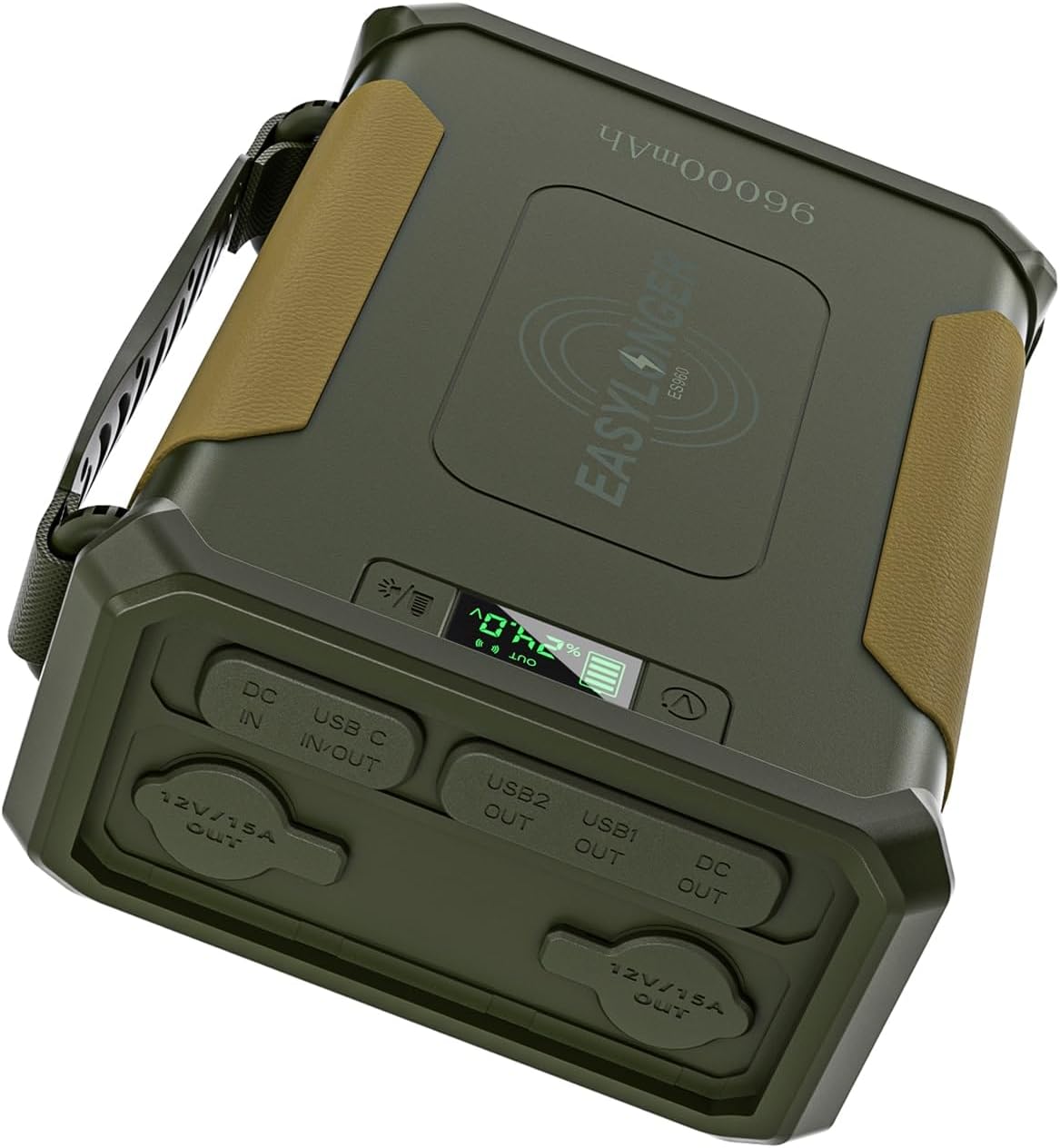
The EASYLONGER ES960 is a 297 Wh dedicated CPAP battery that ships with DC output cables for ResMed AirSense 10, AirSense 11, and other 24V machines. Because it feeds your machine directly over DC, it skips the inverter losses of an AC power station and runs silent at the bedside.
The big advantage over the small 95-100 Wh travel packs is capacity: 297 Wh is enough for a full night even with a heated humidifier, or two-plus nights CPAP-only. Runtime sits around 9 to 12 hours without humidification depending on pressure settings. With a 4.6-star rating it is one of the best-reviewed dedicated CPAP batteries on the market.
The trade-off is that at 297 Wh it exceeds the FAA's 100 Wh carry-on limit, so it's a home, RV, and road-trip battery rather than a flying companion. If you want a ResMed-compatible DC battery that covers a whole night without babysitting the humidifier, this is the pick.
Pros: Large 297 Wh capacity, DC-direct efficiency, ResMed cable kit included, silent operation, excellent 4.6-star rating Cons: Too large for FAA carry-on (over 100 Wh), heavier than pocket travel packs Best for: ResMed users who want a full night of DC-direct runtime at home or in an RV Price: $300 Check price on Amazon
Best portable power stations for CPAP
Portable power stations aren't designed specifically for CPAP, but they bring more capacity and versatility. You can power your CPAP through the AC outlet, charge your phone, and even run a small fan or light. The trade-off is more weight and some energy lost to AC conversion.
EcoFlow RIVER 2

The EcoFlow RIVER 2 packs 256 Wh into a 7.7-pound package, making it one of the most capable compact power stations available. The headline feature is fast charging: 0 to 100% in just 60 minutes from a wall outlet. If you forget to charge the night before a trip, you can top it off while you pack.
LiFePO4 battery chemistry means 3,000+ charge cycles before capacity drops to 80%. That's roughly 8 years of daily use. For CPAP backup, the RIVER 2 delivers approximately 8 to 10 hours of runtime at 25 W draw (no humidifier) or about 4 to 5 hours with a heated humidifier pulling 50 W.
The pure sine wave inverter handles any CPAP machine cleanly, and the built-in app lets you monitor power draw and remaining runtime from your phone. It's also solar-compatible, accepting up to 110 W from a portable panel.
Pros: Fast 60-minute charging, LiFePO4 longevity (3,000+ cycles), compact for 256 Wh, app monitoring, solar input Cons: Heavier than dedicated CPAP batteries, fan noise under load (though quiet at CPAP-level draws), too large for FAA carry-on Best for: Camping, home power outage backup, multi-device charging Price: $179 – $239 Check price on Amazon
Jackery Explorer 300

The Jackery Explorer 300 offers 292 Wh in Jackery's signature orange-and-black design at 7.5 pounds. It has two pure sine AC outlets, a 100W USB-C port, and a 12V car port for a DC CPAP cable.
For CPAP use, expect roughly 9 to 12 hours of runtime without humidification (at 25 W) or 5 to 6 hours with a heated humidifier. The Explorer 300 charges in about 2.5 hours from a wall outlet, which isn't as fast as the EcoFlow but perfectly adequate for overnight prep.
Jackery's build quality is well-proven across millions of units sold, and the simple LCD display makes it easy to see wattage draw and remaining percentage at a glance. Two USB-A ports and one USB-C port let you charge your phone and tablet alongside your CPAP.
Pros: Reliable brand, solid 292 Wh capacity, upgraded LiFePO4 chemistry (4,000+ cycles), lightweight for a power station, dual USB output Cons: Slower wall charging than the EcoFlow, no app connectivity Best for: Budget-friendly one-night CPAP backup with extra capacity for devices Price: Around $199 – $299 Check price on Amazon
Anker SOLIX C300

Anker SOLIX C300 Portable Power Station (288Wh LiFePO4, 300W AC)
$329.99
Check price on AmazonThe Anker SOLIX C300 is the AC version of the C300 DC below: 288 Wh of LiFePO4 (rated for 3,000 cycles, with a 5-year warranty) plus three pure sine AC outlets (300 W total), two 140 W USB-C ports, and a 12V car socket. It weighs 9.1 pounds.
The feature that matters most at the bedside is its UPS mode, which switches over in under 10 ms, so it can sit plugged into the wall and take over the moment the power fails. Runtime lands at roughly 8 to 9 hours without humidification through the AC outlet, or more if you run your CPAP's DC cable from the car socket. It recharges to 80% in about 50 minutes on AC.
Pros: LiFePO4 longevity, fast UPS switchover, three AC outlets, fast AC recharging, 5-year warranty Cons: Pricier than the RIVER 2 or Explorer 300, heavier than both, too large for FAA carry-on Best for: Bedside home outage backup with automatic failover Price: $329.99 Check price on Amazon
Goal Zero Yeti 300

The Goal Zero Yeti 300 brings 297 Wh of LiFePO4 capacity (it replaces the older, now-discontinued Yeti 200X). Goal Zero is well-known in the outdoor and overlanding community, and the Yeti 300 is one of their most travel-friendly models.
For CPAP backup, you'll get around 10 to 13 hours without humidification — a comfortable full night with margin, even at moderate pressure. The Yeti 300 really shines as part of a solar setup, pairing beautifully with Goal Zero's Nomad and Boulder panels for extended off-grid trips.
Pros: Durable LiFePO4 chemistry, excellent solar ecosystem, trusted outdoor brand, USB-C PD output Cons: Heavier and pricier per Wh than rivals like the EcoFlow RIVER 2 Best for: Overlanding and solar-powered camping setups Price: $299 – $349 Check price on Amazon
Anker SOLIX C300 DC

The Anker SOLIX C300 DC packs 288 Wh of LiFePO4 capacity at an aggressive price point. The standout feature for CPAP users is its DC-first design: a regulated 12V car socket and high-wattage USB-C ports let many machines run straight off DC, skipping the inverter losses of an AC power station and stretching every watt-hour further.
LiFePO4 chemistry gives you 3,000+ charge cycles, and the fanless, silent operation means nothing drones next to you while you sleep. Runtime sits around 9 to 11 hours without humidification.
Pros: LiFePO4 durability, efficient DC-direct output for CPAP, great price, silent operation Cons: DC-only — no AC outlet, so it can't run accessories that need a wall plug Best for: DC-direct CPAP users who want maximum runtime efficiency and quiet bedside operation Price: $169 – $249 Check price on Amazon
NiteOwl CPAP Battery Backup

NiteOwl CPAP Battery Backup (2nd Gen, 150Wh Swappable)
$287.01
Check price on AmazonThe NiteOwl is a dedicated CPAP battery backup power supply designed for bedside use. It connects directly to your CPAP via DC, eliminating inverter losses. A solid option for users who want a purpose-built solution without the bulk of a full power station.
Best for: Users who want a dedicated CPAP-only battery with simple DC connection
Bluetti X30 CPAP Battery (297Wh)

Bluetti's dedicated CPAP battery packs 297Wh into a purpose-built form factor with DC output cables for ResMed and Philips machines. Like the Anker SOLIX C300 DC, it skips the inverter entirely for better efficiency than an AC power station, but its CPAP-specific cabling makes bedside setup simpler. LiFePO4 chemistry provides long cycle life.
Best for: Users who want Bluetti quality in a CPAP-specific battery with strong capacity
Comparison table
| Product | Capacity (Wh) | Weight | Est. Runtime (no humidifier) | Est. Runtime (with humidifier) | Price | Link |
|---|---|---|---|---|---|---|
| Medistrom Pilot-24 Lite | 97 | 1.4 lb | 8–13 hrs | 3–4 hrs | $329 – $349 | Amazon |
| EASYLONGER ES270 | 99.9 | 1.3 lb | 3.5–5 hrs (up to ~8 on AirMini) | ~2 hrs | $139.99 | Amazon |
| EASYLONGER ES960 | 297 | ~7 lb | 9–12 hrs | 5–6 hrs | $300 | Amazon |
| Goal Zero Yeti 300 | 297 | ~8 lb | 10–13 hrs | 5–7 hrs | $299 – $349 | Amazon |
| Anker SOLIX C300 DC | 288 | ~9 lb | 9–12 hrs | 5–6 hrs | $169 – $249 | Amazon |
| Anker SOLIX C300 | 288 | 9.1 lb | 8–9 hrs | 4–4.5 hrs | $329.99 | Amazon |
| EcoFlow RIVER 2 | 256 | 7.7 lb | 8–10 hrs | 4–5 hrs | $179 – $239 | Amazon |
| Jackery Explorer 300 | 292 | 7.5 lb | 9–12 hrs | 5–6 hrs | ~$199 – $299 | Amazon |
Runtime estimates assume 25 W draw without humidifier and 50 W draw with heated humidifier. Dedicated batteries (Pilot-24, EASYLONGER ES270, EASYLONGER ES960) use DC-direct connection, which is 10–20% more efficient than AC. Your actual runtime depends on pressure settings, leak rate, and altitude.
How to choose the right CPAP battery backup
Picking the right battery comes down to how you plan to use it. Here's a quick decision framework:
- Flying regularly? Get the Medistrom Pilot-24 Lite or the lower-cost EASYLONGER ES270. They're FAA-approved, weigh under 2 pounds, and connect via DC for maximum efficiency. If you use a ResMed machine at home and want a full night of DC-direct runtime, the EASYLONGER ES960 offers 297 Wh of ResMed-compatible capacity.
- Camping or overlanding? The EcoFlow RIVER 2 or Jackery Explorer 300 balances capacity, weight, and price. Both can charge from solar panels for indefinite off-grid use. Read our CPAP camping setup guide for the full gear list, or our CPAP backpacking guide if you're hiking into the backcountry and need the lightest possible setup.
- Power outage protection at home? A power station with UPS mode like the EcoFlow RIVER 2 is the smartest choice. It sits plugged into your wall, charges automatically, and switches to battery power the instant the electricity fails. For extended outages lasting multiple days, step up to a larger unit like the EcoFlow DELTA 2. Learn more in our CPAP power outage guide.
- Multi-night off-grid? Pair a 500+ Wh station with a portable solar panel for indefinite runtime. The Jackery Explorer 500 v2 (512 Wh) or EcoFlow DELTA 3 (1,024 Wh) are strong choices here.
- Using a heated humidifier? You'll need roughly double the capacity compared to CPAP-only use. A 256 Wh power station that lasts 10 hours without humidification might only give you 4 to 5 hours with it. Read our guide on CPAP humidifier battery drain for tips on extending runtime while keeping moisture levels comfortable.
Not sure which batteries are compatible with your CPAP machine? Check our CPAP battery compatibility guide for a complete breakdown by brand and model.
Understanding battery chemistry: Li-ion vs. LiFePO4
You'll see two battery chemistries across these picks, and the difference matters for long-term value.
Lithium-ion (Li-ion) is the standard chemistry in most consumer electronics. It offers good energy density (more Wh per pound) but typically lasts 500 to 1,000 charge cycles before capacity degrades noticeably. The Medistrom Pilot-24 Lite and EASYLONGER ES270 both use Li-ion cells.
Lithium iron phosphate (LiFePO4) trades a bit of energy density for dramatically longer lifespan: 3,000+ cycles. That means a LiFePO4 battery used every night would last over 8 years before hitting 80% capacity. The EcoFlow RIVER 2 and both Anker SOLIX C300 models (AC and DC) use LiFePO4. If you're buying a battery for daily home backup use, LiFePO4 is worth the investment.
Tips for maximizing CPAP battery runtime
No matter which battery you choose, these tips help you squeeze out more hours:
- Turn off the heated humidifier. This is the single biggest power drain. Switching to a heat moisture exchanger (HME) filter can cut your power draw in half. Our CPAP humidifier battery drain guide covers this in detail.
- Use a DC-direct connection when possible. Skipping the AC inverter saves 10 to 20% of your battery's energy.
- Lower your pressure if clinically safe. Higher pressures require more motor effort. Talk to your sleep doctor before making changes.
- Keep the battery warm. Lithium batteries lose capacity in cold temperatures. In winter camping, keep the battery inside your sleeping bag until bedtime.
- Charge fully before each use. Partial charges don't hurt lithium batteries, but starting at 100% gives you the most runway.
- Address mask leaks. A leaky mask forces the CPAP motor to ramp up to maintain pressure, drawing more power. A well-fitted mask saves battery.
FAQ
How long does a CPAP battery backup last?
A typical CPAP battery backup lasts 1 to 3 nights depending on capacity and settings. A 240 Wh battery powers most CPAPs without humidification for about 8 to 12 hours. With a heated humidifier, expect roughly half that runtime.
Can I use any portable battery with my CPAP?
Not all batteries work with every CPAP. You need a pure sine wave inverter (for AC-powered machines) or a matching DC cable for direct connection. Modified sine wave inverters can damage your CPAP or trigger error codes. Always verify compatibility before buying.
What size battery backup do I need for CPAP?
For one night without humidification, 150 to 250 Wh is sufficient. With a heated humidifier, you'll need 300 Wh or more. Multiply by the number of nights you need coverage. Our CPAP battery sizing guide has a calculator to help you find the exact number.
Do CPAP battery backups work with heated humidifier?
Yes, but humidifiers increase power draw by 2 to 4 times. A battery that lasts 2 nights without humidification may only last one night with it running. Consider lowering the humidity setting or switching to an HME filter to extend runtime significantly.
Get the printable planner
All of this research in one printable PDF, including battery comparison tables, a runtime calculator, packing checklists, and a troubleshooting guide. Get the CPAP Travel Battery Kit Planner ($7.99)
Related reading
- CPAP battery backup guide — the full primer on sizing and compatibility
- CPAP battery sizing guide — calculate exactly how many watt-hours you need
- CPAP battery compatibility guide — which batteries work with your machine
- CPAP humidifier battery drain — how humidification affects runtime
- CPAP power outage guide — UPS setups and automatic failover
- LiFePO4 vs Li-ion CPAP battery — which chemistry to pick
- Anker SOLIX for CPAP — C300X vs C1000 runtime tests
- Bluetti for CPAP — every Bluetti model tested for CPAP runtime
- Goal Zero for CPAP — every Yeti model tested for runtime
- Best battery for ResMed AirCurve — for BiPAP/AirCurve users
- Best battery for ResMed AirMini (2026) — latest 2026 picks for the AirMini
What to do next
There's no single best CPAP battery — the right answer depends on whether you're flying, camping, or bracing for a storm. Pick the category that matches your primary use case and move on the purchase before you actually need it.
- Travel/flying: grab the Medistrom Pilot-24 Lite or EASYLONGER ES270 (under 100 Wh) with the correct DC cable for your machine.
- Home outage: pick a UPS-mode power station like the EcoFlow RIVER 2 so failover is automatic at 3 AM.
- Camping or multi-day: choose the EcoFlow RIVER 2 or Jackery Explorer 300 and add a 100W solar panel for indefinite runtime.
Affiliate disclosure
This site may include affiliate links. If you buy through links, we may earn a commission at no extra cost to you. We only recommend products we've researched and believe are genuinely useful for CPAP users.