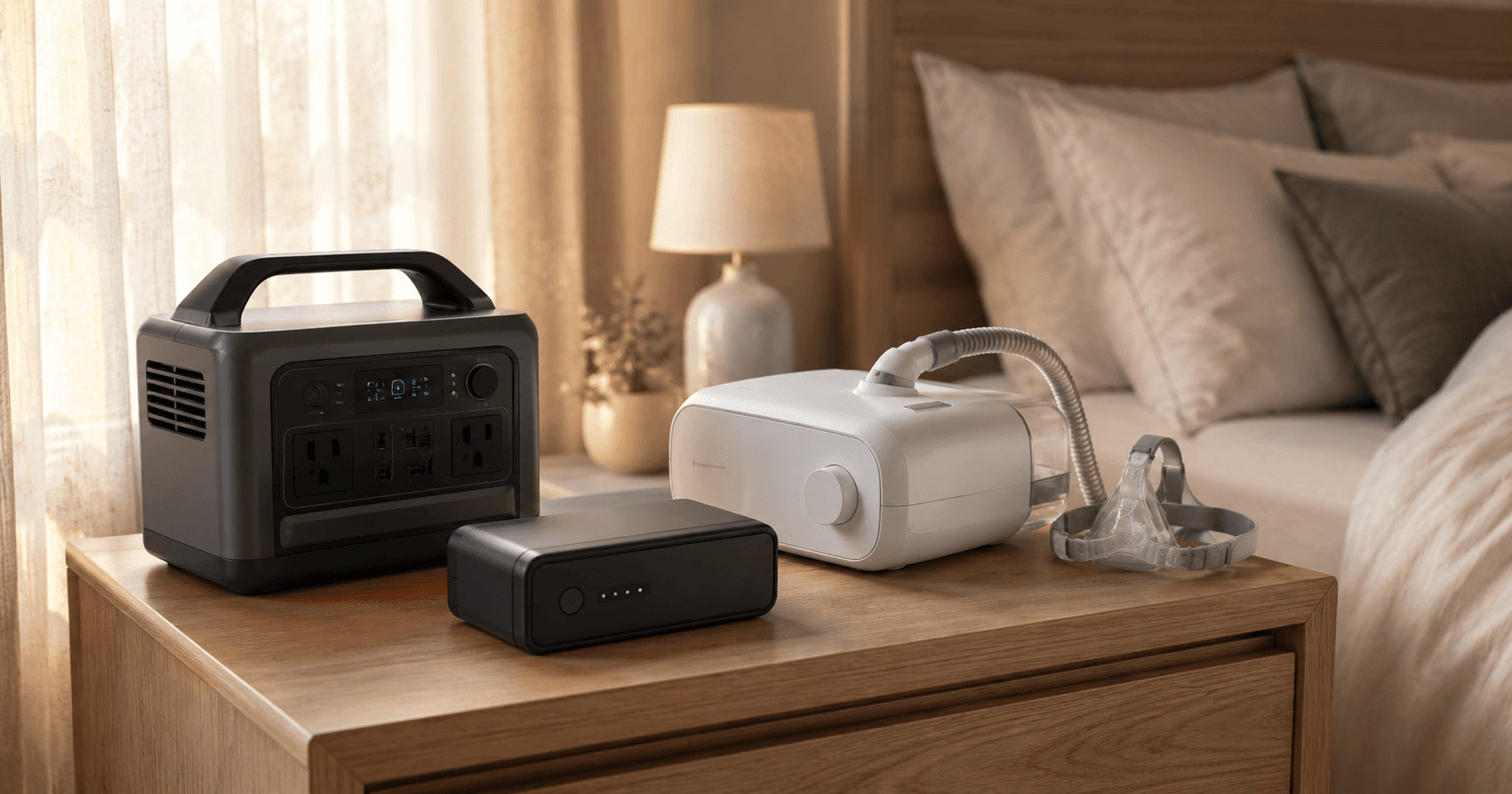
A CPAP battery backup is a portable lithium battery — either a CPAP-specific unit or a general-purpose power station — that powers your CPAP machine when wall power isn't available, such as during a power outage, while flying, or while camping off-grid. It plugs into your CPAP via an AC outlet or 12V DC cable and runs the machine for anywhere from 4 to 20+ hours depending on capacity and pressure.
Do I need a battery backup for my CPAP machine? If you live in an area with grid outages, travel by air, or camp off-grid, yes — missing therapy nights raises blood pressure, causes morning headaches, and worsens sleep apnea symptoms. For most home users, a 200–300Wh power station ($150 – $250) covers one to two nights without a humidifier and is the single best insurance policy for uninterrupted therapy.
This 2026 guide covers exactly how to size a CPAP battery backup, which batteries work with which machines, the runtime math, and what to buy for outages, travel, and camping. New to CPAP batteries? Start with our explainer on what a CPAP battery is and how one works before diving into the buying decisions below. If you want short-list picks, jump to our roundup of the best CPAP backup batteries, the best CPAP battery for 2026, or run your numbers through the CPAP battery runtime calculator.
What your CPAP actually draws
Before buying anything, know your machine's actual power draw. Most CPAPs pull:
| Mode | Typical draw |
|---|---|
| Humidifier off, low pressure (5–8 cm) | 5–15W |
| Humidifier off, medium pressure (10–14 cm) | 15–30W |
| Humidifier off, high pressure (15–20 cm) | 25–40W |
| Humidifier on (any pressure) | 40–80W |
| BiPAP, no humidifier | 15–40W |
| BiPAP, humidifier on | 50–100W |
The single biggest lever: turning off the heated humidifier. It accounts for 60–70% of total power draw on most machines. Turn it off during outages and you'll typically double or triple runtime.
Your machine's exact draw is on the label or in the manual. Use that number — not a generic estimate — when calculating how much battery you need.
Runtime math: how to calculate how long a battery will last
The formula is simple:
Runtime (hours) = Battery capacity (Wh) ÷ Machine draw (W)
Add a 15–20% efficiency buffer if you're running through an AC inverter (DC→AC→DC conversion wastes energy). If using 12V DC directly, skip the buffer.
Example 1 — Power outage, no humidifier:
- Machine: ResMed AirSense 11, pressure 10 cm → draws ~20W
- Battery: EcoFlow River 2 (256Wh)
- Via 12V DC: 256 ÷ 20 = 12.8 hours (~1.5 nights)
- Via AC outlet: 256 × 0.85 ÷ 20 = 10.9 hours (~1.3 nights)
Example 2 — Camping, humidifier on:
- Machine: Philips DreamStation 2, pressure 12 cm → draws ~55W with humidifier
- Battery: Anker SOLIX C300 (288Wh)
- Via AC: 288 × 0.85 ÷ 55 = 4.5 hours (not enough for a full night)
- Solution: turn off humidifier → draw drops to ~25W → 288 × 0.85 ÷ 25 = 9.8 hours ✓
Example 3 — BiPAP user, moderate pressure:
- Machine: ResMed AirCurve 10, draws ~35W without humidifier
- Battery needed for 8 hours: 35 × 8 ÷ 0.85 = 329Wh minimum (via AC)
- Recommendation: EcoFlow River Pro (720Wh) or Bluetti EB70S (716Wh) for 2+ nights
AC vs DC: why it matters for runtime
Your CPAP can run from a battery two ways:
AC output (inverter): The battery converts stored DC power to 120V AC. Your CPAP's power brick converts it back to DC. This double conversion wastes 15–20% of your battery capacity.
12V DC (direct): Your CPAP draws DC power directly through a barrel connector or car adapter. No conversion losses. You get 15–20% more runtime from the exact same battery.
If your CPAP supports 12V DC input — and many ResMed, Philips, and Fisher & Paykel models do — always use it. Check your manual or the label on the power supply for "12V DC input" or a barrel connector port.
Compatible 12V DC machines include:
- ResMed AirSense 10, AirSense 11 (with ResMed DC cable or Medistrom cable)
- ResMed AirMini (12V DC native)
- Philips DreamStation (with 12V DC adapter)
- HDM Z1 and Z2 (12V DC native, ultra-efficient travel machines)
- Löwenstein prisma SMART (12V DC supported)
Which CPAP machines have battery backup?
Almost no home CPAP machine has a built-in battery — the ResMed AirSense 10 and 11, Philips DreamStation, and Fisher & Paykel SleepStyle all need an external battery plus the correct DC cable. If you're searching for "CPAP machines with battery backup," what you actually want is one of two things: an efficient CPAP paired with an external pack, or a travel CPAP designed to clip onto a battery.
Travel CPAPs with integrated or clip-on batteries:
- HDM Z2 Auto — accepts the clip-on PowerShell battery (97Wh) that mounts directly to the machine, the closest thing to a true built-in battery
- ResMed AirMini — no battery port, but its very low draw means a single 97Wh pack runs it for multiple nights
- HDM Z1 — ultra-efficient (4–7W at low pressure), runs 12–20 hours on a 97Wh battery
For home use, the smarter move is to buy the most power-efficient CPAP you can and size an external battery to it. See our roundups of the most battery-efficient CPAP machines and the best battery-powered travel CPAP machines for machine-first picks. To understand exactly what your current machine pulls at the wall, our CPAP power consumption breakdown lists real measured watts by model.
The bottom line: no mainstream home CPAP ships with an internal battery — you pair the machine with an external battery. Only lightweight travel machines like the HDM Z2 offer a clip-on battery that behaves like a built-in one.
Best CPAP battery backups at a glance
The best CPAP battery backup for most people in 2026 is the EcoFlow River 2 (256Wh, ~$179 – $239) — it runs any CPAP for 1–2 nights without a humidifier and works via AC or 12V DC. For air travel under 100Wh, the Medistrom Pilot-24 Lite is the best portable CPAP battery. For BiPAP or high-pressure users, step up to a large LiFePO4 station like the Anker SOLIX C1000 (1,056Wh).
| Pick | Best for | Capacity | Approx. price | Full review |
|---|---|---|---|---|
| EcoFlow River 2 | Best overall CPAP battery backup | 256Wh | ~$179 – $239 | best CPAP backup batteries |
| Medistrom Pilot-24 Lite | Best portable CPAP battery (FAA carry-on) | 97Wh | ~$329 – $349 | best CPAP travel batteries |
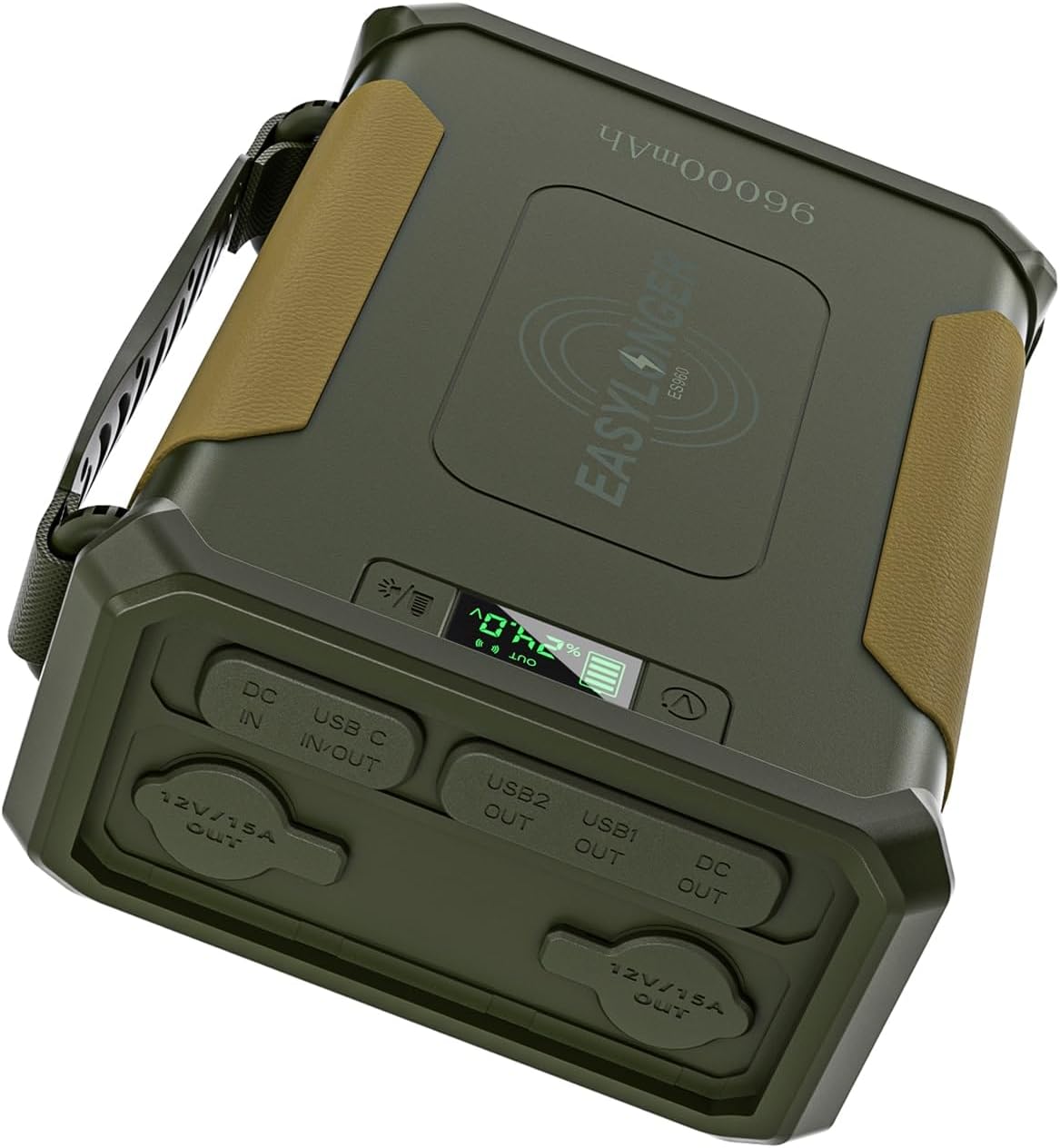
| EASYLONGER ES960 | Best dedicated multi-night CPAP battery | 297Wh | ~$269 – $320 | best CPAP batteries on Amazon |
| Anker SOLIX C1000 | Best for extended outages / BiPAP | 1056Wh | ~$399 – $499 | BiPAP battery backup |
The best CPAP battery backup options in 2026
These are our top picks for battery backup for CPAP machines — covering travel batteries, mid-range power stations, and purpose-built CPAP batteries. For a deeper dive on sizing any of these to your pressure and humidifier setting, see our CPAP battery sizing guide.


Anker SOLIX C300 Portable Power Station (288Wh LiFePO4, 300W AC)
$329.99
Check price on Amazon

NiteOwl CPAP Battery Backup (2nd Gen, 150Wh Swappable)
$287.01
Check price on Amazon
These are the most widely recommended options across CPAP communities as of 2026:
| Battery | Capacity | Weight | Price (approx.) | Air travel | Best for |
|---|---|---|---|---|---|
| Medistrom Pilot-24 Lite | 97Wh | 1.2 lbs | ~$329 – $349 | ✅ Carry-on, no approval (under 100Wh) | Travel, ResMed/Philips users |
| HDM Z1 PowerShell | 97Wh | 0.8 lbs | ~$199 | ✅ Carry-on, no approval (under 100Wh) | HDM Z1/Z2 only |
| NiteOwl (2nd Gen) | 150Wh | ~3 lbs | ~$329 – $379 | ✅ Carry-on with airline approval (100–160Wh) | Travel with swappable cells, multi-brand |
| Anker SOLIX C300 | 288Wh (LiFePO4) | 9.1 lbs | ~$330 | ❌ Over 160Wh — not allowed in cabin | Home outages (sub-10ms UPS), car camping |
| EcoFlow River 2 | 256Wh | 7.7 lbs | ~$179 – $239 | ❌ Over 160Wh — not allowed in cabin | Home outages, car camping |
| Bluetti X30 (CPAP) | 297Wh | 6.4 lbs | ~$249 – $399 | ❌ Over 160Wh — not allowed in cabin | Multi-night CPAP-specific DC power |
| EASYLONGER ES960 | 297Wh | 6.4 lbs | ~$269 – $320 | ❌ Over 160Wh — not allowed in cabin | Best-value multi-night CPAP battery |
| Jackery Explorer 500 v2 | 512Wh | 13.3 lbs | ~$399 – $499 | ❌ Over 160Wh | Extended outages, basecamp camping |
| Anker SOLIX C1000 | 1,056Wh | 24.9 lbs | ~$399 – $499 | ❌ Over 160Wh | Multi-day outages, BiPAP, RV |
| BLUETTI Elite 200 V2 | 2,073.6Wh | 53.4 lbs | ~$899 | ❌ Not portable | Whole-home backup, extended grid outages |
FAA / air-travel note: According to the FAA's PackSafe lithium battery guidance (49 CFR), only batteries under 100Wh fly carry-on with no questions. 100–160Wh need airline approval (max two spares, almost always granted). Anything over 160Wh — which includes every 200Wh+ power station above — is prohibited in the cabin, so for flying you're limited to sub-100Wh units like the Medistrom Pilot-24 Lite. New for 2025–2026: several airlines now also restrict using or charging power banks in flight, so don't count on topping up at your seat. ResMed's own Power Station II (RPS II) has been discontinued; the Medistrom Pilot-24 Lite is now the de facto FAA-friendly pick for ResMed owners.
CPAP machine compatibility guide
Not all batteries work equally well with all CPAP machines. Here's how to match a backup battery for CPAP machines to your specific unit — and for full wiring and cable details, see our CPAP battery compatibility guide.
ResMed AirSense 10 and AirSense 11
- Neither model has an internal battery — they always need an external battery plus the correct DC cable or converter to run off-grid
- Accept 24V DC through a ResMed-branded DC cable or a third-party AirSense 11 DC converter
- General power stations work through that converter or via the AC outlet — check your specific unit
- Best match: Medistrom Pilot-24 Lite, EASYLONGER ES960, or EcoFlow River 2 with the ResMed DC cable (ResMed's own RPS II is now discontinued)
- Machine-specific picks: best battery for AirSense 10, best battery for AirSense 11
ResMed AirMini (travel CPAP)
- No DC battery port — the AirMini runs from its own 20V power supply, so battery backup means powering that adapter from an AC outlet or using the Medistrom AirMini adapter cable
- Its very low draw still lets a 97Wh CPAP-specific battery run it for multiple nights
- Best match: Medistrom Pilot-24 Lite with the AirMini adapter, or any battery with an AC outlet
- See the best battery for ResMed AirMini for full picks
Philips DreamStation 2
- Accepts 12V DC with optional adapter
- Best match: Medistrom Pilot-24 Lite (DreamStation edition), Anker SOLIX C300 via AC
Fisher & Paykel SleepStyle / ICON
- AC only (no native 12V DC input)
- Must use AC output with efficiency penalty
- Best match: EcoFlow River 2 or Anker SOLIX C300 via AC outlet
HDM Z1 / Z2 (travel CPAPs)
- Ultra-efficient — draws as little as 4–7W at low pressure
- 97Wh battery can run Z1 for 12–20 hours at low pressure
- Best match: HDM Z1 PowerShell (proprietary, clips on), any 100Wh+ power station
BiPAP / APAP machines
- Generally draw more power; budget 30–50W without humidifier
- Need 300Wh+ for two nights without humidifier
- Best match: Anker SOLIX C1000 (1,056Wh) or Jackery Explorer 500 v2 (512Wh)
- ResMed AirCurve owners: see our best battery for ResMed AirCurve pick
Deciding between an inline UPS, a CPAP-specific battery, and a general power station? Our UPS vs CPAP battery vs power station breakdown walks through the tradeoffs.
Use case 1: CPAP battery backup for power outages
A CPAP power outage battery is the most common reason people look for backup power. Storms, grid failures, and rolling blackouts don't give advance notice — for a full readiness checklist, see our CPAP power outage guide.
What you need for home outage backup:
- Minimum 150Wh for one night (most people, no humidifier)
- 300Wh+ for two nights or if you run the humidifier
- AC outlet for simplicity, or 12V DC if your machine supports it
- Keep it charged — a dead backup battery is useless at 3 AM
Recommended setup for outage prep:
- Buy a 240–300Wh portable power station (EcoFlow River 2 or Anker SOLIX C300)
- Keep it plugged in and topped off (most have pass-through charging)
- When the grid goes down, unplug your CPAP from the wall and plug it into the power station
- Turn off the humidifier to maximize runtime
How long will it last during an outage?
Using the EcoFlow River 2 (256Wh) as an example, at 20W draw (no humidifier, medium pressure):
- Via 12V DC: ~12.8 hours (1.5 nights)
- Via AC outlet: ~10.9 hours (1.3 nights)
For longer outages — hurricane season, winter storms — size up to 500Wh+ or pair a smaller battery with a solar panel for recharging during daylight. For a multi-day outage timeline broken down by battery size, see how long a CPAP battery lasts during a power outage.
Use case 2: CPAP battery for camping and travel
Camping is the hardest use case: no outlet, weight matters, and you might be away for multiple nights.
Key considerations for camping:
- Weight matters — CPAP-specific batteries (under 2 lbs) beat heavy power stations on the trail
- Humidifier is usually off entirely — passover humidifiers (no power) work well for camping
- Solar charging extends multi-night trips significantly
- Most campgrounds with electrical hookups handle any CPAP fine — this is for off-grid
Camping battery options by scenario:
Weekend car camping (2–3 nights, driving to site):
- EcoFlow River 2 (256Wh) or Anker SOLIX C300 (288Wh) — plenty of capacity, acceptable weight in a car
- Add a 100W foldable solar panel to recharge during the day
Backpacking / backcountry (weight is critical):
- HDM Z1 + PowerShell (total ~1.5 lbs) — the lightest full CPAP solution available
- Medistrom Pilot-24 Lite if your machine is compatible
- See our CPAP backpacking guide for full setup details
RV camping (no hookups):
- Jackery Explorer 500+ or EcoFlow River Pro — size for 2–3 nights without recharge
- RV house battery with 12V DC adapter if available
Flying with a CPAP battery:
- Under 100Wh: carry-on, no questions asked (Medistrom Pilot-24 Lite, HDM Z1 PowerShell)
- 100–160Wh: carry-on with airline approval — declare at the gate, almost always approved (e.g. the 150Wh NiteOwl 2nd Gen)
- Over 160Wh: airlines typically refuse; ship ahead or rent at destination
Three types of CPAP battery backups
1. CPAP-specific batteries
Batteries engineered for CPAP use. Examples: Medistrom Pilot-24 Lite, EASYLONGER ES960, Bluetti X30, HDM Z1 PowerShell.
Best for: Travel, maximum runtime efficiency, FAA carry-on compliance.
Downsides: Expensive per watt-hour. Many are brand-specific. Can't power other devices.
2. Portable power stations (100–300Wh)
General-purpose batteries with AC outlets, USB, and sometimes 12V DC. Examples: Anker SOLIX C300, EcoFlow River 2, Bluetti EB3A.
Best for: Home power outage backup, car camping, flexibility to power multiple devices.
Downsides: Heavier than CPAP-specific units. AC output wastes 15–20% vs. 12V DC.
3. Large lithium power stations (500Wh+)
Higher-capacity units for extended outages or off-grid use. Examples: Jackery Explorer 500 v2, Anker SOLIX C1000, BLUETTI Elite 200 V2.
Best for: Multi-day outages, extended camping, powering more than just a CPAP.
Downsides: Expensive. Heavy. Overkill for a one-night power outage backup.
LiFePO4 vs lithium-ion: which chemistry for a CPAP battery?
The battery inside your power station is one of two chemistries, and the right choice depends on whether you fly with it or keep it charged at home for outages.
| LiFePO4 (LFP) | Lithium-ion (NMC) | |
|---|---|---|
| Charge cycles | 3,000–4,000+ | 500–1,000 |
| Weight per Wh | Heavier | Lighter |
| Thermal stability | Higher (safer) | Lower |
| Typical use | Home outage stations, DIY packs | Sub-100Wh travel batteries |
| Example units | Anker SOLIX C1000, Anker SOLIX C300, BLUETTI Elite 200 V2 | Medistrom Pilot-24 Lite, EASYLONGER ES270 |
For a home outage battery you keep plugged in year-round, choose LiFePO4. It tolerates being kept at full charge and lasts 5–10x more cycles, so a LiFePO4 station bought today can still hold usable capacity a decade from now. For flying, choose a light lithium-ion unit under 100Wh — LiFePO4's weight penalty isn't worth it when you're capacity-capped by FAA carry-on rules anyway.
For the full chemistry deep-dive, including cycle-life math and safety data, see our LiFePO4 vs lithium-ion CPAP battery comparison.
UPS and pass-through: automatic vs manual switchover
A standard portable power station is not a UPS. When the grid drops, you have to wake up, unplug your CPAP from the wall, and plug it into the battery — a real problem if the outage hits at 3 AM while you're asleep.
Two setups solve this:
- Pass-through charging (near-instant): Run your CPAP from the battery full-time while the battery stays plugged into the wall. When grid power fails, the CPAP keeps drawing from the battery with no interruption. Most modern LiFePO4 stations support this, but confirm the model rates continuous pass-through for medical use.
- Dedicated CPAP UPS: Units like the Zopec Explore Mini auto-switch to battery within milliseconds like a computer UPS, sized specifically for CPAP draw. These are the only true "set-and-forget" option for people who cannot risk waking up.
For a full breakdown of UPS vs battery vs power station tradeoffs — including which auto-switch units are worth it — see our UPS vs CPAP battery vs power station guide. Want to plug in your own pressure and capacity numbers? Use the interactive CPAP runtime calculator.
How much capacity you actually need
| Hours of sleep | Pressure (cm) | Without humidifier | With humidifier |
|---|---|---|---|
| 8 hours | Low (5–8) | 40–80Wh | 120–200Wh |
| 8 hours | Medium (10–14) | 80–150Wh | 180–280Wh |
| 8 hours | High (15–20) | 120–200Wh | 250–350Wh |
| 2 nights | Medium (10–14) | 160–300Wh | 360–560Wh |
Add a ~20% buffer if using AC output instead of 12V DC.
Rule of thumb: 150Wh gets most people through one night without a humidifier. 300Wh covers two nights or one night with moderate humidifier use.
What to look for when buying
Capacity (Wh): The only number that actually matters for runtime. Ignore mAh unless you know the voltage — 20,000mAh at 3.7V is only 74Wh.
12V DC output: Look for a 5.5mm barrel connector or a cigarette lighter–style 12V port. Check your CPAP manual to confirm it accepts 12V DC.
AC output wattage: Most CPAPs need only 60–100W, so any power station with 150W+ AC output works fine.
FAA compliance: Under 100Wh flies without restriction. 100–160Wh needs airline approval. Plan accordingly.
Pass-through charging: Lets you keep the battery plugged in at home so it's always ready. Most portable power stations support this.
Weight: CPAP-specific batteries: under 2 lbs. Small power stations: 6–10 lbs. Large stations: 12–60 lbs.
Brand support: Buy from a brand with a real support line. CPAP power needs are medical — you don't want to debug a no-name battery at 2 AM during a storm.
Frequently asked questions
How long will a battery power a CPAP?
It depends on three things: battery capacity (Wh), your CPAP's pressure setting, and whether you're running the humidifier.
Using the formula runtime = capacity ÷ draw:
- 100Wh battery, 15W draw (no humidifier, low pressure) → ~6.7 hours
- 150Wh battery, 20W draw (no humidifier, medium pressure) → ~7.5 hours ✓ one night
- 256Wh battery, 25W draw (no humidifier, medium-high pressure) → ~10.2 hours
- 256Wh battery, 55W draw (humidifier on, medium pressure) → ~4.7 hours ✗
Turn off the humidifier. It's the single biggest runtime multiplier.
Can I use a regular power bank for a CPAP?
No. Standard USB power banks (even the large ones) have two problems:
- Wrong output type: CPAP machines need an AC outlet or 12V DC barrel connector. USB-A/USB-C ports don't work.
- Insufficient capacity: A "big" 30,000mAh phone bank is only ~111Wh — barely enough for one night at low pressure, and only if you could connect to it (which you can't).
You need a portable power station (like the EcoFlow River 2 or Anker SOLIX C300) or a dedicated CPAP battery (like the Medistrom Pilot-24 Lite).
What is the best CPAP battery backup for travel?
For air travel, you need FAA-approved (under 100Wh) options:
- Medistrom Pilot-24 Lite — 97Wh, 1.2 lbs, works with most major CPAP brands via 12V DC
- HDM Z1 PowerShell — 97Wh, HDM machines only, lightest option
- (ResMed's own Power Station II is discontinued — the Pilot-24 Lite is the go-to for ResMed owners)
All three fit in your carry-on without airline approval. For trips where you need more than one night's backup, pack two units or plan to recharge from the hotel.
Is it safe to run a CPAP on battery power?
Yes. CPAP machines are designed to run on DC power internally — the wall adapter is just converting AC to DC anyway. Running on a battery power station or CPAP-specific battery is electrically equivalent. The main thing to watch: make sure the power station's AC output is a pure sine wave (not modified sine wave), which some older inverters produce. Most modern power stations and all CPAP-specific batteries output clean power.
Can I recharge a CPAP battery with solar panels?
Yes. Most portable power stations include a solar input (typically DC, 10–25V). A 100W foldable solar panel can recharge a 256Wh EcoFlow River 2 in 3–5 hours of good sunlight — enough to run your CPAP again the next night. This is the standard setup for multi-night off-grid camping.
Does running a CPAP on battery affect therapy effectiveness?
No, not for modern CPAP machines. Pressure accuracy and algorithms work the same on battery as on wall power. Some machines disable heated humidification when on battery power by default — check your settings. Therapy otherwise functions identically.
What if my CPAP pressure is very high (18–20 cm)?
High-pressure machines draw significantly more power. At 20 cm pressure without humidifier, you might see 35–45W draw. Plan for 300–400Wh for a single night, or buy a 500Wh+ power station. Some BiPAP users at very high pressures need 500Wh just for one night.
Bottom line
For home power outage backup: the EcoFlow River 2 (256Wh, ~$179 – $239) is the best all-around pick. It powers any CPAP, runs most people two nights without a humidifier, and doubles as general backup power. For a dedicated CPAP unit, the EASYLONGER ES960 (297Wh) is the best-value multi-night option.
For travel and air: the Medistrom Pilot-24 Lite (97Wh, ~$329 – $349) is worth the premium if you own a compatible machine — it's the most CPAP-native ResMed/Philips option under the 100Wh cabin limit. Under 100Wh means zero questions at airport security — and it's one of the only options that actually clears the cabin's 160Wh ceiling.
For camping: match capacity to trip length. A 240–260Wh station handles weekend trips. Add a solar panel for anything longer.
Universal advice: turn off the heated humidifier on battery power. It's the single change that has the biggest impact on how long your CPAP battery backup lasts — typically doubling or tripling your runtime.
Ready to buy? See our ranked list of the best CPAP batteries on Amazon for Prime-eligible picks with verified ASINs and current 2026 pricing.
Related reading
- Best CPAP backup batteries — top picks ranked by runtime and value
- CPAP battery sizing guide — exact watt-hour math for your machine
- CPAP battery compatibility guide — connectors and cables by machine
- CPAP power outage guide — home UPS setups and prep
- UPS vs CPAP battery vs power station — pick the right category
- CPAP battery runtime calculator — plug-in-your-numbers tool
- CPAP runtime calculator (interactive tool) — live watt-hour estimator
- LiFePO4 vs lithium-ion CPAP battery — which chemistry to buy
- CPAP power consumption in watts — measured draw by machine
- Most battery-efficient CPAP machines — machine-first picks
- CPAP battery safety — what to know before powering medical equipment from lithium
- CPAP power loss safety guide — what happens when therapy stops mid-night
- Does insurance cover a CPAP battery? — Medicare and private payer rules
- CPAP battery tax deduction — when an HSA, FSA, or medical deduction applies
- DIY CPAP battery — building your own LiFePO4 pack (advanced users only)
- BiPAP battery backup — sizing and gotchas specific to bilevel therapy
What to do next
You now have the sizing math, machine compatibility, and top picks. Turn that into action before you actually need backup power.
- Measure your CPAP's real-world draw at your prescribed pressure, with and without humidifier, for one night.
- Pick one battery from the table above sized at 1.3–1.5x your calculated nightly need so you aren't running it to 0%.
- Keep it charged and do an annual test run — a dead backup battery during a storm is the worst time to discover a problem.