Why the AirMini is the easiest CPAP to battery-power
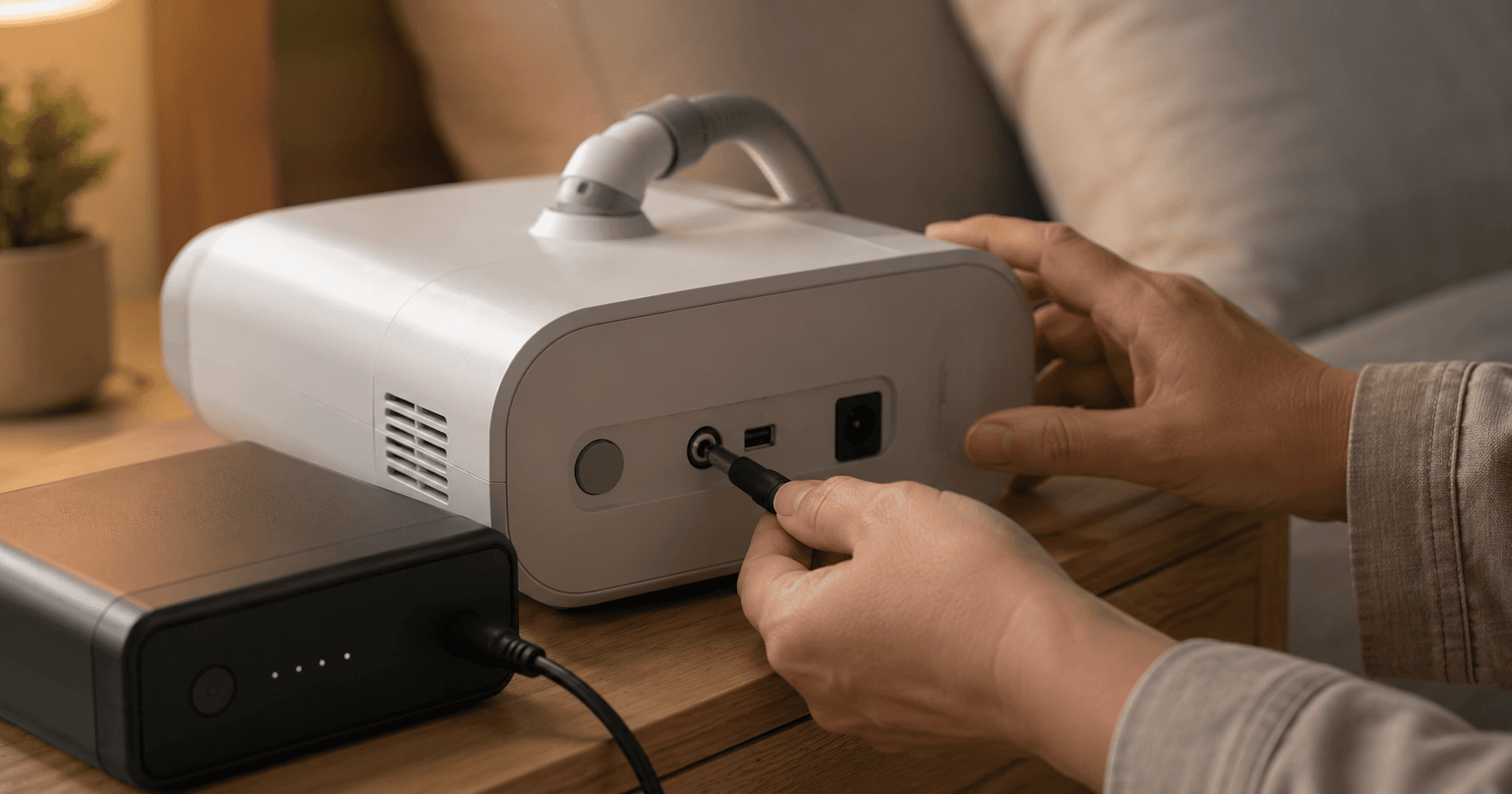
Finding the best battery for ResMed AirMini is easier than for any other CPAP because the machine sips power. The right AirMini battery can be as small as a 50 Wh USB-C power bank — German-speaking readers will know this device as the AirMini "Akku." Most CPAP machines are power-hungry — run an AirSense 11 with its heated humidifier and you're pulling 40-60W, which means you need a massive battery for even one night.
The AirMini is different. It has no powered humidifier at all. It uses a passive HumidX moisture exchanger that adds zero watts to your power draw. That keeps the average consumption at 6-7 watts (ResMed lists 6.3W typical), with brief peaks of up to 27W per ResMed's spec.
The practical result: a 60-65 Wh DC battery that weighs under a pound will run your AirMini for a full night. That opens up options that just don't exist for other CPAP machines — including tiny USB-C power banks, ultralight CPAP-specific batteries, and compact power stations.
AirMini power specs at a glance
The ResMed AirMini draws about 6-7 watts on average and needs roughly 50-56 Wh delivered to the machine for a full 8-hour night — about 55-65 Wh of rated battery capacity via DC-direct. It takes 24V DC input through a 7.4mm x 5.0mm barrel jack, and because it uses a passive HumidX exchanger instead of a powered humidifier, it adds zero watts for humidification. Those numbers are the reason nearly any FAA-legal battery can power the AirMini for a night or more.
| Spec | Value |
|---|---|
| Input voltage | 24V DC, 0.83A |
| Average draw | 6-7W (ResMed: 6.3W typical) |
| Peak draw | 27W (ResMed spec) |
| 8-hour energy needed | ~50-56 Wh at the machine (~55-65 Wh rated, DC) |
| Connector | 7.4mm x 5.0mm barrel jack |
| Humidifier power | 0W (passive HumidX only) |
Best ResMed AirMini battery and power bank picks for 2026
1. Best overall: Medistrom Pilot-24 Lite
The Medistrom Pilot-24 Lite is purpose-built for CPAP machines and it shows. It connects to the AirMini via DC, skipping the energy losses of AC conversion entirely. At 97.68 Wh, it stays under the FAA's 100 Wh carry-on limit with room to spare.
With the AirMini's low power draw and roughly 85-90% of capacity usable over DC, you get about 12-14 hours of runtime per charge. That's about a night and a half on a single battery.
At around $329 – $349 brand-direct, it is now a premium pick rather than a budget one — you're paying for the most CPAP-native, plug-and-play DC option. If price is your priority, the USB-C PD power bank below covers the AirMini for far less.
The display shows remaining capacity in both percentage and estimated hours, so there's no guesswork. It charges via AC wall outlet or optional solar adapter.
Specs at a glance:
| Spec | Value |
|---|---|
| Capacity | 97.68 Wh |
| Output | 12V / 24V DC |
| Connector | AirMini-specific barrel (cable sold separately) |
| Runtime (AirMini) | 12–14 hours (~1.5 nights) |
| Weight | 1.4 lbs (635g) |
| FAA carry-on | ✅ Yes (under 100 Wh) |
| Price | $329 – $349 |

2. Best budget pick: USB-C PD power bank
This is the option most AirMini owners don't know about. The cheapest power bank for ResMed AirMini use is a standard USB-C PD power bank paired with a USB-C PD to AirMini barrel cable that costs $15-25.
Your power bank needs to output at least 20V. Most 65W+ power banks qualify, including popular models from Anker, Zendure, and Baseus. A 100 Wh power bank will run the AirMini for roughly 12-14 hours (factoring in conversion efficiency). The Anker Prime 27,650 mAh (99.5 Wh, 250W) is a strong pick — it stays FAA carry-on legal and has the high-wattage USB-C PD output a trigger cable needs.

Anker Prime Power Bank (27,650mAh, 250W, 140W USB-C PD)
$179.99
Check price on AmazonThe beauty of this approach: you probably already own one of these power banks for your laptop or phone. And if you don't, a quality 100 Wh USB-C PD bank costs $40-80 on Amazon.
What to look for in a USB-C PD bank for the AirMini:
- At least 65W USB-C PD output (to support the 20V trigger with plenty of headroom over the AirMini's 27W peak)
- Capacity of 99 Wh or less to stay FAA carry-on compliant
- PPS (Programmable Power Supply) support — some trigger cables require it
Specs at a glance:
| Spec | Value |
|---|---|
| Capacity | 99–100 Wh (typical) |
| Output | 20V via USB-C PD (with trigger cable) |
| Connector | USB-C → 7.4mm barrel (via cable) |
| Runtime (AirMini) | 12–14 hours per charge (~1.5 nights) |
| Weight | 0.9–1.5 lbs (varies) |
| FAA carry-on | ✅ Yes (if ≤100 Wh) |
| Price | $40–80 + $15–25 cable |
Search USB-C PD AirMini cables on Amazon
3. Best for camping: EcoFlow RIVER 2
For camping trips where you need multiple nights and want to charge your phone and run a fan too, the EcoFlow RIVER 2 is hard to beat. At 256 Wh, it runs the AirMini for about 3-4 nights straight.
You plug the AirMini's stock power brick into the AC outlet. It's not the most efficient connection (expect roughly 70-80% of capacity to be usable), but the RIVER 2 has enough capacity that it doesn't matter much. The whole unit charges from a wall outlet in about an hour, and it accepts solar input for extended off-grid trips. If you want to compare similarly priced units, our roundup of the best power stations under $200 for CPAP puts the RIVER 2 head-to-head with other camping-friendly options.
Specs at a glance:
| Spec | Value |
|---|---|
| Capacity | 256 Wh |
| AC output | 300W (600W surge) |
| USB-C PD output | 60W |
| Runtime (AirMini, AC) | 26–34 hours (~3–4 nights) |
| Weight | 7.7 lbs (3.5 kg) |
| FAA carry-on | ❌ No (exceeds 160 Wh) |
| Price | $179 – $239 |

4. Best larger power station: EcoFlow DELTA 3
If you need a true home-backup unit that also works for camping, the EcoFlow DELTA 3 is the most capable mid-range option. With 1024 Wh of capacity, it powers the AirMini for roughly 100-135 hours through its AC outlet — that's about 13-17 nights of uninterrupted therapy.
The DELTA 3 is overkill for travel, but it's ideal for extended power outages, remote cabin stays, or as a whole-home sleep therapy backup. It also runs a heated humidifier on an AirSense 11 simultaneously if needed.
Specs at a glance:
| Spec | Value |
|---|---|
| Capacity | 1024 Wh |
| AC output | 1800W (3600W surge) |
| USB-C PD output | 100W |
| Runtime (AirMini, AC) | ~100–135 hours (~13–17 nights) |
| Weight | 27.6 lbs (12.5 kg) |
| FAA carry-on | ❌ No |
| Price | ~$599 |
5. Best mid-range station: Goal Zero Yeti 300
The Goal Zero Yeti 300 is a premium, compact LiFePO4 power station beloved by overlanders and car campers. At 297 Wh, it hits the sweet spot between portability and runtime — you get about 29-39 hours (3.5-5 nights) of AirMini therapy per charge through the AC outlet.
It accepts solar input and recharges from the wall in about 50 minutes. The build quality is excellent, the LiFePO4 cells are rated for 4,000+ cycles, and Goal Zero has strong warranty support. The downside: at 297 Wh, it's over the FAA's 160 Wh ceiling, so it can't fly at all — not even with airline approval. Not an option for flyers, but great for car camping or van life.
Specs at a glance:
| Spec | Value |
|---|---|
| Capacity | 297 Wh |
| AC output | 350W continuous (600W surge) |
| USB-C PD output | 100W (the AC outlet with the stock AirMini adapter is the simplest route) |
| Runtime (AirMini, AC) | 29–39 hours (~3.5–5 nights) |
| Weight | 13.7 lbs (6.2 kg) |
| FAA carry-on | ❌ No (exceeds 160 Wh) |
| Price | ~$350 |
Note: The Yeti 300 at 297 Wh exceeds the FAA's 160 Wh airline-approval ceiling, making it not permitted in aircraft cabins. Keep it for ground-based use.
6. Best for power outage standby: Anker SOLIX C300
The Anker SOLIX C300 works as a bedside backup that takes over automatically when your power goes out. Keep it plugged into the wall and its UPS mode switches to battery in under 10 ms, so your AirMini keeps running without interruption when the grid drops.
At 288 Wh of LiFePO4 (rated for 3,000 cycles), it covers roughly three and a half to four and a half nights of AirMini-only runtime through the AC outlet. It weighs 9.1 lbs, so it's a nightstand unit rather than a travel pack, and at $329.99 it isn't a budget pick. You also get two 140W USB-C ports for phones and laptops.
Specs at a glance:
| Spec | Value |
|---|---|
| Capacity | 288 Wh (LiFePO4) |
| AC output | 300W continuous, 3 outlets, pure sine |
| USB-C PD output | 2 × 140W |
| Runtime (AirMini, AC) | ~29–38 hours (~3.5–4.5 nights) |
| Weight | 9.1 lbs |
| FAA carry-on | ❌ No (exceeds 160 Wh) |
| Price | $329.99 |

Anker SOLIX C300 Portable Power Station (288Wh LiFePO4, 300W AC)
$329.99
Check price on Amazon7. Best ultralight DC pick: EASYLONGER ES270
The EASYLONGER ES270 is a CPAP-specific battery that connects to the AirMini directly via DC — no AC inverter, no conversion loss. It ships with four CPAP cables, including one for the AirMini, and its output is selectable between 12V, 19V, and 24V. At 99.9 Wh, EASYLONGER quotes about 8 hours on an AirMini with humidification and heating off — roughly a full night. At 1.3 lbs it packs alongside the AirMini in a travel bag, and a 100W USB-C port lets it charge a phone or laptop too. It replaces the Freedom V² we used to list here, which is currently unavailable on Amazon.
Specs at a glance:
| Spec | Value |
|---|---|
| Capacity | 99.9 Wh (Li-ion) |
| Output | DC 12V/19V/24V (CPAP cables included) + 100W USB-C PD |
| Connector | AirMini cable included |
| Runtime (AirMini) | ~8 hours, humidification off (maker figure) |
| Weight | 1.3 lbs |
| FAA carry-on | ✅ Yes (under 100 Wh) |
| Price | $139.99 |

EASYLONGER ES270 CPAP Battery (99.9Wh, FAA Carry-On)
$139.99
Check price on AmazonFull comparison: the best battery for ResMed AirMini side by side
| Battery | Capacity | AirMini Runtime | FAA OK? | Best For | Price |
|---|---|---|---|---|---|
| Medistrom Pilot-24 Lite | 97.68 Wh | ~1.5 nights | ✅ Yes | Air travel, dedicated CPAP use | $329 – $349 |
| USB-C PD power bank (100 Wh) | ~99 Wh | ~1.5 nights | ✅ Yes | Budget travel, dual laptop/CPAP use | $55–105 |
| EASYLONGER ES270 | 99.9 Wh | ~1 night | ✅ Yes | Ultralight travel, DC-direct | $139.99 |
| EcoFlow RIVER 2 | 256 Wh | ~3–4 nights | ❌ No | Car camping, weekend trips | $179 – $239 |
| EcoFlow DELTA 3 | 1024 Wh | ~13–17 nights | ❌ No | Power outages, extended off-grid | ~$599 |
| Goal Zero Yeti 300 | 297 Wh | ~3.5–5 nights | ❌ No | Overlanding, car camping | ~$350 |
| Anker SOLIX C300 | 288 Wh | ~3.5–4.5 nights | ❌ No | Standby (UPS) backup, camping | $329.99 |
AirMini Akku for EU/DE buyers (German market note)
For German-speaking readers searching "ResMed AirMini Akku" — good news: the AirMini is a universal-voltage device. Its power brick accepts 100–240V AC at 50/60Hz, so any AirMini battery sold in the US works identically in Germany, Austria, or Switzerland. The Medistrom Pilot-24 Lite and standard 100 Wh USB-C PD power banks ship to the EU and charge from a Schuko (Type F) outlet without a voltage converter — only a plug adapter for US-made units. For a deeper dive on Type F outlets, 230V charging, and EU-bound flying, see our international travel CPAP voltage guide.
FAA rules for CPAP batteries on planes
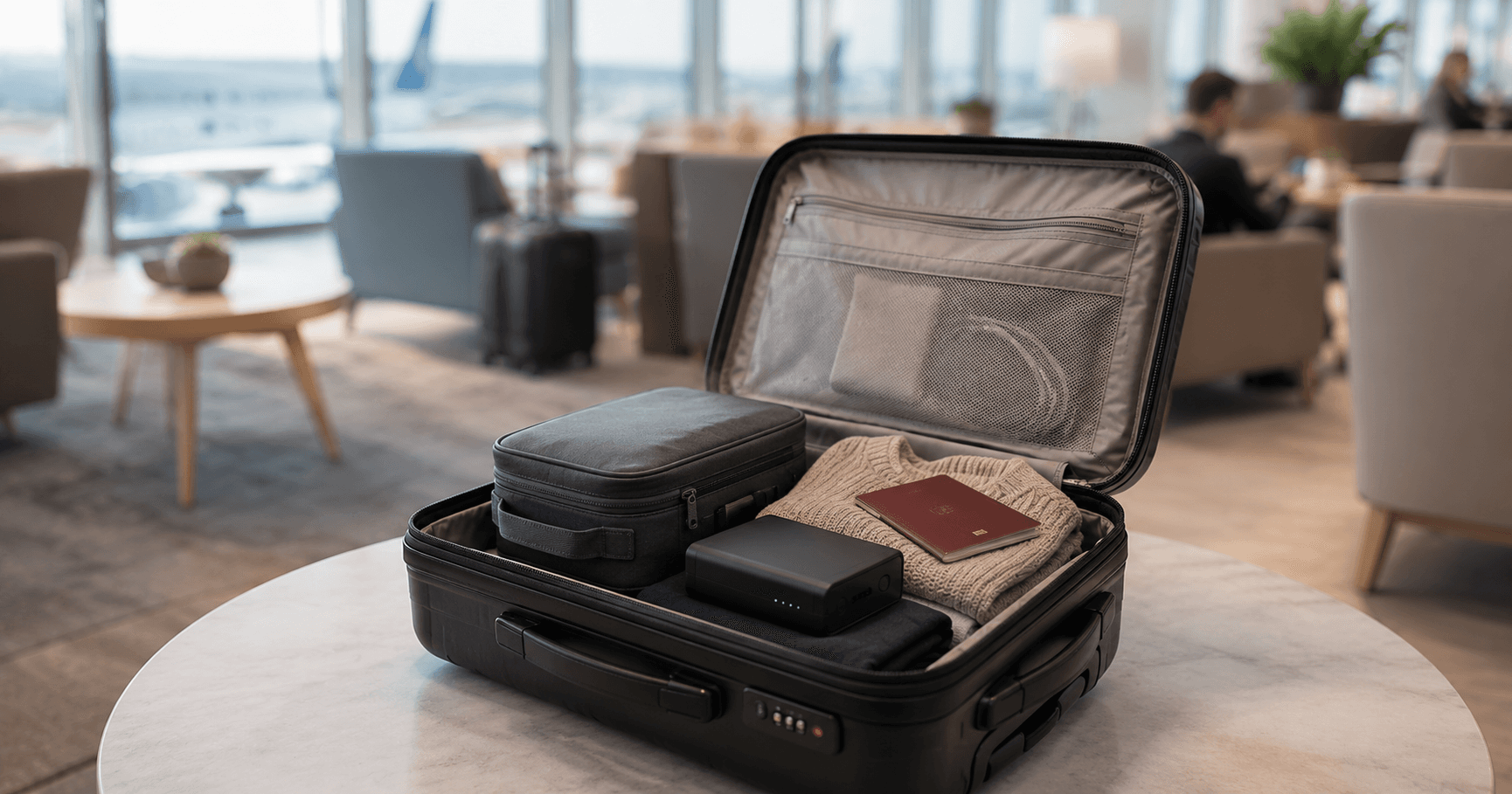
Flying with a CPAP battery is common and legal, but the rules are specific. Getting them wrong means your battery gets confiscated at the gate.
The FAA watt-hour limits, explained
The TSA and FAA classify lithium-ion batteries by watt-hour (Wh) capacity:
| Wh Range | Carry-on Allowed? | Checked Bag? |
|---|---|---|
| ≤100 Wh | ✅ Yes, no approval needed | ⚠️ Only if installed in device |
| 101–160 Wh | ✅ Yes, with airline approval (max 2 batteries) | ❌ Not allowed loose |
| >160 Wh | ❌ Not permitted in cabin | ❌ Not allowed at all |
What this means for AirMini travelers:
- Medistrom Pilot-24 Lite (97.68 Wh): Flies free in carry-on, no questions asked
- USB-C PD power bank (≤99 Wh): Same — keep it under 100 Wh and you're fine
- Goal Zero Yeti 300 (297 Wh): Exceeds 160 Wh — not allowed in cabin
- EcoFlow RIVER 2 (256 Wh): Same — ground use only
- EcoFlow DELTA 3 (1024 Wh): Same — home/camping only
Practical tips for flying with a CPAP battery
- Print or screenshot the Wh label. TSA agents sometimes pull batteries for inspection. Having the spec sheet handy speeds things up.
- Carry-on only — always. Loose lithium batteries are banned from checked bags. Even inside a device, the rules are strict.
- CPAP machines are TSA-exempt from the electronics bin rule. You don't have to remove your CPAP from your bag for X-ray (though some agents still ask). Your battery is a separate item.
- Contact the airline if your battery is 101–160 Wh. Most major carriers allow two with pre-approval; call ahead to confirm.
- Don't try to bring two 100 Wh batteries labeled as "laptop batteries." TSA and flight crew know the CPAP context — just be transparent.
Common mistakes when buying a battery for the ResMed AirMini
Mistake 1: Buying the wrong DC connector
The AirMini uses a 7.4mm x 5.0mm barrel connector — the same physical size as older HP and Dell laptop chargers. It is not the same as:
- The standard ResMed DC input used on the AirSense 10 (5.5mm x 2.5mm)
- The AirSense 11 DC input
- Generic CPAP connectors sold in battery kits
If you buy a Medistrom Pilot-24 Lite, you also need the AirMini-specific cable (sold separately, ~$25). The cable that comes with the Pilot-24 Lite fits other ResMed machines, not the AirMini. Check the product listing — many buyers miss this and end up with a cable that won't connect.
Mistake 2: Buying a power bank with too-low wattage output
Not all USB-C ports are equal. The AirMini needs 20–24V via USB-C PD, which requires the power bank to support 20V output at the USB-C port. Many power banks with USB-C ports only output 5V or 9V — standard phone charging voltages.
To power the AirMini, you need:
- A USB-C PD power bank rated at 65W or higher
- A trigger cable designed for CPAP use that negotiates 20V from the bank
- Optionally: a bank that supports PPS (Programmable Power Supply) for more precise voltage
Buying a cheap $20 USB-C power bank and expecting it to run your CPAP is the #1 frustration-purchase in this category. Spend the extra $30 to get a proper 65W+ bank. For a full breakdown of which trigger cables, voltages, and PPS-capable banks actually work, see our USB-C PD CPAP power guide.
Mistake 3: Not accounting for heated tubing power draw
The AirMini itself has no heated humidifier, but if you've connected a ClimateLine heated tube — this does not apply to the AirMini, which is not compatible with heated tubing. The AirMini uses only HumidX passive exchangers.
However, if you're comparing this page while also researching batteries for an AirSense 11 or AirSense 10 with ClimateLine, know that heated tubing adds roughly 5–15W to your draw, on top of the humidifier itself. ResMed's figures put the AirSense 11 at about 18W dry, ~28W with the humidifier on low, and ~48W on high. A 100 Wh battery that runs an AirMini for about 1.5 nights will last only about 4–5 hours on a dry AirSense 11 — and under 2 hours with full humidification.
Mistake 4: Assuming all "CPAP batteries" support the AirMini
A handful of CPAP batteries on Amazon are not compatible with the AirMini's connector or voltage requirements. Always check for explicit "AirMini compatible" language, not just "ResMed compatible." ResMed makes multiple machines with different inputs.
Mistake 5: Ignoring cold-weather capacity loss
Lithium batteries lose capacity in cold temperatures. At 40°F (4°C), a 100 Wh battery may only deliver 80 Wh. At 20°F (-7°C), it could drop to 65-70 Wh — turning a 1.5-night battery into a marginal one-nighter.
If you're camping in cold weather:
- Keep the battery inside your sleeping bag or tent (not in the vestibule)
- Insulate it in a small pouch
- Buy 20-25% more capacity than you think you need
Quick runtime calculator
The AirMini's math is simple:
Battery capacity (Wh) × usable fraction ÷ 6–7W = estimated hours of runtime
Use 0.85–0.90 for DC-direct (CPAP battery or USB-C PD trigger cable) and about 0.75 for a power station's AC outlet with the stock power brick.
| Battery size | DC-direct runtime | AC-outlet runtime | Nights (8h each) |
|---|---|---|---|
| 50 Wh | ~6–7 hours | ~5–6.5 hours | Most of 1 night |
| 100 Wh | ~12–15 hours | ~10–13 hours | ~1.5 nights |
| 187 Wh | ~23–28 hours | ~19–25 hours | 2–3 nights |
| 256 Wh | ~31–38 hours | ~26–34 hours | 3–4 nights |
| 500 Wh | ~61–75 hours | ~50–67 hours | ~6–8 nights |
| 1024 Wh | ~124–154 hours | ~100–135 hours | ~13–17 nights |
These numbers assume your pressure settings are in the average range (8–12 cm H2O). Higher pressures push peak draw up; lower pressures extend runtime. Users with pressures above 15 cm H2O should budget closer to 9-10W average.
DC vs. AC: which connection to use for the AirMini
When you have the choice, always use a direct DC connection to the AirMini. Here's why it matters:
DC-direct (via dedicated CPAP battery or trigger cable): Energy flows almost straight to the machine. Expect roughly 85-90% of the rated capacity to be usable.
AC outlet (via portable power station): The power station inverts DC to AC, then your AirMini's power brick converts it back to DC. That roundtrip leaves roughly 70-80% usable, with the rest lost as heat.
For a 100 Wh battery, that's a difference of about 10-20 Wh, or roughly 1.5-3 hours of lost AirMini runtime. On a 256 Wh power station it's less of a concern because you have plenty of headroom.
Bottom line: Use DC-direct for travel (Medistrom or trigger cable). Use AC outlet for larger power stations when DC output isn't available.
AirMini connector and compatibility notes
Not every cable and battery that claims "AirMini compatibility" actually works well. A few things to check before you buy:
- The AirMini needs 24V DC input. Some USB-C PD trigger cables are wired for 20V instead of 24V. Most AirMini users report 20V works fine, but 24V is the spec.
- Make sure the barrel connector size matches. The AirMini uses a 7.4mm x 5.0mm barrel connector.
- Avoid cheap knockoff cables with no reviews. The AirMini's power circuitry is not forgiving of low-quality connectors.
- The Medistrom Pilot-24 Lite requires the AirMini-specific cable (separate purchase, around $25). The standard Medistrom cable fits other ResMed machines but not the AirMini.
What about the AirMini's HumidX — does it affect battery life?
No. The AirMini uses passive HumidX and HumidX Plus moisture inserts instead of a powered humidifier, and they draw zero watts. Your battery runtime is identical whether or not you use an insert — a key reason the AirMini is so battery-friendly.
The trade-off is consumables, not power. HumidX inserts cost roughly $3-5 each and last about 30 days of nightly use, so budget for replacements before a long trip. For dry-climate camping, HumidX Plus provides more moisture than the standard insert without adding any draw. If you still get dry mouth, a small battery-powered personal humidifier ($15-25) uses minimal power and helps more than the insert alone.
AirMini vs AirSense 11: which should you battery-power for travel?
The bottom line: for short trips and flying, battery-power the AirMini — it is lighter and needs a smaller battery. For trips that demand real humidification in dry air, the AirSense 11 is better but needs a far larger battery. If you have not bought a travel machine yet, our best battery powered CPAP machine guide compares the AirMini against the Z2 Auto and Transcend Micro on weight, draw and battery options.
| Factor | AirMini | AirSense 11 |
|---|---|---|
| Weight | 0.66 lbs | 2.27 lbs |
| Power draw | 6-7W avg (27W peak) | ~18W dry (15–30W by pressure) |
| Battery needed (1 night) | ~55–65 Wh (DC) | ~160–170 Wh |
| Battery needed (1 night + humidity) | N/A (passive HumidX) | ~260 Wh (low) to ~450 Wh (high) |
| Flight-friendly | Yes, designed for it | Yes, but bulkier |
If you own the full-size machine too, our best battery for ResMed AirSense 11 guide breaks down the humidifier math in detail. Heading off the grid? The CPAP backpacking guide covers the lightest AirMini setups for the trail. A ResMed AirMini travel bag keeps the machine, battery, and cables together in one place.

Tips for longer AirMini battery life
- Use HumidX Plus in dry climates. It delivers more moisture without adding any power draw.
- Lower your ramp time. Extended ramp periods at low pressure don't consume much, but reducing ramp keeps things consistent.
- Turn off Bluetooth. The AirMini's wireless radio draws a small but measurable amount of power. In the backcountry, you don't need it.
- Keep your battery warm. Lithium batteries lose capacity in cold temperatures. At 40°F, a 100 Wh battery might only deliver 80 Wh. Sleep with it in your tent.
- Fix your mask seal. Mask leaks force the motor to run harder to maintain pressure. A good seal saves power and improves therapy.
- Use the AirMini app to check your pressure range. If your machine is prescribing higher pressures than needed, talk to your doctor about adjusting — it directly affects battery life.
Related reading
- Best battery for ResMed AirSense 11 — for the full-size machine
- CPAP battery compatibility guide — connectors and voltage by machine
- CPAP backpacking guide — lightest setups for the trail
- CPAP on airplane TSA rules — flying with a CPAP and battery
- Best CPAP travel batteries — all machines compared in one place
- CPAP battery runtime calculator — exact runtime for your pressure setting
- International travel CPAP voltage — EU/DE/UK plug and voltage notes
What to do next
The AirMini's low power draw gives you more battery options than any other CPAP — match the battery to where you'll actually use it.
- Traveling by air? Grab the Medistrom Pilot-24 Lite with the AirMini-specific cable for plug-and-play DC power under the FAA limit.
- On a budget? Pair a 65W+ USB-C PD power bank with a USB-C to AirMini trigger cable for about a night and a half for under $100.
- Camping or doing outage prep? Step up to the EcoFlow RIVER 2 for three to four nights of AirMini runtime plus solar input.
This site may include affiliate links. If you buy through links on this page, we may earn a commission at no extra cost to you. All product specs and runtime estimates are based on published manufacturer data and real-world user reports.