How to choose a battery for the ResMed AirSense 11
Choosing the right battery for the ResMed AirSense 11 comes down to one number: how much power your machine actually draws. The AirSense 11 uses a 65-watt, 24V DC power supply, smaller than the AirSense 10's 90-watt brick. But the machine doesn't draw 65 watts continuously. Here's what it actually uses:
| Setting | Power draw | 8-hour energy needed |
|---|---|---|
| CPAP only (no humidity, no heat) | ~15-30W (about 18-20W typical) | ~145-240 Wh |
| CPAP + humidifier on low | ~28W | ~225 Wh |
| CPAP + humidifier high + heated tube | ~48W and up (up to ~73W max) | ~385 Wh and up |
| AutoSet (auto-adjusting pressure) | ~15-30W, rises with pressure | Varies with events |
Those figures are energy at the machine. Your battery needs a little more, because conversion losses eat part of the rated capacity. A simple rule: runtime ≈ usable Wh ÷ watts, where usable Wh is about 85-90% of the rated capacity on a DC connection and about 70-80% through an AC inverter. That's why a dry 8-hour night at a typical pressure works out to roughly 190 Wh of battery once losses are included, per our CPAP battery runtime calculator.
This matters because it determines which battery you need and how long it'll last. Turn off the humidifier and heated tube, and a small 100Wh battery runs the AirSense 11 for about 5 hours: a short night, not a full one. Leave everything on, and you need a much bigger battery.
Three ways to power an AirSense 11 on battery
1. DC battery with direct cable (best efficiency)
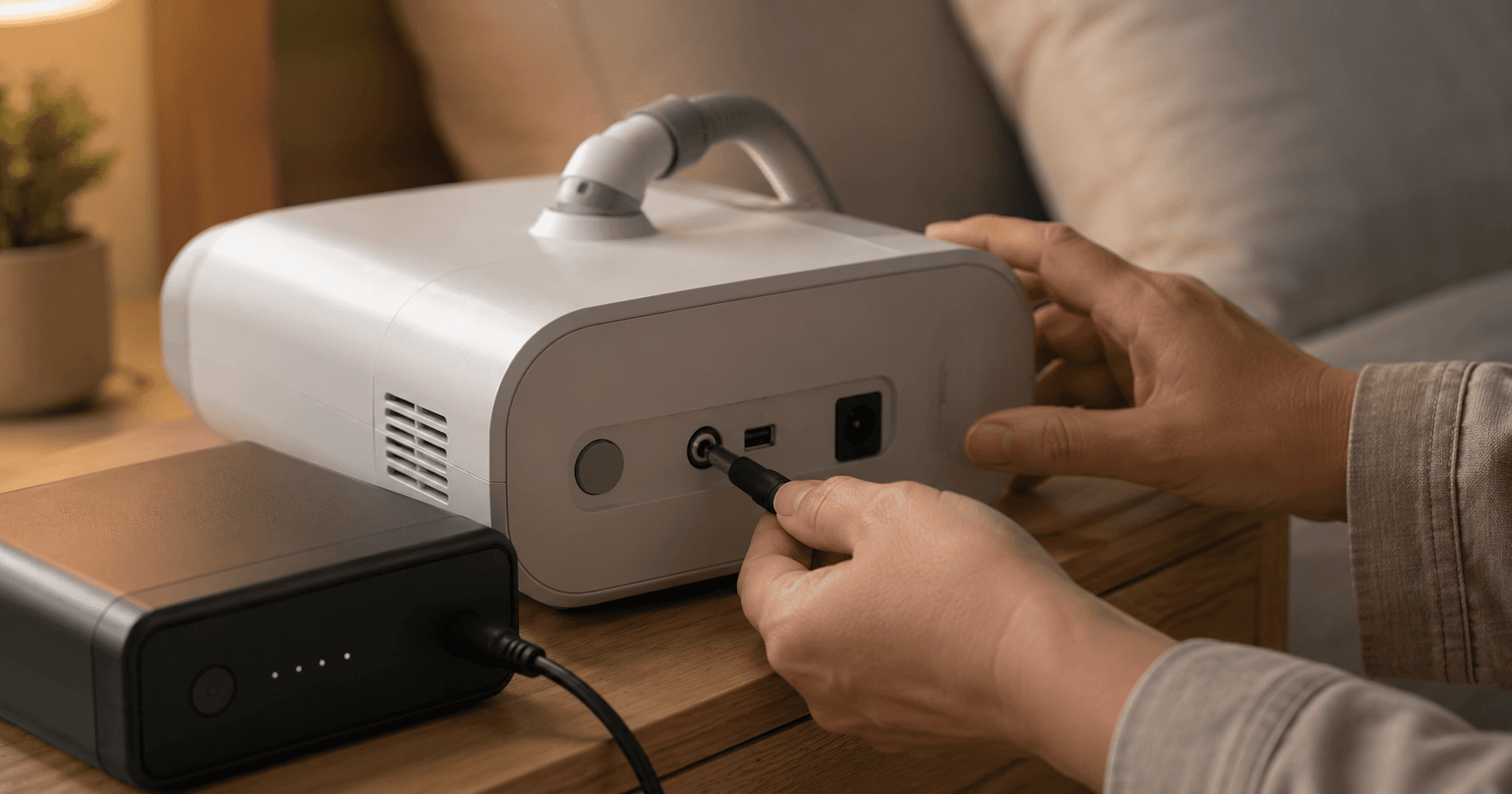
A DC battery connects directly to the AirSense 11's power input, skipping the AC power brick entirely. This is the most efficient option, with no energy lost converting DC to AC and back to DC.
The AirSense 11 runs on 24V DC, the same voltage as the AirSense 10, but through a different connector. You need either a battery with a 24V output and an AirSense 11-specific cable, or a 12V-to-24V converter made for the AirSense 11. Going DC-direct typically recovers 10-15% of capacity that an inverter would otherwise waste. On a 100Wh battery that's roughly an extra 30-45 minutes of CPAP-only runtime. Expect about 5 hours per 100Wh at an 18W CPAP-only draw (100 Wh × 0.88 ÷ 18 W ≈ 4.9 hours). For the full sizing math, see our CPAP battery runtime calculator.
2. Portable power station with AC outlet
Any portable power station with a pure sine wave inverter works. Plug the AirSense 11's stock power brick into the AC outlet. Simple, but you lose 10-15% efficiency to the DC-AC-DC conversion, and the inverter itself adds 5-10W of idle overhead. On AC, a 256Wh station delivers roughly 10-11 hours of CPAP-only therapy (about one full night) or around 4 hours with the heated humidifier and tube running. Switch to a DC converter off the station's car port and the same 256Wh stretches to about 12.5 hours dry. For nightstand outage protection, choose a model with a UPS or passthrough mode so it switches over in milliseconds. See our breakdown of UPS vs CPAP battery vs power station.
3. Car battery with 12V inverter
For RV and car camping, a 12V-to-AC inverter rated at 150W+ will run the AirSense 11. Not ideal for efficiency, but it works when your car battery is the only power source. A CPAP-only night pulls roughly 170-200Wh from a 12V source through an inverter (18-20W × 8 hours, plus conversion losses), or about 14-17Ah. A typical 50Ah deep-cycle lead-acid battery, which you shouldn't drain much past 50%, gives you roughly 300Wh usable, so plan on about one and a half nights. A 12V-to-24V DC converter built for the AirSense 11 is more efficient than an inverter if you go this route. Running the heated humidifier off a vehicle battery is not recommended. See our CPAP humidifier battery drain guide for why heat is the single biggest drain.
Best batteries for the AirSense 11
For travel and flights

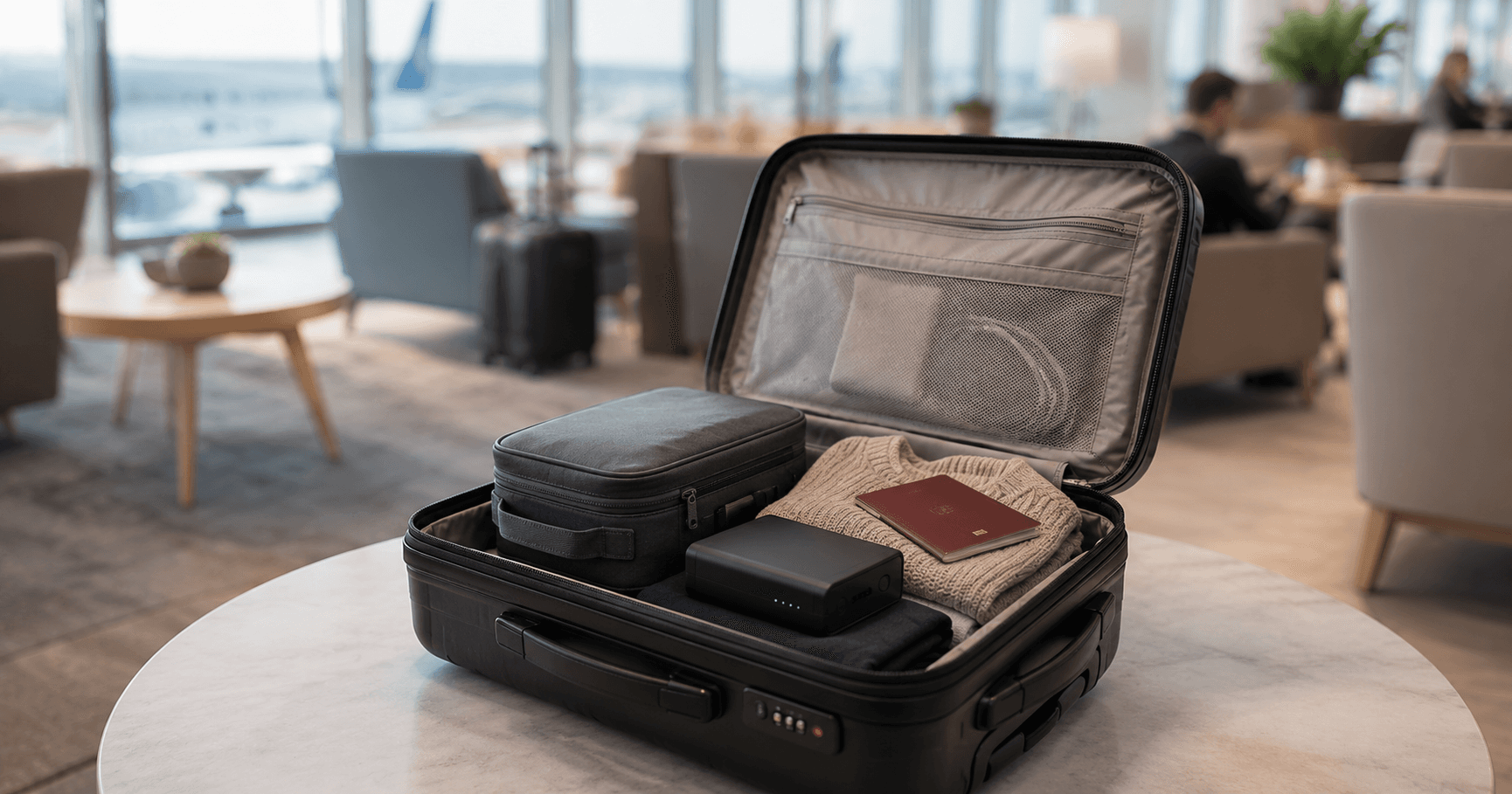
Why it works: The Medistrom Pilot-24 Lite was designed for CPAP machines. It connects to the AirSense 11 via a DC cable, supplies the 24V the machine runs on, and is FAA-approved at 97.68Wh (under the 100Wh carry-on limit). You get about 5 hours without the humidifier: enough for a short night, or a full night if you carry two.
Runtime estimate:
- Without humidifier: about 4.5-5 hours (one short night; 97.68 Wh × 0.88 ÷ 18 W ≈ 4.8 hours)
- With humidifier on low: about 3 hours
- With humidifier high + heated tube: under 2 hours
Price: $329 – $349
For camping and extended trips

Why it works: The EcoFlow RIVER 2 has 256Wh of capacity, enough for one full humidifier-off night with room to spare. It charges from solar panels, car outlet, or wall power. Pure sine wave inverter built in.
Runtime estimate:
- Without humidifier: about 12.5 hours on a DC converter (256 Wh × 0.88 ÷ 18 W), or roughly 10-11 hours through the AC outlet (256 Wh × 0.70-0.80 ÷ 18 W)
- With humidifier high + heated tube: about 4.7 hours on DC (not a full night)
Price: $179 – $239
For power outages at home

Anker SOLIX C300 Portable Power Station (288Wh LiFePO4, 300W AC)
$329.99
Check price on AmazonWhy it works: The Anker SOLIX C300 sits on your nightstand and takes over when the power goes out. Its UPS mode switches over in under 10ms, so the AirSense 11 keeps running without a hiccup while the station stays topped up from the wall. At 288Wh of LiFePO4 (rated for 3,000 cycles), it runs the AirSense 11 through one full night without the humidifier. It has three pure sine AC outlets (300W total), two 140W USB-C ports, and a 12V car socket for a DC converter. It weighs 9.1 lb and recharges to 80% in about 50 minutes on AC.
Runtime estimate:
- Without humidifier: about 13.6-14.4 hours on a DC converter, or roughly 11-13 hours through the AC outlet
- With humidifier on low: about 8.7-9.3 hours on DC, or 7-8 hours on AC
- With humidifier high + heated tube: about 5-5.4 hours on DC, or 4-5 hours on AC (not a full night)
Price: $329.99. It costs more than the RIVER 2, but the fast UPS switchover is what you're paying for at the bedside.
Budget option

EASYLONGER ES270 CPAP Battery (99.9Wh, FAA Carry-On)
$139.99
Check price on AmazonThe EASYLONGER ES270 is a 99.9Wh CPAP battery that costs well under half what the Pilot-24 Lite does. It has selectable 12V, 19V, or 24V output and ships with four CPAP cables, including one for the AirSense 10/11, so it runs the machine DC-direct with no inverter. At 1.3 lb and under 100Wh, it's carry-on OK. It also has a 100W USB-C port, and a pass-through function keeps the CPAP running while the battery charges (it isn't a certified UPS). On its own it covers a short night; carry two for a full 8 hours dry. Its review base (about 150 ratings) is still small.
Runtime estimate:
- Without humidifier: about 4.7-5 hours (99.9 Wh × 0.85-0.90 ÷ 18 W)
- With humidifier on low: about 3 hours
- With humidifier high + heated tube: under 2 hours
Price: $139.99
Dedicated CPAP batteries

The Bluetti X30 is a purpose-built CPAP battery with 297Wh of LiFePO4 capacity and DC output cables for the AirSense 11. It bypasses the inverter entirely for maximum efficiency, delivering about 14-15 hours of humidifier-off runtime (297 Wh × 0.88 ÷ 18 W ≈ 14.5 hours), which is one full night with a healthy reserve.

NiteOwl CPAP Battery Backup (2nd Gen, 150Wh Swappable)
$287.01
Check price on AmazonThe NiteOwl is another dedicated CPAP battery backup that connects directly via DC. Its roughly 150Wh swappable pack gives about 7 hours humidifier-off on the AirSense 11 (150 Wh × 0.88 ÷ 18 W ≈ 7.3 hours), so it's a straightforward option for AirSense 11 users who want a simple, purpose-built power source.
How to maximize battery runtime
The biggest factor isn't the battery. It's your AirSense 11 settings.
- Turn off the humidifier. Going from high humidity with the heated tube (~48W) to dry (~18W) cuts power draw by roughly 60%. Use a standalone room humidifier or nasal spray instead.
- Turn off the heated tube. If you keep the humidifier, at least disable the heated tube. It's the biggest single power drain.
- Use a DC cable instead of AC. Going DC-direct saves 10-15% of your battery capacity.
- Lower your pressure if your doctor allows it. Higher pressures use more power because the motor works harder.
- Use EPR (Expiratory Pressure Relief). EPR reduces pressure during exhale, which slightly lowers average power consumption.
Cables and adapters you need
The AirSense 11 uses a different power connector than the AirSense 10. Both run on 24V DC, but the plugs are not interchangeable, so make sure any DC battery cable is specifically for the AirSense 11, not the 10.
- Medistrom to AirSense 11: Included with the Pilot-24 Lite (or buy separately ~$25)
- Generic DC cable: Look for "ResMed AirSense 11 DC cable 24V". Some third-party batteries ship these
- Car adapter: ResMed sells a 12V/24V DC converter for the AirSense 11 (~$65). Works with any car or RV 12V outlet.
For 12V car and RV power, a dedicated DC converter is the most efficient route. It steps your vehicle's 12V supply up to the 24V the AirSense 11 needs, with no AC inverter in the loop.
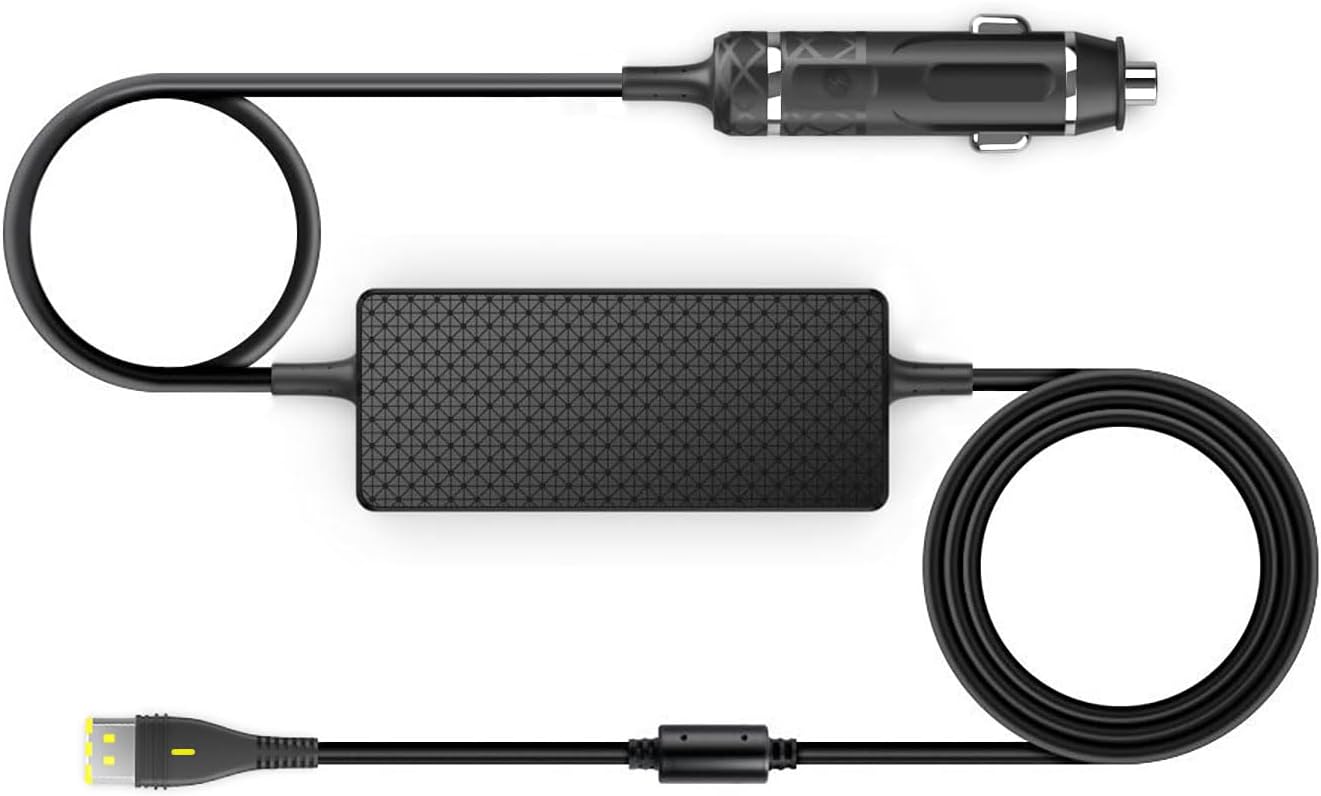
The HKY AirSense 11 DC converter plugs into any 12V cigarette-lighter socket and outputs the regulated 24V the machine expects. Our CPAP DC power adapter guide covers connector pinouts and how to avoid frying your machine with the wrong voltage.
AirSense 11 vs AirSense 10: battery differences
If you're upgrading from the AirSense 10, the good news: the AirSense 11 ships with a smaller, lower-rated power supply (65W vs 90W), and its dry power draw is about the same. The bad news: it uses a different power connector, so your old DC cables won't fit, even though both machines run on 24V.
| Spec | AirSense 11 | AirSense 10 |
|---|---|---|
| Power supply | 65W, 24V DC | 90W, 24V DC |
| CPAP-only draw | ~15-30W (about 18-20W typical) | ~18-30W (about 18.6W at pressure 12) |
| With heated humidifier + tube | ~48W typical, up to ~73W max | similar, with a higher-rated 90W supply |
| DC input voltage | 24V | 24V |
| DC connector / cable | AirSense 11-specific | AirSense 10-specific |
In practice, runtime on the same battery is about the same for both machines with the humidifier off, because the dry draw is similar. On a 97.68Wh Medistrom Pilot-24 Lite at about 18W, either machine lasts roughly 4.5-5 hours (97.68 Wh × 0.88 ÷ 18 W ≈ 4.8 hours). The AirSense 11's advantage is its smaller, lighter 65W power supply, not a longer battery life. The one thing that does not carry over is the cable: you must buy an AirSense 11 DC cable or an AirSense 11 12V-to-24V converter, because the AirSense 10 lead will not fit and can damage the machine if forced.
Related reading
- Best battery for ResMed AirSense 10 — if you're upgrading from an AirSense 10
- Best CPAP backup batteries — full comparison across all machines
- CPAP battery backup guide — sizing math and compatibility primer
- CPAP battery travel checklist — everything to pack
- CPAP power outage guide — home backup strategies
- Can you use a ResMed AirSense without water? — how much runtime you gain by running dry
- Best battery for ResMed AirCurve — same 24V connector as the AirSense 10, BiPAP-specific picks
- Best battery for ResMed AirMini (2026) — if you travel with the AirMini as a backup
What to do next
The AirSense 11 runs well on battery when you turn off the heated humidifier. Pick a battery sized for your actual nightly draw and cable for your specific connector.
- Flying or doing weekend trips: buy the Medistrom Pilot-24 Lite with the AirSense 11 DC cable for direct-DC efficiency under 100 Wh. Plan on about 5 hours per battery and carry two for a full night.
- Home outage protection: choose a 256 Wh+ power station with UPS mode so your therapy never skips a beat.
- Before your next trip, do an overnight test at home to confirm runtime with your actual pressure settings.