Choosing the best battery for ResMed AirSense 10 means matching your machine's real power draw to the right capacity, connector, and form factor. A ResMed AirSense 10 battery backup is not a luxury — it is essential insurance for anyone who travels, camps, or lives in an area with unreliable power. This guide gives you the real numbers so you can buy with confidence.
A CPAP battery backup power supply for ResMed AirSense 10 is a portable energy source — either a dedicated DC battery or a general-purpose power station — that keeps your machine running when wall power is unavailable. We compared every major option so you can match the right battery to your pressure settings, humidifier preferences, and use case — whether that is a weekend camping trip, a cross-country flight, or storm-season peace of mind.
How Much Power Does the ResMed AirSense 10 Actually Use?
The AirSense 10's power draw ranges from roughly 15W to around 100W at peak depending on your settings — not a single fixed number. Without the humidifier, the blower alone is surprisingly frugal: we measured about 18.6W at the machine's DC input at a pressure of 12 cmH2O with the humidifier off (see our DC power adapter guide). The figures below are approximate and rise with pressure, mask leak, and a cold room:
| Condition | Approximate Power Draw |
|---|---|
| Low pressure (4-8 cmH2O), no humidifier | ~15-20W |
| Mid-to-high pressure (10-20 cmH2O), no humidifier | ~20-30W |
| Humidifier on (typical settings) | ~45-65W |
| High pressure + max humidity + heated ClimateLine tube | peaks up to ~90-100W (steady average lower) |
ResMed pairs the AirSense 10 with a 90W, 24V power supply. Its commonly quoted figures of about 53W "typical" and about 104W maximum assume the humidifier (and heated tube) are running, so do not use them to size a battery for humidifier-off nights.
The bottom line: your humidifier is the single biggest variable. Disabling it typically cuts power consumption by around 60% and roughly doubles to triples your runtime.
For an 8-hour night without the humidifier, here is roughly what the machine will consume at different pressure ranges:
| Pressure Setting | Approx. Energy per 8-Hour Night |
|---|---|
| 4-8 cmH2O (~15-20W) | 120-160 Wh |
| 10-14 cmH2O (~20-25W) | 160-200 Wh |
| 16-20 cmH2O (~25-30W) | 200-240 Wh |
With the humidifier and heated tube enabled, consumption jumps dramatically:
| Humidifier Setting | Approx. Energy per 8-Hour Night |
|---|---|
| Humidifier on low-to-mid (~45-55W) | 360-440 Wh |
| Humidifier + heated tube, higher settings (~55-65W) | 440-520 Wh |
| Max humidity + heated tube in a cold room | 520 Wh or more |
Most users fall in the 10-14 cmH2O range without a humidifier, meaning the machine itself uses roughly 160-200 Wh per night. Because you only get about 85-90% of a battery's rating via DC (and only about 70-80% through an AC inverter), shop for roughly 200-250 Wh of rated capacity for one dry night on DC, or about 250-270 Wh if you'll run through an AC outlet. For a deeper breakdown, see our CPAP battery sizing guide and learn how much battery your humidifier really uses.
A Note on the AirSense 10 Connector
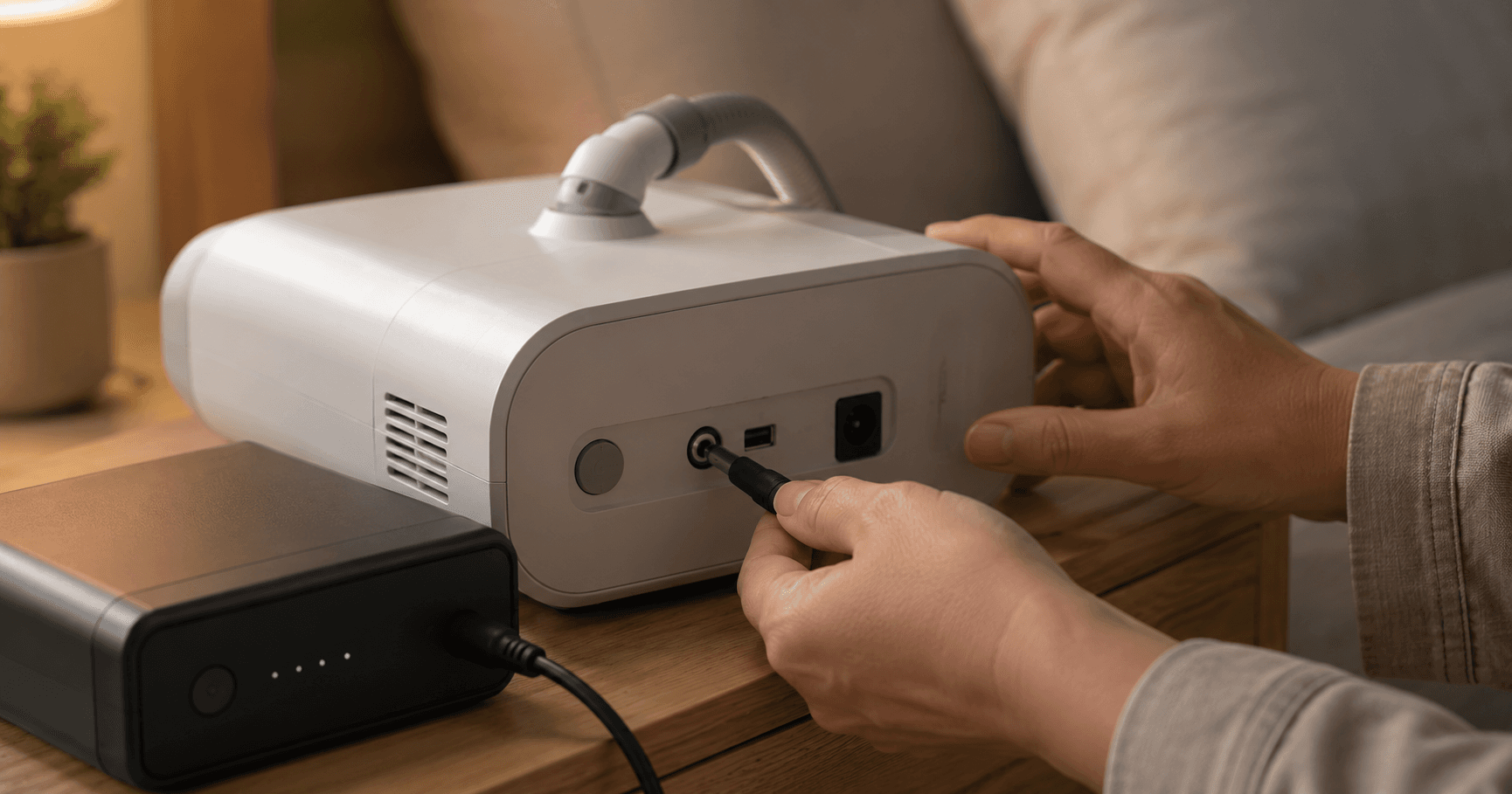
The AirSense 10 uses a 24V DC barrel jack — a different plug than the AirSense 11's proprietary connector (both machines run on 24V DC). This matters when buying batteries: a cable or adapter labeled for the AirSense 11 will not fit the 10. Dedicated CPAP batteries like the Medistrom Pilot-24 Lite ship with machine-specific cables, so always confirm you are ordering the AirSense 10 version. If you own an AirSense 11 instead, check our guide to the best batteries for the AirSense 11.
Best Battery for ResMed AirSense 10: DC-Direct vs Power Station
A DC-direct CPAP battery is a compact unit that plugs into the AirSense 10's 24V barrel jack, delivering power with less conversion loss. A portable power station is a larger, multi-purpose unit that outputs AC wall power through an inverter — versatile, but less efficient for CPAP use. Understanding this Pilot-24 Lite vs power station ResMed AirSense 10 trade-off is key to choosing well.
DC-direct batteries plug into your AirSense 10's 24V barrel jack. The battery sends power to the machine without an AC inversion step, so losses are small. Expect about 85-90% of the rating as usable energy — a 99Wh DC battery delivers roughly 85-89Wh to your CPAP.
Portable power stations convert their stored DC energy to AC (wall outlet power) through an inverter, then your AirSense 10's power brick converts it back to DC. This double conversion wastes more energy as heat, and at the low loads a CPAP draws, only about 70-80% of the rating reaches your machine. A 240Wh power station effectively delivers around 170-190Wh.
| Feature | Dedicated CPAP Battery | Portable Power Station |
|---|---|---|
| Usable energy | ~85-90% of rating (DC-direct) | ~70-80% of rating (via AC inverter) |
| Typical capacity | 95-150 Wh | 200-1000+ Wh |
| Weight | 1-2 lbs | 3-15 lbs |
| Price per Wh | $2.50-3.50/Wh | $0.70-1.00/Wh |
| FAA carry-on approved | Usually yes (under 100Wh) | Rarely (too large) |
| Other device charging | No | Yes (phones, laptops, etc.) |
| UPS function | Some models | Rare |
In short: if you fly frequently or want the lightest travel kit, a dedicated CPAP battery is the clear winner. If you want the most runtime per dollar and do not mind the extra weight, a power station gives you more Wh for less money — plus you can charge your phone, laptop, and other gear. For more on this trade-off, read our UPS vs dedicated CPAP battery vs power station comparison.
You can also use a DC power adapter with many power stations to bypass the inverter and typically gain roughly 10-20% more runtime. See our DC power adapter guide for compatible options.
Best Dedicated CPAP Batteries for the AirSense 10
The top dedicated CPAP batteries for the AirSense 10 are the Medistrom Pilot-24 Lite for travel, the EASYLONGER ES270 for multi-brand households, and the Bluetti X30 for the most backup capacity. All three connect directly via the AirSense 10's 24V DC barrel jack for maximum efficiency.
Medistrom Pilot-24 Lite — Best Overall for Travel
The Pilot-24 Lite is the gold standard for AirSense 10 travel users. At 99Wh, it falls just under the FAA's 100Wh carry-on limit, and it connects via DC for maximum efficiency. With the humidifier off at a typical 10 cmH2O setting (~20W), expect roughly 4-5 hours of runtime (99Wh × 0.88 ÷ 20W ≈ 4.4 hours) — so plan on two batteries for a full 8-hour night unless your pressure is low. It also doubles as a UPS, switching seamlessly to battery power during an outage.

For a detailed breakdown, read our full Medistrom Pilot-24 review.
EASYLONGER ES270 CPAP Battery — Best Universal Option
The EASYLONGER ES270 ships with four CPAP cables covering the ResMed AirSense 10/11, AirCurve 10/11, AirMini, Luna TravelPAP, and Philips DreamStation 1/2, with selectable 12V, 19V, or 24V output. Its 99.9Wh capacity puts it in the same FAA carry-on class as the Pilot-24 Lite at well under half the price ($139.99), and its universal cable kit makes it the better pick if your household has multiple CPAP machines or you might switch brands down the road. At 20W with the humidifier off, expect roughly 4-4.5 hours (99.9Wh × 0.85-0.90 ÷ 20W), so plan on two for a full night at mid pressure. It weighs 1.3 lbs, adds a 100W USB-C port, and has a pass-through function that keeps the CPAP running while it charges (not a certified UPS). It replaces the Freedom V2, which is no longer available on Amazon; its review base is smaller (about 150 ratings).

EASYLONGER ES270 CPAP Battery (99.9Wh, FAA Carry-On)
$139.99
Check price on AmazonBluetti X30 CPAP Battery Backup — Highest Capacity
The Bluetti X30 packs 297Wh — roughly three times the capacity of the ~100Wh travel batteries — into a CPAP-focused backup that connects to the ResMed AirSense 10 via its DC input. At $279 – $359 it delivers far more usable runtime per dollar than the small dedicated packs, and its 4.3-star rating reflects solid real-world reliability. At roughly 250-265Wh usable, that is about 8.5-13 hours at 20-30W. If you want a single unit that covers a full humidifier-off night (with margin to spare) without stepping up to a bulky power station, the X30 is the pick.

Renogy 72000mAh 266Wh Power Bank — Best Budget DC Option
The Renogy power bank offers 266Wh at a fraction of the price of dedicated CPAP batteries. It outputs 12V DC via a cigarette-lighter port, so you will need a DC power adapter with a step-up converter to reach the AirSense 10's 24V requirement. With that adapter, you get roughly 220Wh of usable energy — about 7-11 hours at 20-30W, enough for a full night without the humidifier at most pressure settings.

Best Portable Power Stations for ResMed AirSense 10 Portable Power
Portable power stations offer ResMed AirSense 10 portable power at a lower cost per watt-hour than dedicated batteries, trading compactness for raw capacity and versatility. These are the best options, broken into tiers by use case.
Budget Tier: One Night Without Humidifier
These stations give you 240-290Wh of rated capacity (roughly 170-230Wh usable through AC) — enough for a single night at low-to-mid pressure settings as long as you disable the humidifier.
Anker SOLIX C300 DC — At 288Wh and $169 – $249, this is the best value in the roundup. It packs the most capacity in this tier at the lowest price. The DC output options help you skip the inverter if you pair it with the right adapter cable.

Anker SOLIX C300 — The AC version of the C300 DC above: the same 288Wh of LiFePO4 (rated for 3,000 cycles) plus three pure sine AC outlets, a 140W USB-C port, and a UPS mode that switches over in under 10ms. Through AC that is roughly 10-11.5 hours at 20W — a full dry night with margin. It costs more ($329.99) and weighs 9.1 lbs, so pick it over the DC version only if you want to plug in the AirSense 10's standard power brick or use it as a bedside UPS.

Anker SOLIX C300 Portable Power Station (288Wh LiFePO4, 300W AC)
$329.99
Check price on AmazonEcoFlow RIVER 2 — 256Wh with exceptionally fast AC recharging (0-100% in 60 minutes, according to EcoFlow). If you need to top off quickly between uses, the RIVER 2 is hard to beat.

Jackery Explorer 300 — 293Wh with pure sine wave AC output. Comfortably covers a single night without the humidifier at most pressure settings, with a little margin to spare for higher-pressure users.

Mid Tier: Multi-Night Camping or Humidifier Use
If you camp for multiple nights or refuse to give up your humidifier, you need 400Wh or more. This is where ResMed AirSense 10 battery life camping becomes practical for extended trips.
Jackery Explorer 500 v2 — 512Wh (roughly 360-410Wh usable via AC) handles two full nights without a humidifier, or about one night with the humidifier at low-to-moderate settings. Reliable, well-supported, and pairs with Jackery's solar ecosystem.

Heavy Duty: Extended Off-Grid or Full Humidifier
EcoFlow DELTA 3 — 1024Wh LiFePO4 (roughly 715-820Wh usable via AC) is enough for about two nights with the humidifier at moderate settings (1.5 nights at max humidity with the heated tube), or 4-5 nights without it. It adds a sub-10ms UPS mode, six AC outlets (1800W), and up to 500W of solar input, so it also powers your entire campsite. The trade-off is weight (27.6 lbs) and price (about $599).

Bluetti Elite 100 V2 (1024Wh LiFePO4) — LiFePO4 chemistry is rated for 4,000+ charge cycles to 80% versus the typical 500-800 for lithium-ion. At 1024Wh (roughly 715-820Wh usable via AC), it covers four to five nights without a humidifier or about two nights with the humidifier at moderate settings. It adds a UPS mode (≤10ms switchover), an 1800W inverter, and 0-80% AC recharging in about 45 minutes. At $499 (list $899), the long lifespan makes it the best choice if you plan to use a ResMed AirSense 10 battery backup for years. The trade-off is 25.3 lbs of weight, and it is not water-resistant, so keep it sheltered at camp.

BLUETTI Elite 100 V2 Portable Power Station (1024Wh LiFePO4, 1800W)
$499 – $899
Check price on AmazonPicking the Right Battery by Use Case
The right battery depends on how you use your AirSense 10 away from wall power. Here is a quick decision matrix based on common scenarios:
| Use Case | Recommended Battery | Why |
|---|---|---|
| Air travel (carry-on) | Medistrom Pilot-24 Lite | Under 100Wh FAA limit, DC-direct, 1.2 lbs |
| Weekend camping (no humidifier) | Anker SOLIX C300 DC or Jackery Explorer 300 | 288-292Wh covers 1 night (2 at low pressure); solar-chargeable |
| Extended camping (3+ nights) | Jackery Explorer 500 v2 + SolarSaga 100W | 512Wh + solar recharging = indefinite runtime |
| Camping with humidifier | EcoFlow DELTA 3 | 1024Wh handles ~2 nights with the humidifier at moderate settings |
| Home power outage backup | Medistrom Pilot-24 Lite or Zopec Explore Mini | UPS function for seamless switchover |
| Car/RV travel | EcoFlow RIVER 2 + car adapter | Fast recharging from 12V vehicle outlet |
| Budget pick | Anker SOLIX C300 DC | 288Wh at $169 – $249, best value per Wh |
For car and RV setups, a 12V-to-24V DC converter lets you run the AirSense 10 from your vehicle's 12V outlet or a power station's car socket. The HKY AirSense 10 converter (about $28) is rated 90W, the same as the stock power brick, and also fits the AirCurve 10 and AirStart 10:

For off-grid solar charging, pair your power station with a portable panel:

And for bedside UPS backup that also works as a travel battery:

For a complete rundown of camping-specific considerations, read our CPAP battery camping guide.
Tips to Maximize Battery Life with Your AirSense 10
These seven tweaks can easily double your AirSense 10's battery runtime — most of the gain comes from turning off the humidifier:
-
Turn off the humidifier and heated tube. This alone cuts power draw from roughly 45-65W to about 15-30W — typically around a 60% reduction, which roughly doubles to triples runtime. Use a heat moisture exchanger (HME) filter as a low-power alternative to heated humidification.
-
Use a DC-direct connection. Bypassing the AC inverter typically gives you roughly 10-20% more usable energy (about 85-90% of rating instead of 70-80%). If your power station has a 12V DC output, use it with a 12V-to-24V converter built for the AirSense 10.
-
Lower your pressure if clinically safe. Every 2 cmH2O reduction saves roughly 10-20 Wh per night. Talk to your sleep specialist before adjusting — AutoSet users may naturally draw less on good nights.
-
Enable EPR (Expiratory Pressure Relief). EPR reduces the motor's workload during exhalation, marginally lowering power consumption without affecting therapy quality.
-
Keep the machine cool. Batteries and CPAP motors both lose efficiency in heat. In a tent, position the machine near a vent. In a car, avoid leaving the battery in direct sun.
-
Charge fully before each trip. Lithium batteries self-discharge a few percent per month when idle. A full charge the day before travel ensures you start with maximum capacity.
-
Carry a backup power source. For multi-night trips, a 100W solar panel can fully recharge a 240Wh power station in roughly 4-5 hours of strong sunlight, giving you indefinite off-grid runtime.
For more runtime optimization strategies, see our guide on fixing CPAP battery runtime issues.
Frequently Asked Questions
How long will a battery last with the ResMed AirSense 10?
Without the humidifier, the AirSense 10 typically uses about 120-240Wh over an 8-hour night depending on your pressure setting, so a 240Wh power station (roughly 170-190Wh usable through AC) covers most low-to-mid pressure users for a full night. With the humidifier and heated tube enabled, expect roughly 360-520Wh per night, and more at maximum settings, so even a 500Wh power station may fall short. Disabling the humidifier is the single biggest way to extend runtime.
Can I use a portable power station instead of a dedicated CPAP battery?
Yes, but there is a trade-off. Power stations like the Anker SOLIX C300 or EcoFlow RIVER 2 cost less per watt-hour and offer more capacity, but running the AirSense 10 from their AC outlet delivers only about 70-80% of rated capacity. Dedicated CPAP batteries connect via DC and typically deliver about 85-90% of their rating to your machine. The choice comes down to whether you prioritize capacity and versatility (power station) or efficiency and portability (dedicated battery).
Does the AirSense 10 use the same battery connector as the AirSense 11?
No. The AirSense 10 uses a 24V DC barrel jack, while the AirSense 11 uses a different proprietary connector. Batteries like the Medistrom Pilot-24 Lite include machine-specific cables, so make sure you select the AirSense 10 cable when ordering. A battery built for the AirSense 11 will not plug into the 10 without an adapter.
Is the ResMed AirSense 10 still worth powering with a battery in 2026?
Absolutely. The AirSense 10 remains one of the most widely used CPAP machines worldwide, and power supplies, DC converters, and battery cables for it are still widely available. Battery options have actually improved since its release — prices have dropped, capacities have grown, and LiFePO4 chemistry now offers 3,000+ cycle lifespans. Whether you are camping, traveling, or preparing for power outages, investing in a battery for your AirSense 10 is practical and cost-effective.
Can I charge my AirSense 10 battery with a solar panel?
Yes. Most portable power stations accept solar input via an XT60 or Anderson connector. A 100W panel like the Jackery SolarSaga 100W typically produces 60-80W in real sunlight, so it can recharge a 240Wh power station in roughly 4-5 hours of strong, direct sun, giving you indefinite off-grid CPAP power. Dedicated CPAP batteries typically lack solar input, so you would charge them from the power station or a car adapter instead.
Related reading
- CPAP battery sizing guide
- How much battery your humidifier really uses
- DC power adapter guide
- Best batteries for the AirSense 11
- CPAP battery camping guide
- UPS vs dedicated CPAP battery vs power station
- Best battery for ResMed AirCurve — for BiPAP/AirCurve users on the same connector
- Best battery for ResMed AirMini (2026) — if you also travel with the AirMini
What to do next
Start with the numbers. Check your AirSense 10's pressure setting in the clinical menu, decide whether you can live without the humidifier on battery nights, and match your watt-hour needs to the table above. If you fly regularly, the Medistrom Pilot-24 Lite is the safest bet. If you camp or want a multi-purpose backup, the Anker SOLIX C300 DC gives you the most capacity per dollar. Either way, you will sleep better knowing the power grid is optional.