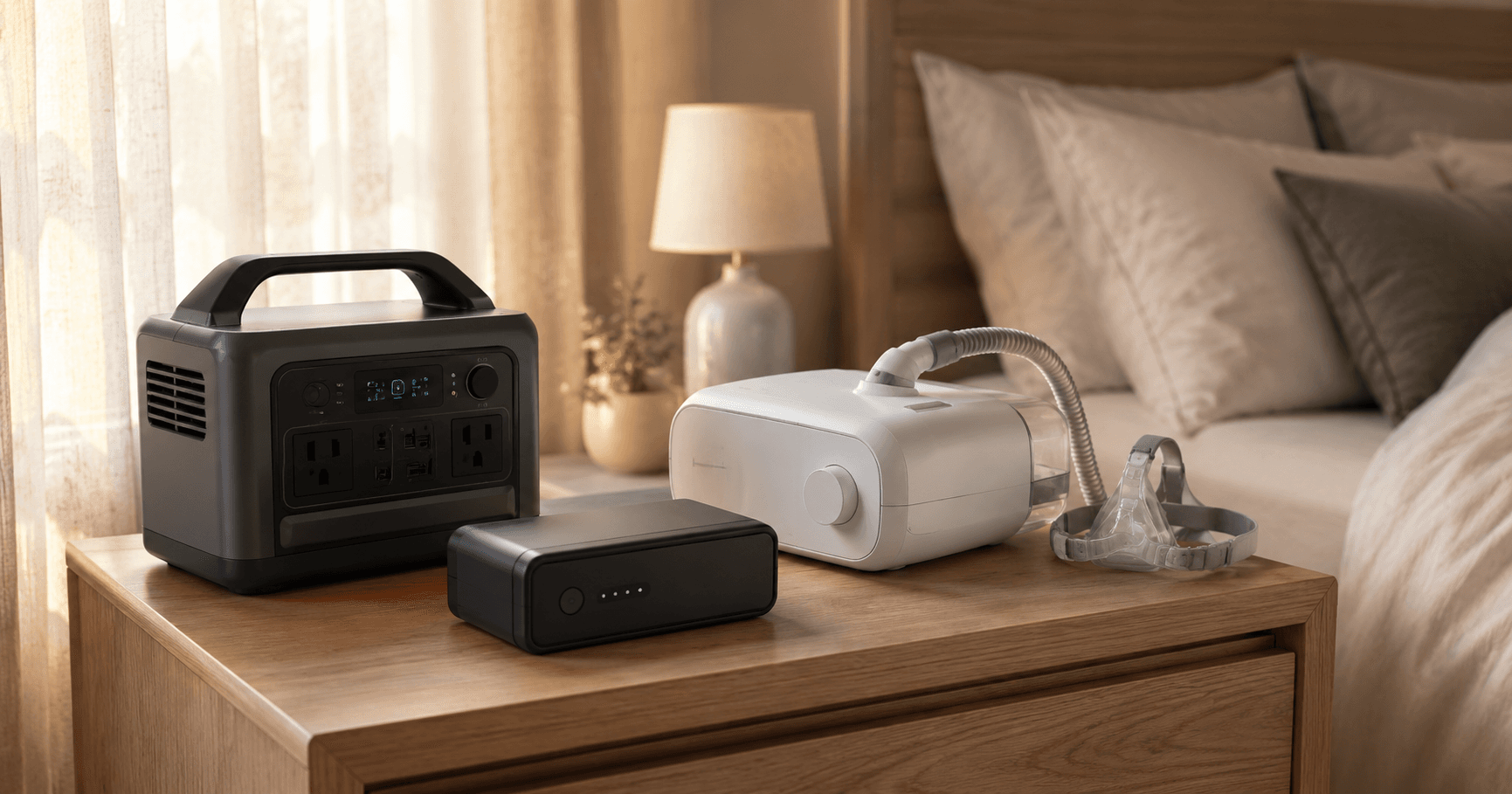
What the Medistrom Pilot-24 Lite is
This Medistrom Pilot-24 Lite review is for anyone who wants a CPAP backup battery that was built specifically for the job, not a generic power station with a sleep apnea machine bolted onto it. The Pilot-24 Lite is a dedicated, DC-output lithium-ion battery designed to keep a 24V CPAP running through a power outage, an overnight camping trip, or a long-haul flight. If you have searched "medistrom pilot 24 lite" looking for whether it actually delivers the runtime it promises and whether it justifies its price, this guide walks through the specs, the watt-hour math, and the trade-offs in plain terms.

Medistrom sells the Pilot in two variants, and getting the right one matters more than almost anything else about this product. The Pilot-12 Lite is for 12V machines, and the Pilot-24 Lite is for 24V machines, which includes the ResMed AirSense 10 and AirSense 11 along with many Philips DreamStation units. Plug a 24V machine into a 12V battery (or the reverse) and it simply will not run correctly, so confirm your device's voltage before you buy. Most ResMed travel and bedside machines are 24V, which is why the Pilot-24 Lite is the version most readers of this site need.
What makes the Pilot-24 Lite different from a portable power station is that it has no AC inverter. It feeds your CPAP directly over a machine-specific DC cord. Skipping the inverter is the whole point: converting battery DC up to wall AC and back down to the DC your CPAP actually uses wastes 10-20% of your stored energy as heat. By delivering DC straight to the machine, the Pilot-24 Lite keeps nearly all of its roughly 97-99Wh available for therapy. If you want the deeper explanation of why a direct connection beats an inverter, our CPAP DC power adapter guide covers the cabling and efficiency in detail.
The battery is rated at approximately 97-99Wh of usable capacity. It charges from the included AC adapter and can optionally be topped up from a compatible solar panel, which is genuinely useful for multi-night off-grid trips. It also works as a passthrough (UPS-style) backup: leave it plugged into the wall with your CPAP connected, and if the power drops in the middle of the night the machine keeps running off the battery without waking you. That single feature is the reason many people buy it for home use rather than travel.
Runtime by CPAP model
Runtime is the number everyone wants, so let's be precise about how it is calculated rather than quoting a single marketing figure. Battery runtime is watt-hours divided by your machine's average watt draw. The Pilot-24 Lite holds about 97-99Wh. A modern CPAP motor running at a typical pressure draws roughly 15-25 watts. That math lands the Pilot-24 Lite in the 6-10 hour range for a full night of therapy with humidification turned off.
The catch is the heated humidifier, which is by far the biggest battery drain in any CPAP setup. A heated humidifier and heated tube can add roughly 15-45 watts on top of the motor, which can cut your runtime by 50-80%. We explain why heat is so expensive in the CPAP humidifier battery drain breakdown, but the short version is: heating elements convert electricity directly into thermal energy, and that is enormously more power-hungry than spinning a small blower motor.
The table below shows estimated runtimes. These are calculated from manufacturer watt-hour specs and typical published power draws, not measured in a lab, so treat them as planning estimates. Your real numbers will vary with pressure setting, leak rate, and room temperature.
| CPAP model | Approx. watt draw (motor only) | Est. runtime, no humidifier | Est. runtime, with heated humidifier |
|---|---|---|---|
| ResMed AirSense 11 | ~18-22 W | ~5-6 hrs | ~2-3 hrs |
| ResMed AirSense 10 | ~18-22 W | ~5-6 hrs | ~2-3 hrs |
| ResMed AirMini | ~10-15 W | ~7-9 hrs | N/A (waterless humidification) |
| Philips DreamStation (24V) | ~15-20 W | ~5-7 hrs | ~2-3.5 hrs |
| ResMed AirCurve (BiPAP) | ~20-28 W | ~4-5 hrs | ~1.5-2.5 hrs |
A few practical notes on reading that table. Higher pressures and APAP machines that ramp up draw more power, so a person prescribed 14 cmH2O will see shorter runtimes than someone at 7 cmH2O. The AirMini is unusually efficient because it uses waterless (HumidX) humidification, so there is no heating element to feed. And if your nightly numbers fall short, the single most effective change is to turn off heated humidification and the heated tube when running on battery — a cool-passover humidifier or going dry for a night costs you nothing in runtime. To size a battery around your specific pressure and humidifier habits, walk through our CPAP battery sizing guide.
Size weight and portability
For travel, the Pilot-24 Lite's biggest selling point after efficiency is its size and weight. It weighs roughly 1.3-1.5 lb and is small enough to slip into a CPAP travel case alongside the machine itself. Compare that to a portable power station rated for a similar single night of CPAP use, which typically weighs 6-8 lb or more because it carries a heavier cell pack plus an inverter, AC outlets, and a display.
That weight difference is the entire argument for a dedicated battery on a trip. When you are carrying a CPAP machine, a mask, a hose, and the rest of your luggage through an airport, a 1.5 lb battery is almost unnoticeable, while a 7 lb power station is a real burden and eats into your carry-on allowance. The Pilot-24 Lite is purpose-built to be the lightest way to power exactly one CPAP for one night.
The trade-off is flexibility. The Pilot-24 Lite powers your CPAP and nothing else — there are no USB ports or AC outlets to charge a phone, run a CPAP heated blanket, or power a laptop. It is a single-purpose tool, and it is excellent at that one purpose. If you want a battery that can also keep your other devices alive, that is where a power station starts to make sense, and we compare the categories directly in UPS vs CPAP battery vs power station. For a broader shortlist of lightweight options, see our roundup of the best CPAP travel batteries.
On chemistry: the Pilot-24 Lite uses lithium-ion (NMC) cells, which is what keeps it so light and compact. That is a deliberate trade-off against the heavier LiFePO4 chemistry found in many power stations, which lasts more charge cycles and runs cooler but weighs considerably more for the same capacity. If you want to understand which chemistry suits your use case, our LiFePO4 vs Li-ion CPAP battery comparison lays out the lifespan, weight, and safety differences.
TSA and airline compliance
This is where dedicated CPAP batteries shine, and it is a major reason to choose the Pilot-24 Lite for air travel. At approximately 97Wh, the Pilot-24 Lite sits under the 100Wh FAA limit for lithium batteries. That threshold matters enormously: batteries rated at or below 100Wh can be carried on board with no airline approval required, while batteries between 100Wh and 160Wh need advance airline permission and are limited in quantity. Anything over 160Wh is banned from passenger aircraft entirely.
Many portable power stations land in the 200-300Wh range or higher, which means they cannot legally fly in your carry-on at all. The Pilot-24 Lite's deliberate sub-100Wh design is what makes it flight-friendly out of the box.
A couple of practical rules to remember at the airport. Lithium batteries must travel in your carry-on, never in checked luggage — this applies to the Pilot-24 Lite and to spare batteries of any kind. And while CPAP machines themselves are medical devices that do not count against your carry-on bag limit, it helps to keep the battery's spec label visible in case a screener asks about the watt-hour rating. For the full set of checkpoint rules, machine handling, and documentation tips, read our CPAP on an airplane: TSA rules guide before you fly.
Is it worth the price vs a power station
Here is the honest trade-off. The Pilot-24 Lite is more expensive per watt-hour than a general-purpose power station, and it powers only your CPAP. So why would you pay more for less flexibility? Because for the specific job of "keep my CPAP running for a night," it does three things a power station cannot match: it is dramatically lighter, it is legal to fly, and its inverter-free DC connection wastes almost no energy.
A power station like the EcoFlow RIVER 2 or Anker SOLIX C300 makes the opposite trade. You get more total capacity, AC outlets and USB ports to run anything, and a lower cost per watt-hour — but you carry several extra pounds, you lose 10-20% of capacity to inverter conversion, and most units cannot board a plane.


Anker SOLIX C300 Portable Power Station (288Wh LiFePO4, 300W AC)
$329.99
Check price on AmazonThe comparison table below frames the decision around how you actually intend to use the battery.
| Factor | Medistrom Pilot-24 Lite | EcoFlow RIVER 2 | Anker SOLIX C300 |
|---|---|---|---|
| Capacity | ~97-99 Wh | ~256 Wh | 288 Wh |
| Weight | ~1.3-1.5 lb | ~7.7 lb | ~9.1 lb |
| Connection to CPAP | Direct DC (no inverter) | AC outlet + inverter | AC outlet + inverter |
| Efficiency to CPAP | Very high (~90%+) | Lower (inverter loss) | Lower (inverter loss) |
| Flies in carry-on | Yes (under 100Wh) | No (over 100Wh) | No (over 100Wh) |
| Powers other devices | No (CPAP only) | Yes (AC + USB) | Yes (AC + USB) |
| Best for | Air travel, light packing, UPS backup | Home backup, road trips, multi-device | Home backup (UPS under 10ms), camping, multi-device |
The decision really comes down to this. Choose the Pilot-24 Lite if you fly with your CPAP, want the lightest possible kit, or want a clean bedside UPS that only ever needs to power your machine. Choose a power station if you are mainly worried about home outages, drive rather than fly, or want one battery that can also charge phones, lights, and laptops during a camping trip or emergency. For a head-to-head of the strongest options across both categories, see our best CPAP backup batteries roundup, and if you specifically own a newer ResMed machine, our pick for the best battery for the ResMed AirSense 11 narrows it down further.
One more honest caveat worth weighing: because the Pilot-24 Lite holds under 100Wh, it is genuinely a single-night battery for most users with the humidifier off. If you need multiple nights off-grid, you will either carry a second Pilot, add a solar panel to recharge during the day, or step up to a larger power station and accept the weight. Set expectations accordingly and the Pilot-24 Lite is a superb specialist tool.
Related reading
- Best battery for the ResMed AirSense 11
- Freedom V2 CPAP battery review
- LiFePO4 vs Li-ion CPAP batteries
- CPAP battery sizing guide
What to do next
If you fly with your CPAP, pack light, or want a quiet bedside UPS, the Pilot-24 Lite is one of the easiest dedicated batteries to recommend — just confirm you are buying the 24V version for your machine and plan around a single humidifier-off night per charge. If you would rather have extra capacity and the ability to power other devices, compare it against the strongest power stations in our best CPAP backup batteries guide before you decide.