Freedom V2 overview and what is included
If you are shopping for a Freedom V2 CPAP battery, you are almost certainly trying to solve one of two problems: keeping therapy running during a power outage, or staying compliant on the road and in the air without dragging a wall outlet everywhere you go. The Freedom V² from EXP/Freedom is built squarely for the second job. It is a portable lithium-ion battery that sits under the 100 watt-hour (Wh) threshold, which is the magic number for air travel — it qualifies as FAA carry-on compliant with no airline pre-approval required. This Freedom V2 review walks through what is in the box, the runtime you can realistically expect from the watt-hour math, machine compatibility, and how it stacks up against the popular Medistrom Pilot-24 Lite.
Availability update (September 2026): The Freedom V2 is currently unavailable on Amazon. We've kept this review up for owners and anyone who finds one elsewhere, but if you want to buy new today, our recommended in-stock alternative is the EASYLONGER ES270.
The in-stock alternative: EASYLONGER ES270
The ES270 takes the same approach as the Freedom V2: a 99.9Wh lithium-ion pack that flies in your carry-on without airline approval and runs your CPAP over direct DC. Its output is selectable (12V, 19V, or 24V), and it ships with four CPAP cables covering the ResMed AirMini, AirSense 10/11, AirCurve 10/11, Luna TravelPAP, and Philips DreamStation 1/2.
| Feature | Freedom V2 | EASYLONGER ES270 |
|---|---|---|
| Capacity | 99.9Wh Li-ion | 99.9Wh Li-ion |
| FAA carry-on | Yes, no approval | Yes, no approval |
| DC output | 12-24V, up to 8A | 12V, 19V, or 24V (up to 5A at 12V) |
| USB-C | No PD hub | 100W USB-C PD (in and out) |
| Weight | 1.7 lb | 1.3 lb |
| Price | $349 – $399 when listed | $139.99 |
| AirSense 11 runtime, dry (~18W) | ~5 hrs | ~4.7-5 hrs |
| Availability | Unavailable on Amazon | In stock |
The trade-offs: the ES270 is not hot-swappable like the Freedom's multi-battery kits, it has no Fisher & Paykel cable in the box, and its review base is much smaller (about 150 ratings versus roughly 570 for the Freedom). Its pass-through function keeps a CPAP running while the battery charges, but it is not a certified UPS. At about 40% of the Freedom's price, it's the pick for most travelers.

EASYLONGER ES270 CPAP Battery (99.9Wh, FAA Carry-On)
$139.99
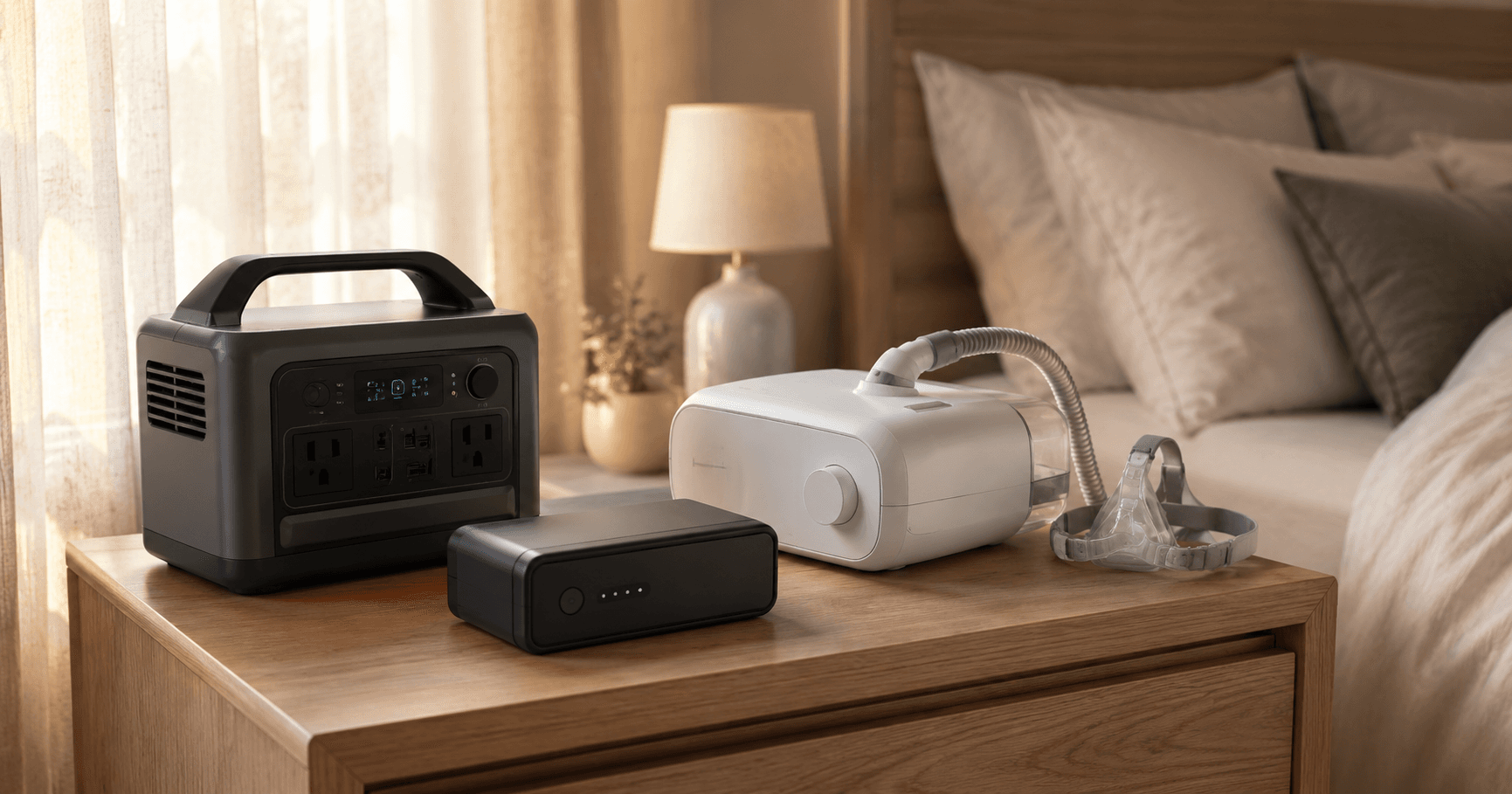
Check price on AmazonOut of the box, the Freedom V2 is a self-contained pack with a built-in capacity display, a DC output port, and a set of adapter/output cables designed to mate with the most common CPAP machines on the market. Because it outputs DC power directly to the machine rather than running an inverter, it avoids the conversion losses that drain AC-style power stations faster — more of the stored energy actually reaches your blower motor. You also get the charging brick to top the unit back up from a wall outlet, and the platform is solar-compatible, so a folding panel can recharge it off-grid for camping, van life, or extended outages.
A quick note on the lineup: the Freedom V2 is the larger, travel-focused member of the family. Its smaller sibling, the Freedom CPAP Battery 160Wh, trades airline carry-on simplicity for more raw capacity — we cover that trade-off near the end of this review. If you want to understand how capacity translates into nights of therapy before you buy, our CPAP battery sizing guide breaks down the watt-hour math in detail.
Runtime by CPAP machine
The single most important thing to understand about Freedom CPAP battery runtime — or any CPAP battery — is that the advertised "5 to 8 hours" is not a fixed number. It is the output of a simple equation:
Estimated runtime (hours) ≈ usable watt-hours ÷ average machine watt draw
A CPAP blower motor on its own typically draws around 15 to 25 watts, depending on your prescribed pressure, mask leak, and whether you use a ramp. That modest draw is why a sub-100Wh pack can carry you through a full night. The variable that wrecks runtime is the heated humidifier, which adds roughly 10 to 30 watts depending on the setting. Add a heated tube and the draw climbs further. In practice, running humidification cuts your runtime by 50 to 80 percent — turning a comfortable full night into a few hours. This is the number-one mistake first-time buyers make, and it is why every figure below is split into two columns.
The table below uses the Freedom V2's sub-100Wh capacity and the typical watt-draw ranges above to estimate runtime. Treat these as planning estimates derived from watt-hour math, not lab-measured guarantees — your pressure setting, mask fit, altitude, and ambient temperature all move the needle.
| CPAP machine | Typical watt draw (blower) | Est. runtime — no humidifier | Est. runtime — with humidifier |
|---|---|---|---|
| ResMed AirSense 10 | ~18-23W | ~5-7 hrs | ~1.5-3 hrs |
| ResMed AirSense 11 | ~18-23W | ~5-7 hrs | ~1.5-3 hrs |
| ResMed AirMini (travel) | ~15-20W | ~6-8 hrs | n/a (waterless HME) |
| Philips DreamStation | ~20-25W | ~5-6.5 hrs | ~1.5-3 hrs |
| Philips DreamStation 2 | ~18-24W | ~5-7 hrs | ~1.5-3 hrs |
| Fisher & Paykel SleepStyle | ~20-25W | ~5-6.5 hrs | ~1.5-3 hrs |
Two practical takeaways. First, the ResMed AirMini is the runtime champion on this list precisely because it has no built-in water chamber — it uses a waterless heat-and-moisture exchange (HME) filter, so there is no heating element to feed. Second, if you need humidification and multi-night runtime, no sub-100Wh battery will deliver it; you either turn humidification off, switch to an HME, or step up to a larger pack. For a deeper look at why the water chamber is such an energy hog, see our breakdown of how the CPAP humidifier drains your battery.
Compatibility with ResMed Philips and Fisher Paykel
Freedom V2 compatibility is one of its strongest selling points. Rather than locking you into a single brand, the Freedom V2 ships with — or supports — adapter cables for the three CPAP manufacturers that dominate the market:
- ResMed — AirSense 10, AirSense 11, and the travel-sized AirMini. The AirSense line uses ResMed's proprietary DC barrel input, so you will use the matching ResMed output cable rather than the machine's stock AC brick. The AirMini uses its own connector; confirm the AirMini-specific cable is included or available for your kit.
- Philips Respironics — DreamStation and DreamStation 2. Both accept a DC input cable that bypasses the AC power supply, which is the most efficient way to run them off a battery.
- Fisher & Paykel — SleepStyle and compatible models via the appropriate DC adapter.
The reason DC-to-DC matters: running your machine through its normal AC adapter would force the battery to invert DC to AC, only for the machine's brick to rectify it back to DC — a double conversion that wastes 15 to 25 percent of your stored energy as heat. The Freedom V2's direct-DC cables skip that round trip, which is a big part of how it stretches a small pack into a full night. Before you order, verify the exact connector for your specific model and firmware revision, since manufacturers occasionally change barrel sizes between generations. Our CPAP battery compatibility guide is the fastest way to match your machine to the right cable. If you also own a USB-C laptop or phone you want to keep topped up, note that the Freedom platform is DC-output focused rather than a full USB-C PD hub — read more in our USB-C PD CPAP power explainer.
Travel and TSA compliance
This is where the Freedom V2 earns its name. The FAA and TSA allow spare lithium-ion batteries in carry-on baggage only, and they sort those batteries by watt-hour rating:
- Under 100Wh — permitted in carry-on with no airline approval needed. This is the Freedom V2's category.
- 100Wh to 160Wh — permitted, but requires airline approval, and you are usually limited to two spares.
- Over 160Wh — prohibited on passenger aircraft entirely.
Because the Freedom V2 sits under 100Wh, you can pack it in your carry-on and walk through security without a special form, a gate-agent conversation, or a quantity restriction. That regulatory simplicity is the entire point of the V2 versus its higher-capacity sibling. CPAP machines themselves are recognized medical devices and do not count against your carry-on bag limit — but the battery is still treated as a standard lithium battery, so it must come out of checked luggage. For the full pre-flight checklist, including how to handle the machine at the security checkpoint and overseas voltage, read our guide to CPAP on an airplane and TSA rules.
A few field-tested tips: keep the battery in your personal item where you can reach it, store the adapter cables with the pack so you are not hunting for the right tip at 30,000 feet, and recharge fully before you leave since outlets are scarce on long-haul flights. If you fly often, the V2 belongs on any shortlist of the best CPAP travel batteries for exactly these reasons.
Freedom V2 vs Medistrom Pilot-24 Lite
The most common cross-shop for the Freedom V2 is the Medistrom Pilot-24 Lite, another sub-100Wh, travel-class CPAP battery. Both are FAA carry-on compliant and both run your machine over DC. The differences come down to ecosystem, cabling, and extras.

| Feature | Freedom V2 | Medistrom Pilot-24 Lite |
|---|---|---|
| Capacity class | Under 100Wh (FAA carry-on) | Under 100Wh (FAA carry-on) |
| Output | Direct DC to CPAP | Direct DC to CPAP |
| Est. runtime, no humidifier | ~5-8 hrs | ~5-8 hrs |
| Brand compatibility | ResMed, Philips, Fisher & Paykel via adapters | ResMed, Philips (model-specific Pilot kits) |
| Pass-through / UPS use | Battery-first travel focus | Optional Backup Power Supply (BPS) for auto-failover |
| Solar charging | Yes, solar-compatible platform | Limited, via DC input |
| Best for | Multi-brand travelers wanting one flexible pack | Owners wanting a tightly matched ResMed/Philips kit |
The honest summary: these two are closely matched on the things that matter most — capacity, no-humidifier runtime, and airline legality. The Medistrom system leans into a tightly integrated, model-specific kit and an optional Backup Power Supply accessory that turns it into an automatic uninterruptible supply for outages. The Freedom V2 leans into multi-brand flexibility and solar recharging, which makes it the more versatile pick if you own more than one machine or want off-grid charging. For a full standalone teardown of the Medistrom option, see our dedicated Medistrom Pilot-24 review. And if you are weighing battery chemistry for longevity and safety, our LiFePO4 vs Li-ion CPAP battery comparison explains why both of these lithium-ion packs prioritize light weight over the longer cycle life of LiFePO4.
Freedom CPAP Battery 160Wh — the compact alternative
If the Freedom V2 is more capacity than you need, the Freedom CPAP Battery 160Wh is a lighter, more affordable option for short trips and emergency backup.

The naming here can be confusing, so read the watt-hour rating carefully. At 160Wh, this sibling holds more energy than the sub-100Wh V2, which means longer runtime — but it lands in the 100-160Wh airline tier, so you would need airline approval to fly with it and are limited to two spares. That makes the 160Wh pack a strong choice for home backup, road trips, and car-based travel where you are not boarding a plane, while the V2 remains the no-hassle flying companion. Choose based on how you travel, not just on price.
Related reading
- Best CPAP backup batteries — full comparison of our top-rated picks
- CPAP battery sizing guide — match watt-hours to your nights of runtime
- Solar charging for CPAP batteries — go off-grid with the V2
- CPAP on an airplane and TSA rules — fly without surprises at security
What to do next
The Freedom V2 was an easy recommendation for hassle-free air travel: it clears the FAA 100Wh line, runs ResMed, Philips, and Fisher & Paykel machines over efficient DC, and delivers a realistic 5 to 8 hours of therapy with humidification off. With the V2 currently unavailable on Amazon, the EASYLONGER ES270 is the in-stock pick with the same 99.9Wh carry-on capacity, bundled ResMed and Philips cables, and 100W USB-C, for $139.99. If you need longer runtime for car trips or home outages, the 160Wh Freedom sibling is the better value. Either way, turn off your heated humidifier or switch to an HME on battery nights to protect your runtime. Ready to compare options side by side? Start with our best CPAP backup batteries guide, then size your pack with the CPAP battery sizing guide.