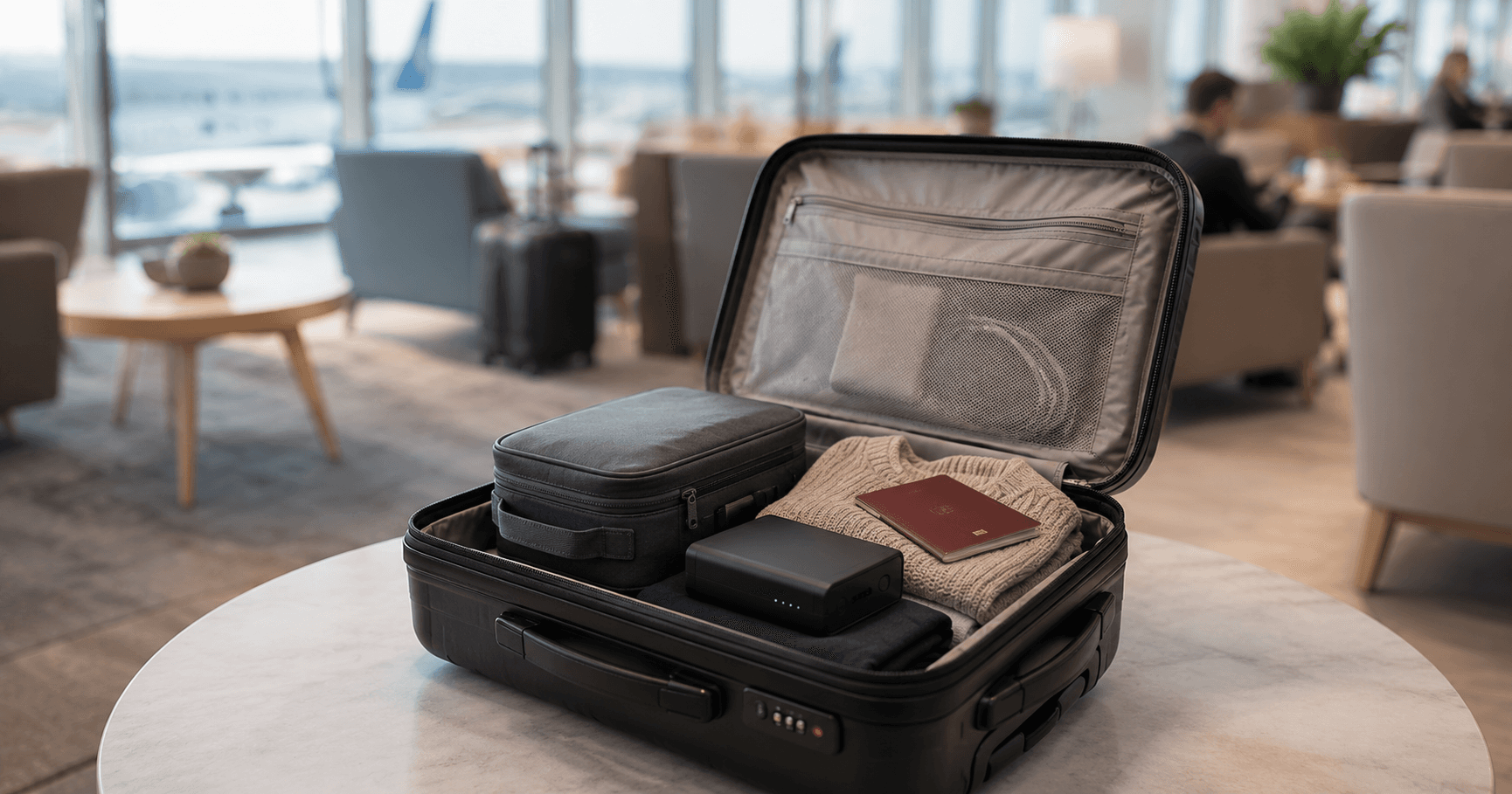
Bringing your CPAP on an airplane sounds simple until you are standing at the security line wondering whether your machine counts as a carry-on, or staring at a battery box trying to figure out if TSA will confiscate it at the checkpoint. Flying with a CPAP is completely allowed and millions of travelers do it every year, but the rules around the machine, the lithium battery, and in-flight use trip people up constantly. The good news: once you understand three things — how TSA screens the device, the FAA watt-hour limits for batteries, and what each airline permits onboard — air travel with sleep apnea therapy becomes routine. This guide walks through every rule so you arrive rested and never lose a night of therapy to a paperwork problem.
TSA screening rules for CPAP machines
Your CPAP machine is classified as a medical device, and that classification carries real benefits at the airport. The single most important one: a CPAP does not count toward your carry-on bag limit. You can bring your standard carry-on, a personal item, and your CPAP in its own travel case, and no US airline or TSA agent will count the machine against your allowance. Always carry the machine on the plane — never check it. Checked luggage gets thrown, crushed, soaked, and occasionally lost, and a CPAP is both fragile and expensive to replace mid-trip.
At the checkpoint, the rule mirrors the one for laptops: the CPAP must come out of its bag and into its own bin for X-ray screening. The humidifier chamber and tubing can usually stay in the case, but the main unit needs a clear path through the scanner. To avoid the machine touching the bin directly, place it in a clear plastic bag of your own before setting it down. TSA officers are trained to recognize CPAPs, but the dense motor and electronics can still prompt a closer look.
If you would rather not send your machine through the X-ray at all, you have the right to request a visual or hand inspection instead. Tell the officer at the start of screening that you have a medical device you would prefer to have inspected by hand. This takes a few extra minutes and may involve an explosive-trace-detection swab, so give yourself buffer time. Either way, a sturdy dedicated CPAP travel case makes the whole process faster, because everything is organized and the machine lifts out cleanly. For a step-by-step pre-flight routine, our CPAP battery travel checklist covers exactly what to pack and in what order.
FAA lithium battery limits explained
This is where most travelers get tripped up. CPAP backup batteries are lithium-ion, and the FAA regulates lithium batteries by watt-hours (Wh), not by amp-hours or physical size. The rules are strict and consistent across US carriers, and they exist because lithium cells can overheat. Here is the core framework:
| Battery capacity | FAA / airline status | Where it must travel |
|---|---|---|
| Under 100Wh | Allowed, no approval needed | Carry-on only |
| 100Wh to 160Wh | Allowed with airline approval (limit 2 spares) | Carry-on only |
| Over 160Wh | Prohibited on commercial passenger flights | Not permitted |
Two rules apply to every category. First, spare batteries and power banks must travel in your carry-on, never in checked baggage — a loose lithium battery in the cargo hold is a fire risk the airlines will not accept. Second, terminals should be protected from short-circuiting, so keep batteries in their original case or tape over exposed contacts.
To know which bracket your battery falls into, find its watt-hour rating, usually printed on the label or in the manual. If only amp-hours and voltage are listed, multiply them: Wh = Ah multiplied by V. A 24Ah battery at 12V is roughly 288Wh — well over the limit — while most purpose-built CPAP travel batteries are deliberately engineered to stay under 100Wh so they sail through without approval. Here is how common options compare:
| Example battery | Approx. capacity | FAA bracket |
|---|---|---|
| Medistrom Pilot-24 Lite | ~95Wh | Under 100Wh — no approval |
| Medistrom Pilot-24 (full) | ~99Wh | Under 100Wh — no approval |
| EASYLONGER ES270 | ~99.9Wh | Under 100Wh — no approval |
| RoyPow 12V power bank | ~86.6Wh | Under 100Wh — no approval |
| Large power stations (240Wh+) | 240Wh and up | Over 160Wh — prohibited |
Notice the pattern: the leading CPAP travel batteries cluster just under the 100Wh line on purpose. That is why a single station works for one or two nights but a giant 500Wh unit gets left at home. Our best CPAP travel batteries roundup and the Medistrom Pilot-24 review dig into real options that clear security cleanly, and the Freedom V2 battery review covers that modular design, though the Freedom V2 is currently unavailable on Amazon — the EASYLONGER ES270 in the table above is the closest in-stock 99.9Wh CPAP battery.
Airline-specific CPAP policies
The FAA sets the battery floor, but individual airlines layer their own paperwork and in-flight rules on top. Across major US carriers — American, Delta, United, Southwest, Alaska, and JetBlue — the universal truths are that the CPAP rides free as a medical device and lithium batteries follow the watt-hour table above. The differences show up in the details.
If your battery is in the 100-160Wh range, you must notify the airline in advance and get approval; most carriers cap you at two such spare batteries. Below 100Wh, no notification is required, though carrying the manufacturer's Wh documentation is still smart in case a gate agent asks. Some airlines also limit how many power banks you can bring regardless of size, so check the specific carrier's "medical devices" or "battery-powered devices" page before you fly internationally, where rules can be even tighter.
A few practical habits smooth things over with any airline:
- Carry a printout of the battery's watt-hour rating or a photo of the label. If the number is borderline, this is your proof.
- Bring a doctor's note or prescription for the CPAP. It is rarely required, but it instantly resolves questions about why you are carrying medical equipment and extra batteries.
- Tell the crew if you plan to use the machine in flight so they know what the device is when they see it running.
Cruise travelers face a related but separate set of rules around outlets and distilled water — our CPAP on a cruise ship guide covers those if a sailing is part of your trip.
How to pack your CPAP and battery for flights


RoyPow 86.58Wh Power Bank with Regulated 12V Car Socket (30W USB-C PD)
$77.89
Check price on AmazonPacking well is what separates a smooth trip from a stressful one. Keep the machine, mask, tubing, and battery together in a single dedicated case so nothing gets left in an overhead bin or forgotten at security. The Medistrom Pilot-24 Lite shown above is a favorite for air travel precisely because it sits comfortably under the 100Wh threshold while still powering most travel CPAPs for a full night. The RoyPow power bank is a cheaper (~$78) under-100Wh option with a regulated 12V car socket: paired with a 12V CPAP cable or converter it runs an AirSense 11 for about 4 hours dry — roughly half a night — or close to a full night on an AirMini-class machine. It has no AC outlet and its USB-C port tops out at 30W, so treat it as a top-up battery rather than a full-night solution for a home-size CPAP.
A few packing rules worth committing to memory:
- Battery in the carry-on, always. This is non-negotiable for lithium cells and is the rule airlines enforce most strictly.
- Drain the humidifier chamber before you fly. Empty it completely so it does not leak in the pressurized cabin, and refill with distilled water at your destination.
- Protect the terminals. Use the original sleeve or a small bag so loose keys and coins cannot short the contacts.
- Charge everything to full the night before. A topped-off battery means a missed outlet at the gate or a delayed flight will not cost you a night of therapy.
To match a battery to your specific machine and pressure settings, run the numbers using our CPAP battery sizing guide. And if you are unsure whether a given battery physically connects to your model, the CPAP battery compatibility guide lists which adapters and DC cables you need.
Can you use a CPAP on the plane
Yes, you can run a CPAP during the flight — but only if you follow the airline's onboard rules, and they are more restrictive than the rules for simply transporting the device. Under FAA guidance, a CPAP used in flight must carry FAA-approved labeling (the same standard applied to portable oxygen concentrators), and most airlines require you to ask the crew before powering it on. Many carriers also restrict overnight medical-device use to battery power only, because in-seat AC and USB outlets are not guaranteed to be available, switched on, or capable of running a CPAP reliably for hours.
That battery-only reality is why runtime math matters. Runtime is simply watt-hours divided by the watts your machine draws. A 95Wh battery powering a travel CPAP that pulls around 10 watts at a modest pressure could run roughly 9 to 10 hours in theory — but heated humidification and higher pressures can double or triple draw, slashing real-world runtime. Turning off the heated humidifier and heated tubing in flight is the single biggest way to stretch a charge. For a long-haul flight, size your battery for the actual hours of sleep you expect, then add margin; the CPAP battery sizing guide shows how to plug in your machine's wattage.
If you mainly want therapy on the ground at your destination and not in the air, a compact battery-powered travel CPAP machine paired with a sub-100Wh battery is the simplest setup — light enough to carry on, efficient enough to last the night, and fully compliant with the rules above.
Related reading
- Best CPAP travel batteries
- CPAP battery travel checklist
- Best CPAP travel case for 2026
- CPAP battery sizing guide
What to do next
Flying with a CPAP comes down to one decision you make before you ever reach the airport: choosing a battery that clears the FAA's 100Wh line and lasts the nights you need. Get that right and TSA screening, airline approval, and in-flight use all fall into place. If you're ready to pick a battery, check our best CPAP backup batteries guide for side-by-side comparisons.