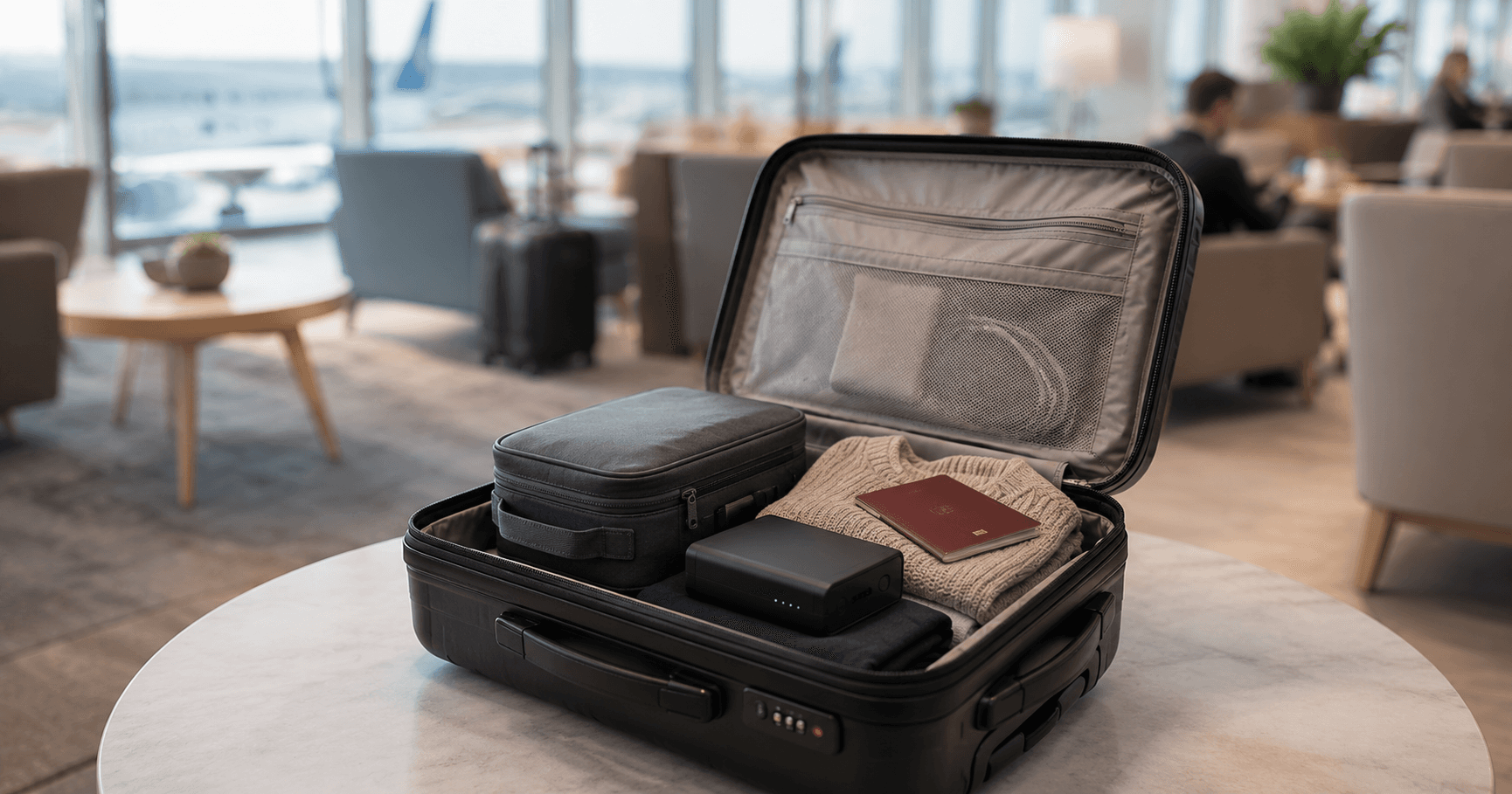
A CPAP battery for a cruise ship is a sealed lithium-iron-phosphate or lithium-ion pack, typically 99–160 Wh, that powers your CPAP for one full night without shore power. Cruise lines treat these batteries differently than airlines do: there is no published watt-hour ceiling on Royal Caribbean, Carnival, NCL, Princess, MSC, or Disney, but embarkation security can still pull anything that looks like a power-tool battery. Below is the cabin-by-cabin policy matrix nobody else publishes, plus six batteries that consistently clear the gangway.
In short: Bring a CPAP-labeled battery at 160 Wh or less, file the Special Needs form 30 days out, request distilled water in advance, and leave the power strip at home — every major line confiscates them.
Why cruise CPAP rules differ from flight rules
Cruise CPAP rules are looser than flight rules in one direction and stricter in another. The FAA caps lithium batteries at 100 Wh (or 160 Wh with airline approval) for carry-on. No cruise line publishes an equivalent ceiling, which means a 288 Wh pack that gets you grounded at the TSA checkpoint will sail through cruise security if it's clearly medical and UL-listed.
The flip side: cruise ships run on floating-neutral electrical systems where a standard household surge protector can create a ground fault and trip cabin breakers. Every major line confiscates power strips with surge protection at embarkation — it's the single most common item pulled at the gangway. If you fly to the port, plan around the stricter airline 160 Wh cap from our CPAP-on-airplane TSA guide, then bring that same battery onto the ship.
Cruise line CPAP policies at a glance (2026)
Every major cruise line allows CPAP machines in the cabin without question — the differences are in distilled water, outlet count, and pre-notification paperwork. Here's the 2026 matrix:
| Line | CPAP Policy | Free Distilled Water | Cabin Outlets (typical) | Pre-Notify Required | Published Wh Limit |
|---|---|---|---|---|---|
| Royal Caribbean | Allowed, extension cord on request | Yes (free, request 30 days out) | 1× US 110V + 1× EU 220V | Special Needs Form, 30 days | None — UL-listed only |
| Carnival | Allowed | Paid — about $6/gal via Fun Shops | 1× US 110V (older), 2× US + EU (Excel-class) | Recommended | None |
| Norwegian (NCL) | Allowed | Yes (free via Access Desk) | 1× US + 1× EU near desk | Special Needs form | None |
| Princess | Allowed | Yes (free) | 1× US + 1× EU desk-side | Accessible Travel form | None |
| MSC | Allowed | Inconsistent — treat as BYO | 1× EU Schuko, 1× US on newer ships | Yes (medical form) | None |
| Disney | Allowed | Yes (free, pre-request) | 1× US + 1× EU near bed (Wish/Treasure class) | Yes (Special Services) | None |
Embarkation security can still pull any battery at their discretion. Stay at or below 160 Wh, keep the watt-hour label visible, and carry a doctor's letter naming the CPAP machine model. For a deeper checklist by destination, see our sleep apnea travel guide.
Cabin outlet reality: what's actually in the wall
Most cruise cabins built before 2010 have exactly one outlet, mounted at the vanity or desk — nowhere near the bed. That means an extension cord is mandatory, and it has to be the right kind.
Power strips with surge protection are confiscated on every major line. Royal Caribbean, Carnival, NCL, Princess, MSC, and Disney all explicitly ban them because shipboard floating-neutral wiring treats a surge protector's MOV as a fault and can trip the cabin's GFCI breaker mid-cruise. Bring a non-surge USB-A/USB-C cube and a 6-foot non-surge extension cord instead, or request the line's loaner cord at guest services.
The 2026 Excel-class Carnival ships (Mardi Gras, Celebration, Jubilee) and Disney's Wish/Treasure are the exceptions: they ship with bedside USB-A ports and at least one outlet within four feet of the headboard. Older Carnival Conquest-class and most pre-2015 Royal ships still leave you reaching across the room. Review our CPAP battery safety guide for non-surge product picks.
Distilled water: the real cruise CPAP problem
Distilled water — not power — is the bottleneck for most cruisers. Tap water and bottled mineral water destroy humidifier chambers within three nights through calcium scaling, and you cannot top off from the cabin sink without voiding your machine's warranty.
How much distilled water you actually need per night
A ResMed AirSense 11 humidifier set to level 4 evaporates roughly 12 oz of water across an 8-hour night. A Philips DreamStation 2 at the same setting uses about 10 oz. That means a 1-gallon jug (128 oz) lasts a single cruiser 10–12 nights at moderate humidity, or 5–6 nights for a couple sharing the cabin with two machines. For a 7-night Caribbean cruise, request one gallon per CPAP user; for a 14-night transatlantic, request two. Always pad the math by 20% — heat and dry air-conditioning push consumption higher than the bench numbers suggest.
Per-line pricing and request mechanics
Royal Caribbean, NCL, Princess, and Disney supply distilled water free if you submit the medical request 30 days before sailing — call it in to the Access Desk or Special Needs department, then confirm by email 14 days out and again 48 hours before boarding. Carnival charges through the Fun Shops portal at roughly $6.00 per gallon, and room service will deliver an additional gallon mid-cruise for the same price billed to your Sail & Sign card. MSC's policy varies ship-to-ship — Yacht Club guests usually get it free, but standard balcony guests are quoted €4–€7 per liter (about $15 – $25 per gallon), so assume bring-your-own. Pack a sealed 1-gallon jug in your checked bag — every major line allows up to 12 sealed liters of non-alcoholic liquid in luggage, well above what you'll need.
The smart-water-bottle workaround
If your water request doesn't show up at boarding (it happens on roughly 1 in 10 cruises despite the paperwork), the bridge fix is Smartwater or any vapor-distilled bottled water sold in the ship's gift shop or at port stops. Vapor-distilled water has been boiled to steam and recondensed, so it carries the same near-zero mineral content as the supermarket distilled gallon — safe for the humidifier chamber. Aquafina and Dasani are reverse-osmosis filtered (close, but not bench-distilled) and acceptable as a 2–3 night emergency only. Avoid Evian, Fiji, San Pellegrino, and any "spring" or "mineral" water — these carry 50–500 ppm of dissolved minerals that scale your chamber within nights.
What happens if you skip distilled (the buildup timeline)
Run tap water or mineral water through a heated humidifier and you'll see visible white calcium ring on the chamber base by night 3. By night 5, the heater plate develops a chalky crust that reduces evaporation efficiency by roughly 30%, so the same humidifier setting delivers drier air and a sore throat. By night 7, mineral deposits can clog the float sensor that prevents overfilling, and ResMed and Philips both consider this a user-induced failure that voids the humidifier warranty (chambers run $40 – $80 to replace). On the same night you'd also see white particulate aerosolizing into the hose — not dangerous in the short term, but enough to irritate sensitive airways.
The fallback if water arrives late: turn the humidifier off and use heated tubing, which also stretches a 160 Wh battery from one night to nearly two. We cover the runtime math in our CPAP humidifier battery drain guide.
Best CPAP batteries for cruises in 2026 (ranked)
The best CPAP battery for a cruise ship is the 99.9 Wh EASYLONGER ES270 — it weighs 1.3 lb, stays under the 100 Wh FAA limit so it doubles as your flight battery on the way to the port, and includes CPAP cables for the ResMed AirMini, AirSense 10/11, AirCurve 10/11, and Philips DreamStation 1/2. On an AirSense 11 with the humidifier off it runs about 4.7–5 hours over DC (EASYLONGER quotes about 8 hours on an AirMini), so on a full-size machine treat it as a bridge for keycard cutoffs rather than a whole-night battery. (We previously recommended the Freedom V2 here; it is currently unavailable on Amazon.) Here's how the cruise-tested shortlist ranks:
| Product | Wh | Weight | Flight Legal | Under-Bed Fit | Best For |
|---|---|---|---|---|---|
| EASYLONGER ES270 | 99.9 | 1.3 lb | Yes (under 100 Wh) | Yes | 7-night Caribbean — top pick |
| Medistrom Pilot-24 Lite | 99 | 1.4 lb | Yes | Yes | 3–4 night short cruises, dual flight + sea |
| Bluetti X30 CPAP Battery | 297 | 7.9 lb | No | Yes | ResMed owners, humidifier-on nights |
| RoyPow 86Wh Power Bank | 86.6 | 1.4 lb | Yes | Yes | Budget pick, 12V socket + phone charging |
| Anker Solix C300 DC | 288 | 6.5 lb | No | Yes | 14-day repositioning cruise, BiPAP |
| Bluetti AC2A | 204 | 7 lb | No | Yes | Drive-on / homeport cruises only |

EASYLONGER ES270 CPAP Battery (99.9Wh, FAA Carry-On)
$139.99
Check price on AmazonShort cruises (3–4 nights) and dual flight + sea use
If your trip is a quick Bahamas or Mexico run, the 99 Wh Medistrom Pilot-24 Lite is the lightest pick at 1.4 lb and, at $329 – $349, a premium ResMed-native battery that still covers one full night with the humidifier off. It clears both TSA and embarkation without questions.

ResMed AirSense 10 and 11 owners
The Bluetti X30 is a 297 Wh CPAP-focused backup that connects to the ResMed AirSense 10 and 11 via their DC input. With roughly three times the capacity of the flight-legal packs, it comfortably runs a humidifier-on night at pressure 10 — the trade-off is that at 297 Wh it exceeds the 160 Wh aviation cap, so it's a sail-only battery best suited to drive-on cruises. At $279 – $359 and a 4.3-star rating, it's the pick for ResMed owners who want maximum in-cabin runtime.

Budget cruisers
The RoyPow 86Wh power bank is the lowest-cost cruise- and flight-legal option at about $78. Its regulated 12V car socket runs a CPAP through a 12V DC cable for about 4 hours on an AirSense 11 with the humidifier off (roughly a full night on an AirMini-class travel CPAP), and its USB ports recharge your phone and watch from the same pack. It has no AC outlet, and its 4.1-star rating is solid rather than top-tier.

RoyPow 86.58Wh Power Bank with Regulated 12V Car Socket (30W USB-C PD)
$77.89
Check price on AmazonDrive-on / homeport cruises (no flight)
If you're driving to Port Canaveral, Galveston, or Long Beach, skip the 160 Wh aviation cap entirely. The 288 Wh Anker Solix C300 DC runs two full nights at pressure 12 with the humidifier on — useful for repositioning cruises and BiPAP users.

For the full sizing math, see our CPAP battery runtime calculator and the broader best CPAP travel batteries roundup.
How to pre-clear your CPAP with the cruise line
File the medical accommodation form 30 days before sailing — every major line has one, and they all close intake at the 14-day mark. The form is the difference between distilled water waiting in your cabin at embarkation and a $30 ship-store run on night 1.
The exact form, contact, and timeline per line
- Royal Caribbean — Special Needs at Sea Form. Email
special_needs@rccl.comor call 866-592-7225. Intake closes 30 days before sailing for water/oxygen requests, 14 days for cord-only requests. - Carnival — Guest Special Needs department. Email
guestaccess@carnival.comor call 800-438-6744 ext. 70025. Distilled water must be added to Fun Shops 7 days out; in-cabin cord delivery is night-of. - Norwegian (NCL) — Access Desk Special Needs form (in your MyNCL account under "Edit Reservation"). Email
accessdesk@ncl.comor call 866-584-9756. Hard cutoff is 14 days; water requests confirmed by Access Desk reply email. - Princess — Accessible Travel Request via Cruise Personalizer. Email
access@princesscruises.comor call 800-774-6237. 30-day cutoff. Specify gallons + extension cord on the same form. - MSC — Medical Form via Guest Services (downloadable PDF on MSC's accessibility page). Email
specialneeds@msccruisesusa.comor fax 954-653-9510. 21-day cutoff. Always request a Yacht Club upgrade quote in the same email — MSC waives water fees for Yacht Club guests. - Disney — Special Services Request via Disney Cruise Line website (Guest Services menu). Email
specialservices@disneycruise.comor call 407-566-3602. 30-day cutoff. Distilled water arrives pre-stocked in-cabin at embarkation.
Copy-paste email template (works for all lines)
Subject: Medical accommodation request — Booking [XXXXXX], [Sail date]
Hello Access Desk,
I am a CPAP user sailing under booking [XXXXXX] on [ship name, sail date]. I'd like to request the following medical accommodations:
- One gallon of distilled water per three nights of sailing (total: [N] gallons), delivered in-cabin at embarkation.
- One non-surge 6-foot extension cord delivered to the cabin at embarkation.
- Acknowledgement that I will be carrying a [Brand/Model] CPAP machine and a [160 Wh / Wh value] UL-listed CPAP-labeled lithium battery in my carry-on for use in the cabin.
A signed letter from my prescribing physician naming the device is attached. Please confirm by reply email and let me know if any additional paperwork is required.
Thank you, [Name, Stateroom #, Phone]
Send it 30 days out, follow up at 14 days, and print the confirmation reply to bring to the gangway. Bring a one-paragraph doctor's letter naming the device — embarkation security accepts it as proof of medical necessity. Our CPAP battery travel checklist has the printable template.
Overnight power loss in cabins (and how to bridge it)
Most cruise cabins keep outlets live 24/7 — roughly 95% of staterooms across the major lines have always-on power based on cruiser-reported electrical surveys. The exceptions are concentrated in a few specific ship classes and cabin categories.
Which cabins actually cut power overnight
- MSC Lirica-class (Lirica, Opera, Armonia, Sinfonia) — every interior and ocean-view cabin uses a keycard slot that cuts all outlets when the card is pulled. Yacht Club suites on the same ships are on a separate always-on circuit and do not cut.
- MSC Musica-class (Musica, Orchestra, Poesia, Magnifica) — same keycard cutoff in standard cabins, but the desk USB ports on newer refits remain live.
- Carnival Sunshine, Carnival Ecstasy, Carnival Inspiration (pre-2018 retrofits) — interior and ocean-view cabins on decks 1–6 use the keycard slot; balconies and suites are always-on.
- Older MSC and Costa charters sold as bareboat in Europe — assume keycard cutoff unless your booking confirms otherwise.
- Always-on across the fleet: Royal Caribbean (all classes), NCL (all classes), Princess (all classes), Disney (Wish, Treasure, Dream, Fantasy, Wonder, Magic), Carnival Excel-class (Mardi Gras, Celebration, Jubilee), and Carnival Vista-class (Vista, Horizon, Panorama).
Night-bridging math
Cabin power is cut for the time you're at dinner, in the casino, or off-ship in port. On a typical sea day, that's roughly 4–6 hours away from the room; on a port day, it can be 8–10 hours. If your CPAP battery is supplying the machine during sleep (8 hours at pressure 10 with humidifier off = ~50 Wh), it needs to fully recharge between use windows. The 99.9 Wh EASYLONGER ES270 recharges over its 100W USB-C PD input, so with a matching 100W USB-C wall charger it can top back up during a 4-hour dinner+show. Drop the daytime window below 3 hours and the pack starts the next night at 70–80% — still enough for a humidifier-off run but tight for humidifier-on use.
Two practical fixes
First, insert a spare cruise keycard, an expired hotel keycard, or a folded piece of cardboard cut to credit-card dimensions into the slot so the cabin reads "occupied" 24/7. Housekeeping won't pull it because they use their master card. Second, run your CPAP off a battery in UPS pass-through mode — the EASYLONGER ES270 (pass-through charging, not a certified UPS) and Bluetti X30 both support this. The pack charges from the wall when power is on and seamlessly takes over the moment outlets cut, so the CPAP never sees an interruption. See our CPAP power outage guide for the wiring.
International voltage and overnight excursions
Cruise ships supply both 110V US and 220V EU outlets in most modern cabins, and every ResMed, Philips, and Löwenstein power brick made since 2015 is dual-voltage (100–240V). You do not need a voltage converter — only the plug-shape adapter, which the cabin already provides.
The exception is overnight off-ship excursions: Norwegian fjord cabins, Antarctica zodiac landings, Galapagos panga overnights, and Alaskan glacier lodges. Shore power is unreliable to nonexistent, so a 99 Wh pack covers one night and a 160 Wh pack covers two. Always recharge during the day back on the ship. For voltage edge cases, see our international travel CPAP voltage guide.
Related reading
- CPAP on airplane: TSA rules and battery limits
- Sleep apnea travel guide
- International travel CPAP voltage
- CPAP battery travel checklist
- Best CPAP travel batteries
- CPAP battery sizing guide
- CPAP battery runtime calculator
What to do next
Thirty-plus days before sailing, file the Special Needs form with your cruise line and request distilled water in writing. Seven days out, confirm the water request and pack a sealed 1-gallon jug in checked luggage as backup. Day-of, put your CPAP battery in your carry-on (never checked), make sure the watt-hour label is visible, and bring your doctor's letter to the gangway.
The single best purchase for almost every cruiser is the 99.9 Wh EASYLONGER ES270 — it clears both TSA and cruise embarkation, fits under the cabin bed, runs an AirMini for about a night (or an AirSense 11 for about 5 hours dry), and bridges keycard power cutoffs with pass-through charging.
EASYLONGER ES270 CPAP Battery (99.9Wh, FAA Carry-On)
$139.99
Check price on Amazon