Before you pack
Traveling with a CPAP is straightforward once you know the rules. The battery is the part that requires planning — different airlines, countries, and camping scenarios all have different constraints.
This checklist covers everything you need to know.
Air travel checklist
FAA battery size rules
| Battery capacity | Carry-on | Checked bag | Approval needed |
|---|---|---|---|
| Under 100 Wh | ✅ Allowed | ❌ Never | None |
| 100–160 Wh | ✅ Allowed | ❌ Never | Airline approval |
| Over 160 Wh | ❌ Banned | ❌ Banned | N/A |
How to find your battery's watt-hours
Look for "Wh" on the battery label. If only voltage (V) and amp-hours (Ah) are listed:
Wh = V × Ah
Example: 14.4V × 6.75Ah = 97.2 Wh (under 100 Wh — good to fly)
Pre-flight checklist
- Confirm battery is under 100 Wh (or get airline approval for 100–160 Wh)
- Pack battery in carry-on — never checked luggage
- Tape over exposed battery terminals (TSA recommendation)
- Carry a copy of your CPAP prescription or doctor's letter
- Label the CPAP bag as medical equipment
- Download your CPAP machine's compliance data (some airlines request this)

- Charge battery to 100% before departure
- Bring your wall charger for recharging at your destination
- Check your airline's specific lithium battery policy online before flying
At the airport
- TSA screening: The CPAP machine goes through the X-ray like a laptop. You may be asked to remove it from the bag. The battery is fine in your carry-on.
- At the gate: Inform the gate agent you have medical equipment. It won't count toward your bag limit.
- On the plane: Your CPAP bag goes in the overhead bin or under the seat. Some planes have seatback power outlets — bring your AC adapter.
Camping and off-grid checklist
- Calculate your nightly Wh needs (see our battery sizing guide)
- Charge battery fully before departure
- Bring a solar panel if camping 2+ nights without power
- Pack a DC-direct cable for maximum efficiency (skip the inverter)
- Bring an HME filter as a humidifier alternative (saves power)
- Test your full setup at home before your trip
- Pack a backup USB power bank for charging your phone separately
For detailed camping setups, check our complete CPAP camping setup guide. If you're heading into the backcountry, our CPAP backpacking guide covers ultralight setups where every ounce counts.
Solar charging tips
A 100 W portable solar panel produces roughly 300–400 Wh on a sunny day (4–5 peak sun hours). That's enough to recharge most mid-range batteries in one day.
Tips:
- Position the panel facing the sun by 10 AM
- Clear any shade — even partial shade cuts output dramatically
- Expect 50–70% of rated panel wattage in real conditions
- Foldable panels pack easier; rigid panels perform better
Road trip checklist
- Bring a 12V car charger cable for your battery
- Install a cigarette lighter adapter or use a 12V DC-DC converter for direct CPAP power
- Consider a battery isolator if running CPAP from your vehicle battery overnight
- Keep a backup portable battery fully charged in case you can't run the vehicle
- Test the car charging setup before your trip to confirm adequate power delivery
International travel tips
- Many countries use 220–240V power — confirm your CPAP power supply is dual-voltage (most are 100–240V)
- Bring a plug adapter for your destination country
- Some countries have strict lithium battery import rules — check before flying
- Carry your CPAP prescription in English and the local language if possible
Packing strategy
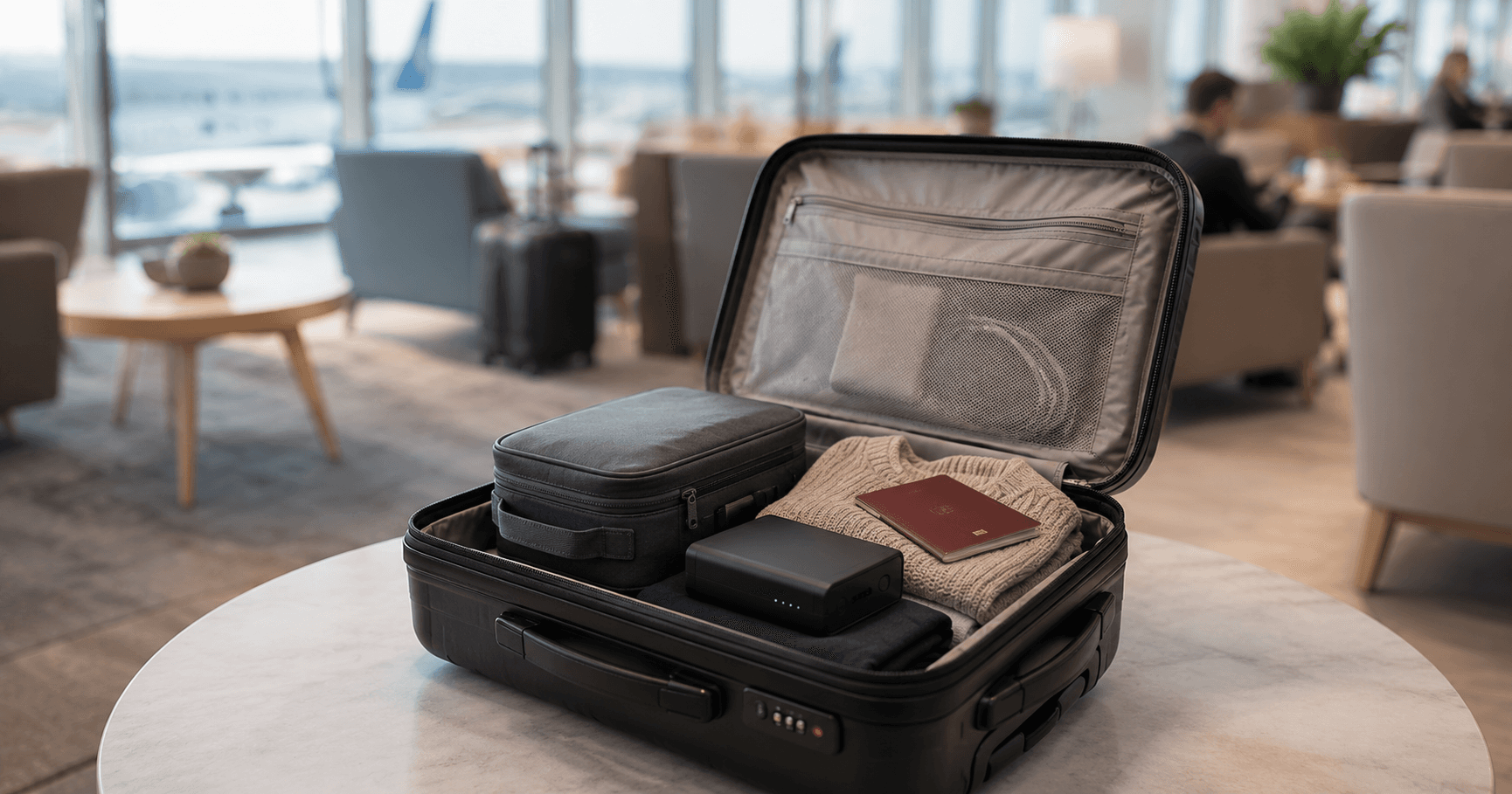
- CPAP machine — in its own soft case or a dedicated travel bag
- Battery — in carry-on, ideally in the same bag as the CPAP
- Cables — DC power cable, AC adapter, car charger
- Accessories — mask, hose, HME filter, distilled water packets
- Documents — prescription, compliance report, battery Wh rating
Pro tip: Keep everything CPAP-related in one bag. If you need to pull it out at security or the gate, you want it accessible without digging through your luggage.
Recommended gear
Batteries
- Medistrom Pilot-24 Lite — purpose-built CPAP battery, FAA-approved (97 Wh), ideal for air travel. View on Amazon
- EcoFlow RIVER 2 — 256 Wh portable power station with fast charging and UPS mode. View on Amazon
- Anker SOLIX C300 — 288 Wh LiFePO4 power station with three AC outlets, great for weekend trips. View on Amazon
- Bluetti Elite 30 V2 — 288 Wh LiFePO4 with 10 ms UPS mode for reliable failover. View on Amazon
Solar panels
- Jackery SolarSaga 100W Light — 100W bifacial foldable panel (~$249) for multi-night camping trips. View on Amazon
- EcoFlow 110W Solar Panel — IP68-rated foldable panel with carry case. View on Amazon
Get the complete travel kit planner
Want all of this in one printable PDF? The CPAP Travel Battery Kit Planner ($7.99) includes battery comparison tables, a runtime calculator, decision matrix, packing checklists for every scenario, and a troubleshooting guide. Get the PDF on Gumroad
Related guides
- Best CPAP Backup Batteries — top battery picks for every use case
- CPAP Camping Setup — complete off-grid guide with solar charging
- CPAP Battery Sizing Guide — calculate your watt-hour needs
- CPAP Battery Compatibility Guide — which batteries work with your machine
- CPAP Batteries 101 — everything beginners need to know
Related reading
- CPAP on Airplane: TSA & FAA Rules — what screeners and airlines actually check
- International Travel CPAP Voltage — plug adapters and dual-voltage gotchas
- Best CPAP Travel Batteries — under-100 Wh picks built for flying
- CPAP Camping Setup — tent, trailer, and car-camp power plans
- Solar Charging Your CPAP Battery — staying charged off-grid
What to do next
Print this checklist and run it the night before every trip until it's muscle memory. Catching a forgotten DC cable or an oversized battery at home is trivial; catching it at a TSA counter or a remote campsite is not.
- Confirm your battery's Wh rating and write it on a label stuck to the unit
- Save your airline's lithium-battery policy page to your phone before heading to the airport
- Do a full dry-run night on battery at home before your first trip
Affiliate disclosure
This site may include affiliate links. If you buy through links, we may earn a commission at no extra cost to you.