Why camping with a CPAP is easier than you think
Camping with CPAP is no longer the logistical nightmare it used to be. A battery powered CPAP for camping now fits in a daypack: a 240–500 Wh LiFePO4 power station weighs 7–13 lb, runs a full night on a single charge, and recharges from a 100W foldable solar panel in 3–5 hours of direct sun. As of April 2026, the category has matured — Jackery, EcoFlow, Bluetti, and Goal Zero all ship sub-8-lb lithium-iron units purpose-built for overnight medical loads.
Whether you're tent camping for a weekend, boondocking in an RV, or heading deep into the backcountry, there's a CPAP for camping setup that works. This guide covers real runtime numbers by CPAP model, 2026 battery comparisons ranked by camping suitability, solar panel integration, and complete packing checklists for every scenario.
The bottom line: For weekend tent camping, pair a ResMed AirMini or AirSense 11 with a 240–300 Wh LiFePO4 power station, skip the heated humidifier, and use a DC-direct cable. That setup gets most campers through 1–2 nights without recharging.
If you're new to CPAP batteries in general, start with our CPAP Batteries 101 guide for the basics, then come back here for the camping-specific details. We also have a dedicated CPAP battery camping guide for 2026 with the latest product picks if you want a quick-reference version, plus a CPAP battery runtime calculator to dial in your exact Wh needs.
Quick decision matrix: which setup fits your trip?
This guide is the "how-to" companion to our 2026 buyer's guide — that one ranks the products, this one walks through the actual setup. Use the matrix below to figure out which setup section to focus on:
| Trip Type | Battery Capacity | Weight Budget | Charging Strategy | Jump To Section |
|---|---|---|---|---|
| 1-night car-accessible camping | 240–300 Wh | Doesn't matter | Pre-charge at home only | Tent setup |
| 2–3 night tent camping | 300–500 Wh + solar | Under 15 lb | 100W solar, midday recharge | Tent + solar |
| Weekend car camping (with kids/gear) | 500–1,000 Wh | Doesn't matter | Car alternator on drive in | Car camping |
| RV / van life | House battery (200+ Ah) | Already mounted | Roof solar + shore power | RV section |
| Backcountry hike-in | 98–200 Wh dedicated CPAP battery | Under 3 lb | Pre-charge only, no recharge | Backpacking |
| Cold-weather (below 40°F) | +30% capacity buffer | Insulation needed | Keep battery warm | Cold weather addons |
This decision tree drives every other choice in this guide. Wrong battery for the trip type is the #1 reason CPAP campers wake up at 3 AM to a dead machine.
Real runtime numbers by CPAP model
Before picking a battery, you need to know how much power your specific CPAP draws. Here are typical numbers (without heated humidifier, at typical therapy pressures). Runtimes assume about 88% of the rated capacity is usable over a DC cable:
| CPAP Model | Avg. Power Draw (no humidifier) | 240 Wh Battery Runtime | 500 Wh Battery Runtime |
|---|---|---|---|
| ResMed AirMini | ~15 W | ~14 hours | ~29 hours |
| ResMed AirSense 11 | ~18 W (15–30 W depending on pressure) | ~11.5 hours | ~24 hours |
| DreamStation 2 | ~28 W | ~7.5 hours | ~15.5 hours |
A few things to note:
- A heated humidifier adds roughly 10–30 W depending on the setting — an AirSense 11 draws about 28 W total with the humidifier on low and about 48 W on high. With a heated tube too, total draw can reach ~50–70 W at high settings (ResMed lists the AirSense 11's maximum at 73.2 W), cutting runtime by half or more.
- EPR and AutoSet modes cause slight power spikes when the motor ramps up, but the average stays close to the numbers above.
- Cold temperatures reduce battery capacity by 10–20%. If you're camping in 40°F weather, plan for shorter runtimes.
- DC-direct power is 10–15% more efficient than running through the AC inverter. Always use a DC cable when your battery supports it.
For a deeper dive into the math, check out our CPAP battery sizing guide. It walks you through the exact Wh calculation for your machine and settings.
Battery options ranked by camping suitability
Not all power stations are created equal for camping. Weight, portability, solar input capability, and ruggedness matter when you're hauling gear to a campsite. Here's how the top options stack up:
| Battery | Capacity | Weight | Solar Input | Best For | Price |
|---|---|---|---|---|---|
| EcoFlow RIVER 2 | 256 Wh | 7.7 lb | 110W max | 1-night, fast solar recharge | $179 – $239 |
| Bluetti Elite 30 V2 | 288 Wh | 8.6 lb | 600W max | Compact LiFePO4, UPS + solar input | $199 – $249 |
| Jackery Explorer 300 | 292 Wh | 7.5 lb | 100W max | Lightweight weekend trips | $199 – $299 |
| Jackery Explorer 500 v2 | 512 Wh | 13.3 lb | 100W max | Multi-night without solar | ~$359 |
| Goal Zero Yeti 300 | 297 Wh | 8.1 lb | 100W max | Fast-charge LiFePO4 (50 min to full) | $299 – $349 |
| Anker SOLIX C300 | 288 Wh | 9.1 lb | 100W max | 1-night camping that doubles as a home UPS | $329.99 |
| BLUETTI Elite 100 V2 | 1,024 Wh | 25.3 lb | 1,000W max | Multi-night car camping, big solar input | $499 – $899 |
For weekend tent camping, the EcoFlow RIVER 2 is the top pick. It's light enough to carry comfortably, has LiFePO4 chemistry (lasts 3,000+ charge cycles), and recharges fast via solar. With an AirMini, you'll get two full nights on a single charge.
For extended camping or higher-draw machines, the Jackery Explorer 500 v2 (512 Wh) gives you 2–3 nights with an AirSense 11 (no humidifier) without needing to recharge at all.
For multi-night car camping, the BLUETTI Elite 100 V2 (1,024 Wh LiFePO4) runs an AirSense 11 without the humidifier for about 48–51 hours on a 12V DC converter, roughly six nights, or 26–29 hours through AC with the humidifier on low. It takes up to 1,000W of solar, so a decent panel array can refill it in a day. At 25.3 lb it stays in the car, not the tent, and it is not water-resistant, so keep it under cover and off wet ground.
For fast turnarounds, the Goal Zero Yeti 300 (LiFePO4, 297 Wh) is the 2026 standout. It charges 0–100% in about 50 minutes from a wall outlet and delivers 4,000+ cycle life, so if you're car-camping near a trailhead with a quick outlet stop, you can top off during a lunch break. Its IPX4 rating also shrugs off a light rain. For a deeper breakdown of why LiFePO4 is the preferred chemistry for camping CPAP use, see our LiFePO4 vs Li-Ion CPAP battery comparison.
For backpackers counting ounces, consider a dedicated CPAP battery like the Medistrom Pilot-24 Lite (only 1.5 lb, 98 Wh). It won't power a full-size CPAP for long, but it handles the AirMini for a single night. Check our CPAP backpacking guide for ultralight setups.


BLUETTI Elite 100 V2 Portable Power Station (1024Wh LiFePO4, 1800W)
$499 – $899
Check price on AmazonFor a full ranking of every battery we've tested, see our best CPAP backup batteries roundup. You can also browse our best CPAP travel batteries list if you need something FAA-approved for flying to your camping destination.
Tent camping vs. RV camping: different power needs
The camping setup that works for you depends entirely on how you camp. Tent campers need lightweight, portable solutions. RV and car campers can use larger, heavier batteries and even plug into shore power.
Tent camping
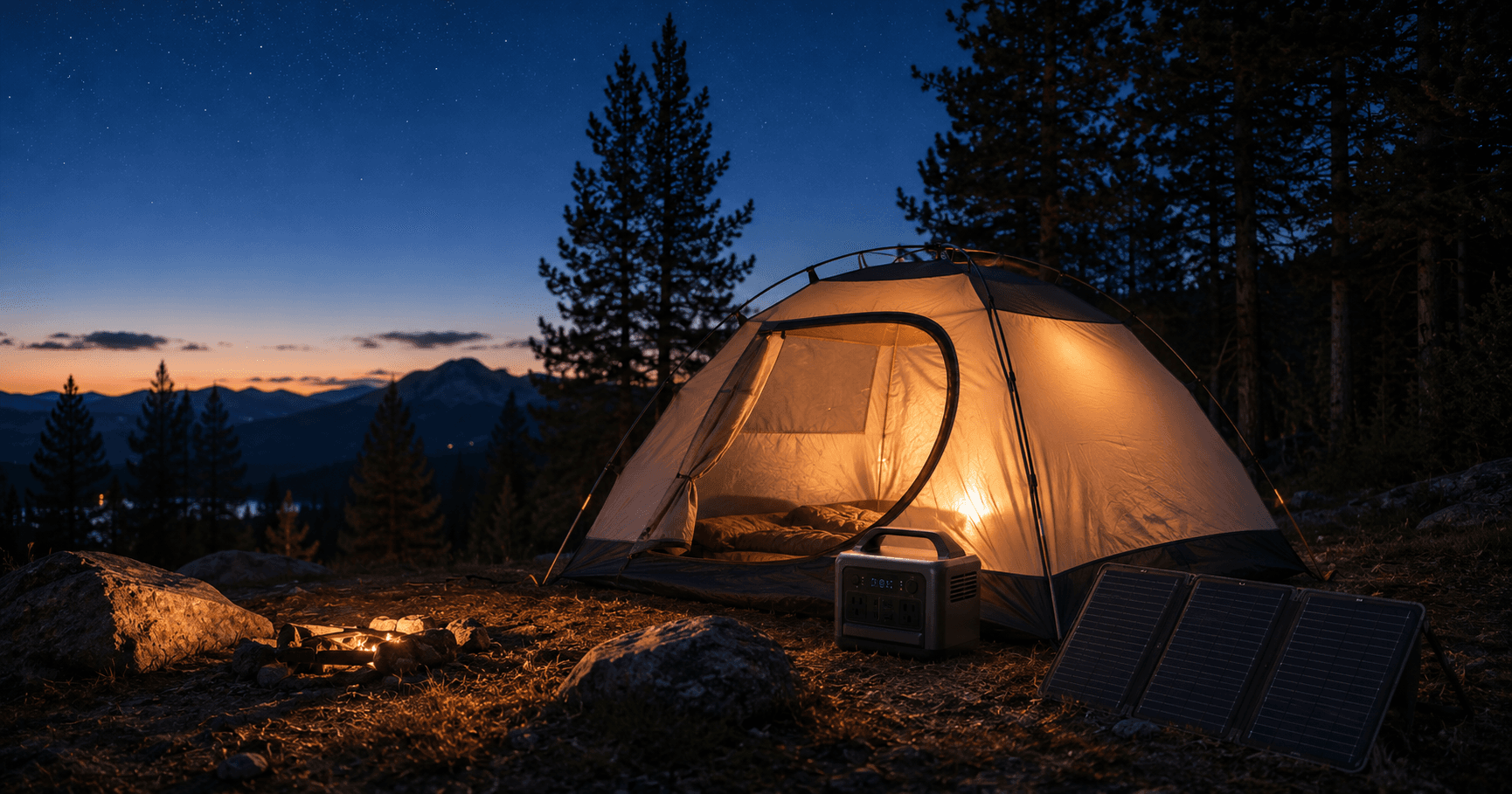
Tent camping is the most challenging scenario for CPAP power because you're carrying everything yourself (or at least from your car to the campsite). Here's what to prioritize:
- Weight matters. Keep your total CPAP kit under 15 lb if possible. An AirMini (0.66 lb) plus a Jackery Explorer 300 (7.5 lb) comes in around 8 lb before cables and accessories.
- Skip the humidifier. Use an HME filter instead. It adds zero power draw and weighs almost nothing. You'll save roughly 10–30 W of continuous draw, which can mean the difference between your battery lasting the whole night or dying at 4 AM.
- Keep the battery inside your tent. Lithium batteries lose capacity in cold temperatures. On chilly nights, tuck the battery inside your sleeping bag vestibule or next to your body warmth.
- Elevate the CPAP. Place it on a small camp table, overturned bin, or inside the lid of a hard case. Keeping it off the ground prevents dirt and moisture from getting into the intake filter.
- Protect from condensation. If you do run the humidifier in cold weather, the warm, humidified air it produces can condense inside the hose ("rainout"). A fleece hose cover (about $15) on an unheated hose helps, and so does turning the humidity down.
Car camping
Car camping is the easiest CPAP scenario because you have your vehicle nearby:
- Bring a bigger battery. Weight doesn't matter as much when you're only carrying it 50 feet from the car. A 500 Wh unit gives you 2–3 nights without recharging.
- Charge from your car. Most power stations include a 12V car charging cable. Drive to the trailhead or into town, and your battery charges while you drive.
- Run directly from the car (with caution). You can plug a DC cable into your car's 12V outlet and run the CPAP all night, but this risks draining your starter battery. Use a battery isolator or voltage monitor to prevent a dead car in the morning.
- Consider a battery isolator. A dual-battery isolator ($30 – $60) lets you add a second battery to your vehicle dedicated to CPAP power, completely separate from your starter battery.
RV and van camping
RV campers have the most options:
- Shore power. If your campsite has electrical hookups, just plug in your CPAP directly. No battery needed.
- House battery. Most RVs have a 12V house battery system (100–400 Ah). Your CPAP can run directly from this via a DC cable. A 200 Ah lithium house battery holds roughly 2,400 Wh, enough for a week or more of CPAP use.
- Built-in solar. Many RVs come with roof-mounted solar panels that keep the house battery topped off. If yours doesn't, a portable 100W panel on the picnic table works just as well.
- Generator backup. If you're boondocking for weeks, a small inverter generator can recharge your battery bank on cloudy days when solar isn't enough.
The key advantage for RV campers is that you don't need to buy a separate portable power station at all. Your existing house battery system almost certainly has enough capacity. Just grab a DC cable for your specific CPAP model. For help picking the right DC cable for your machine, see our CPAP DC power adapter guide.
Solar panel integration for multi-night camping
For trips longer than one or two nights, solar is a game-changer. Instead of carrying multiple heavy batteries, you carry one battery and one foldable solar panel. The panel recharges your battery during the day while you're hiking, fishing, or relaxing at camp.
How solar recharging works
The concept is simple: your CPAP uses 120–250 Wh per night (depending on model and settings). A 100W solar panel produces roughly 300–500 Wh per day in good sunshine. That means you're generating more power during the day than you use at night.
Here's what a typical solar camping day looks like:
- Morning: Unplug CPAP from battery. Set up solar panel facing east/southeast.
- Midday: Adjust panel to face south for maximum exposure.
- Afternoon: Panel has likely recharged the battery to 80–100%. Angle toward west for the last hour of direct sun.
- Evening: Pack up the panel. Plug CPAP into the fully charged battery. Sleep well.
Best solar panels for CPAP camping
| Panel | Wattage | Weight | Folded Size | Solar Input Compatible With |
|---|---|---|---|---|
| Jackery SolarSaga 100W Light | 100W | 10.3 lb | 24 x 21 x 1.4 in | Jackery power stations |
| EcoFlow 110W Panel | 110W | 8.8 lb | 20.2 x 16.5 x 0.8 in | EcoFlow power stations |
| Bluetti PV100 | 100W | 10.9 lb | 23.4 x 22.2 x 2.2 in | Bluetti power stations |
Compatibility note: Most solar panels use standard MC4 or Anderson connectors, but each brand optimizes for its own ecosystem. A Jackery SolarSaga panel works best with a Jackery power station, and the same goes for EcoFlow and Bluetti. Cross-brand setups are possible with adapter cables, but you may lose some charging efficiency.
Sizing tip: A 100W panel is the sweet spot for most CPAP campers. It recharges a 240–300 Wh battery in about 3–5 hours of direct sunlight. If you're running a humidifier (which can roughly double your power consumption or more), step up to a 200W panel or use two 100W panels side by side.

For a complete walkthrough of solar panel sizing, charge times, and setup tips, read our solar charging CPAP battery guide.
Power optimization tips for camping
Every watt you save extends your battery life. Here are the most effective ways to stretch your runtime:
-
Ditch the heated humidifier. This is the single biggest power saver. An HME filter costs $2–5 each and provides basic moisture exchange without any electricity. You'll cut your power draw by roughly 10–30 W, potentially doubling your battery runtime.
-
Use a DC-direct cable. When your CPAP runs through the battery's AC inverter, you lose 10–15% of the energy to conversion heat. A DC cable (12V or 24V depending on your CPAP) bypasses the inverter entirely. Check our DC power adapter guide to find the right cable for your machine, or see our compatibility guide for a full machine-to-battery matching chart.
-
Lower your pressure if possible. Talk to your sleep doctor about a travel pressure profile. Even dropping 1–2 cm of pressure reduces motor power draw. Don't change settings without medical guidance.
-
Keep the battery warm. Lithium batteries lose 10–20% capacity below 40°F. On cold nights, keep the battery inside your tent, near your body. Never leave it outside overnight in freezing temperatures.
-
Charge fully before leaving home. This sounds obvious, but it's easy to forget. Top off your battery the night before, and if your campsite has a long drive, charge from the car's 12V outlet on the way there.
-
Turn off unnecessary features. Disable the CPAP's display backlight, turn off Bluetooth if you don't need sleep tracking, and disable ramp mode if you fall asleep quickly. These are small savings (1–3 W), but they add up over an 8-hour night.
-
Use AutoSet mode wisely. Auto-adjusting CPAPs ramp pressure up and down throughout the night. If you spend most of the night at lower pressures, AutoSet can actually save power compared to a fixed high pressure. But if your prescription is relatively low already, fixed mode may be slightly more efficient.
Complete packing checklist
Essential gear (every camping trip)
- CPAP machine
- CPAP mask, hose, and filters
- Portable battery (charged to 100%)
- DC power cable for your CPAP model
- HME filter (if skipping humidifier)
- Wall charger for the battery (for pre-trip charging)
- Microfiber cleaning cloth
- Ziplock bags for storing mask and accessories
- Small camp table or flat surface for the CPAP
Multi-night and solar add-ons
- Foldable solar panel (100W+)
- Solar panel cable (usually included with the panel)
- Second battery (for extended trips without reliable sun)
- Battery monitor or watt meter (track real consumption)
- Car charging cable (12V, for recharging while driving)
Cold weather add-ons
- Fleece hose cover (reduces condensation if you run the humidifier)
- Insulated battery sleeve or wrap
- Extra HME filters (they wear out faster in cold, dry air)
Comfort and protection
- Waterproof dry bag or hard case for the CPAP
- Mesh bag for cable organization
- Pre-packaged mask wipes
- Distilled water packets (if using humidifier)
- Extension cord (10–15 ft, for flexible tent placement)
- Pillow with hose-friendly design (a cutout or strap to manage the hose)
Backpacking (ultralight setup)
- ResMed AirMini (0.66 lb)
- Medistrom Pilot-24 Lite or similar compact battery
- Minimalist mask (nasal pillows weigh less than full-face)
- Single HME filter
- Short DC cable
For weight-obsessed backpackers, we break down every gram in our CPAP backpacking guide.
Setting up your CPAP at camp
Tent setup step by step
- Choose your tent placement. Set up the CPAP on the side of the tent where you sleep. Pick a spot where the machine won't get kicked or knocked over during the night.
- Create a flat surface. Use a small folding camp table, an overturned storage bin, or the lid of a hard case. The CPAP needs to be level to prevent water from the humidifier (if you're using one) from flowing into the hose.
- Position the battery nearby. Keep cables short and tidy. Most DC cables are 4–6 ft, so the battery should be within arm's reach of the CPAP.
- Route the hose. Run it from the CPAP to your pillow. Keep it slightly elevated if possible to prevent condensation pooling.
- Set up solar for morning. If you have a solar panel, lean it against a tree or stake it at an angle facing east/southeast. It'll start charging as soon as the sun hits it, even before you wake up.
Tip: Keep the CPAP inside a dry bag or under a tarp during rain. Most CPAP machines are NOT waterproof, even if your battery has a weather resistance rating.
Cold-weather field notes (below 40°F)
Cold camping is where most CPAP setups fail unexpectedly. Lab-rated runtimes assume 70°F. Real overnight performance below freezing is meaningfully different:
- At 32°F: Lithium-ion power stations lose 15–20% of usable capacity. A 256 Wh battery effectively becomes ~205 Wh.
- At 20°F: Loss climbs to 25–35%. LiFePO4 chemistry is more cold-tolerant than Li-ion NMC, but still derates ~15%.
- At 10°F or below: Many BMS (battery management systems) refuse to discharge at all to protect the cells. The battery appears "dead" but recovers fully when warmed.
What actually works:
- Sleep with the battery. Place it inside your sleeping bag against your torso. Body heat keeps it above 50°F all night. (Yes, it's lumpy. You'll get used to it.)
- Pre-warm before bed. Bring the battery into the warm vestibule for 30 minutes before connecting the CPAP.
- Insulate, don't seal. Wrap the battery in a fleece or wool layer, but don't put it inside a sealed plastic bag — condensation will form when you bring it back into warm air.
- Use the heated humidifier as the LAST drop. In cold dry air you'll want it for comfort, but it's the first thing to disable when battery percentage is uncertain.
Condensation and "rainout" prevention
The hose between machine and mask is where warm, humidified air from your CPAP's humidifier meets cold tent air, cools below its dew point, condenses, and dumps water into your nose at 3 AM. ResMed calls this "rainout," and it's one of the most common camping CPAP complaints that has nothing to do with batteries. If you're running dry with an HME instead of the humidifier, there's little water vapor in the hose to condense, so rainout is mainly a humidifier problem. For the full breakdown, see our guide to water in your CPAP hose.
- Turn the humidity down a step or two — the zero-cost, zero-watt first fix, and it saves battery too.
- Keep the machine lower than your head — condensation then drains back toward the humidifier chamber instead of toward your mask.
- Hose cover (insulated fleece sleeve) on unheated tubing — $12–18 on Amazon. It insulates the tube so the air stays warmer on the way to your mask, and it uses zero watts. ResMed recommends tubing wraps for cold rooms.
- Don't bury the hose under your sleeping bag or blankets — Philips warns that covering breathing tubes with a blanket can affect the quality of therapy or injure the user. Use a purpose-made hose cover instead.
- Hose-up routing — clip the hose to a tent loop above your head so any condensation drains back toward the machine instead of toward your face.
- Heated hose users: a heated tube is the manufacturers' recommended rainout fix, but it adds roughly 5–15W (our estimate; neither ResMed nor Philips publishes a tube-only figure), which may not be worth the runtime cost on cold trips. An insulated cover on a non-heated hose plus lower humidity is often a better tradeoff on battery.
Dealing with dirt and dust
Camping exposes your CPAP to more airborne particles than a bedroom. Here's how to keep things clean:
- Use a fine-particle filter. Most CPAPs come with a basic filter, but you can buy hypoallergenic or fine-particle filters that catch more dust and pollen. Bring spares and swap every 2–3 days on dusty campsites.
- Keep the intake facing away from the ground. Elevating the machine helps, but also orient the air intake away from the tent floor where dust settles.
- Wipe down the machine daily. A quick pass with a microfiber cloth keeps grit out of the vents and ports.
- Store the mask in a ziplock bag during the day to keep bugs and dust out. Nobody wants to put on a mask full of gnats at bedtime.
Common mistakes to avoid
Over the years, we've heard from plenty of CPAP campers who learned things the hard way. Here are the most common mistakes:
-
Not testing the setup at home first. Don't wait until you're at the campsite to discover your DC cable doesn't fit or your battery dies after 5 hours. Do a full test run at home: connect everything, run the CPAP all night, and check the battery level in the morning.
-
Relying on the AC inverter. The inverter wastes 10–15% of your battery's capacity as heat. That's an hour or more of lost runtime. Always use a DC cable.
-
Forgetting the humidifier draws massive power. Many campers pack their humidifier out of habit, then wonder why the battery died at 3 AM. If you can tolerate an HME filter, skip the humidifier entirely.
-
Leaving the battery in the cold. A battery sitting outside your tent in 30°F weather might lose 20% of its capacity overnight. Bring it inside.
-
No backup plan. Batteries can fail. Cables can break. Bring a backup power source (even your car's 12V outlet) or at least know where the nearest power outlet is. Some campgrounds have charging stations at the bathhouse.
-
Overestimating solar output. That "100W" panel only hits 100W in perfect conditions (direct noon sun, ideal angle, no clouds). Realistically, expect 60–80% of rated output on a good day, and much less in forests with canopy shade.
FAQ
What is the best battery powered CPAP for camping in 2026?
For 2026, the best battery powered CPAP for camping is a ResMed AirMini (0.66 lb, ~15W draw) paired with a 240–300 Wh LiFePO4 power station like the EcoFlow RIVER 2 or Goal Zero Yeti 300. This combo weighs under 9 lb total, delivers 1–2 full nights per charge without a humidifier, and recharges from a 100W solar panel in 3–5 hours.
Is camping with a CPAP hard?
No. Camping with a CPAP in 2026 takes about 10 minutes of setup: place the machine on a flat surface inside the tent, run a DC cable from a portable battery, and swap the heated humidifier for an HME filter to double runtime. The main adjustments are skipping the humidifier and keeping the battery warm on cold nights.
Can you run a CPAP while tent camping?
Yes. A portable battery rated 200–500 Wh (depending on your pressure and humidifier settings) can power a CPAP for a full night in a tent. Pair with a solar panel for multi-night trips.
How long will a portable battery run a CPAP while camping?
Without a humidifier, a 240 Wh battery runs a ResMed AirMini for about 14 hours and an AirSense 11 for about 11–12 hours. With humidification on, expect roughly half that runtime, or less at high settings.
What's the best portable battery for camping with a CPAP?
For weekend tent camping, the EcoFlow RIVER 2 (256 Wh, 7.7 lb) offers the best mix of portability, solar input, and LiFePO4 longevity. For longer trips, the Jackery Explorer 500 v2 (518 Wh) gives you multi-night capacity. For car camping over several nights, the BLUETTI Elite 100 V2 (1,024 Wh, up to 1,000W solar input) covers about six dry nights on DC; keep it covered, since it isn't water-resistant.
Can I charge my CPAP battery with a solar panel?
Yes. Most portable power stations from Jackery, EcoFlow, and Bluetti accept solar input. A 100W foldable panel can recharge a 250 Wh battery in 3–5 hours of direct sunlight. See our solar charging guide for the full setup walkthrough.
Do I need a humidifier when camping with a CPAP?
Not necessarily. An HME (heat moisture exchanger) filter provides basic moisture without using any power. Skipping the heated humidifier can double your battery runtime, which matters on multi-night camping trips.
Is a portable power station or a dedicated CPAP battery better for camping?
For tent camping, a dedicated CPAP battery like the Medistrom Pilot-24 Lite is lighter (1.5 lb vs 7+ lb) and uses DC-direct power for better efficiency. For car or RV camping where weight doesn't matter, a portable power station (250–500 Wh) offers more capacity, solar charging, and can charge phones and other devices too.
Can I bring a CPAP battery on an airplane to fly to a camping trip?
Yes, most CPAP batteries under 100 Wh are FAA approved for carry-on without restrictions. Batteries between 100–160 Wh require airline approval. Power stations over 160 Wh (like the Jackery Explorer 500 v2) cannot fly and must be shipped or purchased at your destination. See our CPAP on airplane TSA rules guide for the full breakdown.
What to do next
- Pick your battery. Use our CPAP battery runtime calculator or our CPAP battery sizing guide to calculate the exact Wh you need for your machine and settings.
- Test at home. Run your full camping setup for one night at home before your trip. Check battery level in the morning.
- Add solar for multi-night trips. A 100W foldable panel pays for itself on the second camping trip by eliminating the need for a second battery.
- Check our 2026 camping battery picks for the latest product recommendations and deals.
Related reading
- Best CPAP Backup Batteries: top battery picks ranked by runtime and weight
- CPAP Battery Sizing Guide: calculate exactly how many Wh you need
- Solar Charging Your CPAP Battery: panel sizing, charge times, and off-grid setup
- CPAP Backpacking Guide: ultralight setups for trail camping
- Best CPAP Travel Batteries: FAA-compliant batteries for flying to camping trips
- CPAP Battery Camping Guide 2026: latest product picks for this year
- CPAP Battery Runtime Calculator: plug in your model and settings for exact Wh numbers
- LiFePO4 vs Li-Ion CPAP Battery: why LiFePO4 is the preferred chemistry for camping
- CPAP DC Power Adapter Guide: find the right DC cable for your machine
- CPAP Travel Checklist: FAA rules, TSA tips, and packing strategies
- CPAP Batteries 101: everything beginners need to know
Affiliate disclosure
This site may include affiliate links. If you buy through links, we may earn a commission at no extra cost to you.