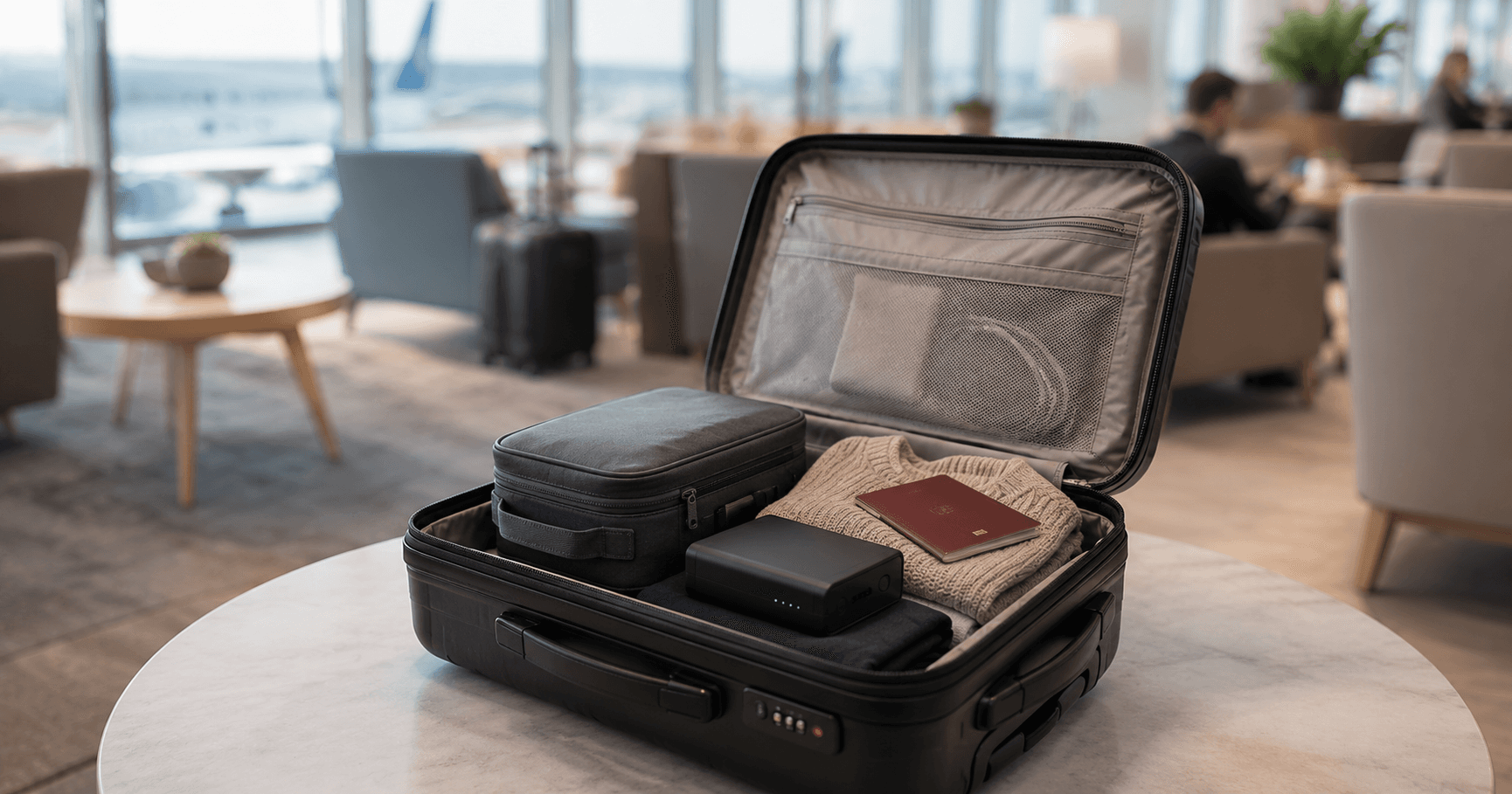
You pack your CPAP machine. You pack your battery backup. You grab the DC power cable, the travel humidifier, the mask and headgear — and then you open your current bag and realize nothing fits together. Finding the best CPAP travel bag is already a chore, but finding one that also accommodates a backup battery is a problem that almost no guide bothers to address. This one does. Every recommendation below includes specific internal dimensions and a battery clearance note so you know exactly what will — and won't — fit before you buy.
What Makes a Good CPAP Travel Case
The best CPAP travel bag balances four things: internal dimensions that match your machine, enough organization for accessories, TSA compatibility, and (for this audience) room for a backup battery.
Dimensions. Your machine's footprint determines everything. The ResMed AirSense 11 is 10.4 × 5.7 × 3.4 in; the DreamStation 2 is 10.7 × 6.6 × 3.5 in; the AirMini is just 5.4 × 3.3 × 2.1 in. A case that comfortably fits a DreamStation will be oversized for an AirMini, and a case optimized for the AirMini won't come close to fitting a full-size machine.
Hard vs. soft shell. Hard cases (typically EVA or ABS plastic) protect against compression in overhead bins and checked luggage. Soft cases are lighter and more flexible — useful when you need to stuff the bag into a tight carry-on. Hard is better for protection; soft is better for casual travel.
TSA rules. The TSA treats CPAP machines as medical devices, meaning they get their own bin during screening and don't count against your personal item or carry-on limit. Cases that open fully flat (like a laptop bag) speed up the screening process. More on TSA rules in the dedicated section below.
Build quality markers to look for: YKK or equivalent zippers, reinforced carrying handles, padded interior panels, and at least two external pockets for cables and masks.
Will It Fit Your Battery Too?
This is the question every CPAP traveler with a battery backup needs answered — and almost no review addresses it. Here is the practical breakdown.
Most popular CPAP backup batteries fall into two size categories:
- Compact (under 6 × 4 × 2 in): Medistrom Pilot-24 Lite (5.9 × 3.7 × 1.3 in, 96 Wh), ResMed Power Station II (similar footprint). These fit in the accessory pockets of most CPAP bags.
- Lunchbox-size power stations (roughly 7–8 lb): Jackery Explorer 300 (292 Wh, 7.5 lb), EcoFlow River 2 (256 Wh, 7.7 lb). These require either a large main compartment or a dedicated battery pocket.
- Full-size (over 9 × 6 × 4 in): Goal Zero Yeti 200X (7.9 × 5.0 × 6.0 in, 187 Wh) and similar. These typically require their own bag — attempting to squeeze one into a CPAP case alongside the machine is unrealistic.
The rule of thumb: if your battery is Medistrom-sized, nearly any CPAP bag will accommodate it in an accessory pocket. If your battery is a lunchbox-size power station (Jackery Explorer 300, EcoFlow River 2) or larger, you need a case with a large secondary compartment or you need to plan on a second bag.
The reviews below call out exactly which batteries fit each case.
Best CPAP Travel Cases in 2026
1. USA Gear XL CPAP Travel Bag — Best Overall for Battery Users
Price: ~$70 – $80 | Weight: 1.2 lb | Material: Water-resistant nylon, soft shell
The USA Gear XL is the top pick for anyone carrying a battery backup alongside their CPAP. The main compartment fits an AirSense 11 or DreamStation 2 with room to spare. More importantly, the large front accessory pocket is sized to accept a Medistrom Pilot-24 Lite or a compact battery without forcing anything.
Interior organization includes a mesh divider in the main compartment (useful for keeping the mask separate from the machine), zippered internal pockets for cables, and a luggage pass-through strap on the back.
Battery clearance: Medistrom Pilot-24 Lite — fits easily in front pocket. Jackery Explorer 300 and EcoFlow River 2 — too large for the accessory pocket; use the main compartment and carry the machine in a separate sleeve.
Best for: Full-size CPAP users (AirSense 11, DreamStation 2) who also carry a mid-size battery.

USA Gear XL CPAP Travel Bag – Fits ResMed AirSense 11, DreamStation 2, AirMini
$79.99
Check price on Amazon2. USA Gear CPAP Carrying Case — Best Hard-Shell Protection
Price: ~$40 – $50 | Weight: 1.6 lb | Material: Reinforced RipStop nylon, semi-rigid shell
The USA Gear CPAP case uses a semi-rigid reinforced shell with customizable padded interior that handles most standard CPAP machines. The clamshell opening lies completely flat, which speeds up TSA screening. The padded interior protects better than any soft case in this roundup at this price.
Battery clearance: Medistrom Pilot-24 Lite — fits alongside the machine in the main compartment (the foam can be trimmed to custom-fit). Jackery Explorer 300 and EcoFlow River 2 — do not fit with the CPAP machine inside.
Best for: Travelers who prioritize protection over organization, and who use compact batteries like the Medistrom or ResMed Power Station.

3. ResMed AirMini Travel Bag — Best for AirMini Users
Price: ~$45 – $62 | Weight: 0.7 lb | Material: Soft nylon
ResMed's official AirMini bag is designed specifically around the AirMini's 5.4 × 3.3 × 2.1 in footprint. It's a small, single-purpose case with a padded main compartment, two accessory pockets, and a top carry handle. It does not fit any full-size CPAP machine — don't try.
The build quality is above average for an OEM case: the zippers are smooth, the padding is substantial for the machine's size, and the case fits in a jacket pocket if needed.
Battery clearance: Medistrom Pilot-24 Lite — fits in the secondary accessory pocket. ResMed Power Station II — fits with moderate effort. Jackery Explorer 300 — does not fit; this case is simply too small. AirMini users who carry a lunchbox-size power station should use the Everest Backpack (see below) instead.
Best for: AirMini-only travelers with compact batteries. Not suitable for any other machine.

4. CPAP.com Hard-Sided Carry-On CPAP Case — Best for Checked Luggage
Price: ~$55 – $70 | Weight: 2.4 lb | Material: ABS hard shell, TSA-approved locks
The CPAP.com carry-on case is the most durable option in this roundup. The ABS shell meets airline carry-on size limits (20 × 14 × 9 in exterior), and the interior measures approximately 18 × 12 × 7 in — spacious enough for a full-size CPAP with humidifier attached, plus a mid-size battery, plus a full set of accessories. It includes TSA-approved combination locks on both zippers.
The trade-off is weight: at 2.4 lb empty, it's the heaviest case here by a significant margin. If you're already carrying a full-size CPAP plus a Jackery Explorer 300, total kit weight can approach 10–11 lb.
Battery clearance: Medistrom Pilot-24 Lite — easily fits in accessory compartment. Jackery Explorer 300 and EcoFlow River 2 — fit with the humidifier detached and stored separately. Goal Zero Yeti 200X — fits if the CPAP accessories are packed minimally. This is the only case in this roundup capable of accommodating a full-size battery alongside a standard CPAP.
Best for: Travelers who want to check their CPAP, carry a large battery, and want TSA-lock security.
5. CURMIO CPAP Travel Backpack — Best for Backpackers and Frequent Flyers
Price: ~$45 – $65 | Weight: 1.8 lb | Material: Durable nylon, padded back panel
The CURMIO CPAP Backpack is designed for people who want hands-free carry and maximum organization. The main compartment accommodates a full-size CPAP with humidifier and has padded internal dividers that can be repositioned. A padded secondary compartment is purpose-built for accessories and doubles as an ideal battery compartment.
The backpack format is the most comfortable for airport transit — particularly if you're already pulling a roller bag and need both hands free. The padded back panel and sternum strap distribute the weight of CPAP + battery across your shoulders rather than loading one hand.
Battery clearance: Medistrom Pilot-24 Lite — fits easily in the front pocket. Jackery Explorer 300 and EcoFlow River 2 — fit in the secondary compartment if packed solo (no other accessories in that compartment); expect a total carry weight of roughly 10–11 lb with a full-size CPAP. Goal Zero Yeti 200X — fits in secondary compartment; tight, but doable with dividers repositioned.
Best for: Frequent flyers and backpackers who carry mid-to-large batteries and want hands-free mobility.

CURMIO CPAP Travel Backpack Compatible with ResMed AirSense 10/11, Philips DreamStation
$49.99
Check price on AmazonComparison Table
| Case | Price | Shell | Interior | AirSense 11 | DreamStation 2 | AirMini | Explorer 300 / River 2 Fit | Weight |
|---|---|---|---|---|---|---|---|---|
| USA Gear XL Travel Bag | ~$70 – $80 | Soft | Large | Yes | Yes | Yes | Main compartment (machine in separate sleeve) | 1.2 lb |
| USA Gear CPAP Case | ~$40 – $50 | Semi-rigid | Adjustable | Yes | Yes | Yes | No (not with CPAP inside) | 1.6 lb |
| ResMed AirMini Bag | ~$45 – $62 | Soft | 6 × 4 × 3 in | No | No | Yes | No | 0.7 lb |
| CPAP.com Carry-On | ~$60 | Hard (ABS) | 18 × 12 × 7 in | Yes | Yes | Yes | Yes (humidifier detached) | 2.4 lb |
| CURMIO Backpack | ~$55 | Soft (padded) | 12 × 8 × 6 in | Yes | Yes | Yes | Secondary compartment (packed solo) | 1.8 lb |
Hard Case vs Soft Bag vs Backpack: Which Is Right for You
The right format depends on how you travel, not just what machine you own.
Choose a hard case if:
- You check your luggage or your overhead bin gets rough handling
- You travel to humid or dusty climates
- You want maximum protection for an expensive machine (AirSense 11 retails for $850+)
- You don't mind the extra weight and don't need external pockets
Choose a soft bag if:
- You travel carry-on only and need to stuff the case into a tight overhead bin
- You want a lighter kit (soft cases average 0.5–1 lb less than comparable hard cases)
- You need multiple external pockets for accessories
- You're carrying a mid-size battery and need the flexibility of a non-rigid compartment
Choose a backpack if:
- You transit through large airports and want hands-free carry
- You carry a large battery (Jackery Explorer 300 or larger) alongside your CPAP
- You combine CPAP travel with hiking, camping, or multi-day off-grid trips
- You're a frequent flyer who has already optimized a roller bag and needs the CPAP kit separate
One practical note: if you use a dedicated CPAP battery for camping or power outages and a lighter travel setup for hotels, consider owning two cases — a lightweight soft bag for hotel travel (where you'll use wall power) and a larger backpack or hard case for off-grid trips where the battery is essential.
TSA Rules for CPAP and Batteries When Flying
The TSA's stance on CPAP machines is clear and traveler-friendly: CPAP devices are medical equipment and are exempt from the standard carry-on + personal item limit. You can bring your CPAP in addition to your regular bags.
At the security checkpoint:
- Remove your CPAP from its bag and place it in a separate bin for X-ray screening — same procedure as a laptop
- You do not need a doctor's note or special documentation for the machine itself, though some airlines recommend carrying your prescription
- Distilled water for your humidifier is subject to the 3.4 oz liquid rule — buy it after security or request it from your airline
For batteries on planes:
- Lithium batteries ≤ 100 Wh: carry-on allowed, no approval needed (most compact CPAP batteries)
- Lithium batteries 100–160 Wh: carry-on allowed with airline approval (Jackery Explorer 300 is 292 Wh — exceeds this; see below)
- Lithium batteries > 160 Wh: generally prohibited in passenger aircraft cabins
- The Jackery Explorer 300 (292 Wh) exceeds the 160 Wh limit and is prohibited by most major airlines. The EcoFlow River 2 (256 Wh) is similarly prohibited. If you fly, stick to batteries ≤ 100 Wh (Medistrom Pilot-24 Lite at 96 Wh, ResMed Power Station II at 97.2 Wh) or get airline-specific approval for 100–160 Wh batteries.
This is one of the most important practical distinctions for battery-carrying CPAP travelers: your ground setup (a Jackery Explorer 300 for camping) may be completely different from your air-travel setup (Medistrom Pilot-24 Lite for flights).
For the full breakdown of Wh limits by airline and documentation requirements, read our dedicated guide: CPAP on an Airplane: Complete TSA Rules.
Related reading
If you're building out your travel CPAP kit, these posts cover the adjacent decisions:
- CPAP Battery Travel Checklist — Everything to pack before you leave, from DC cables to distilled water sourcing
- Best Battery for ResMed AirMini — If you're an AirMini user, this covers the battery options that pair best with that machine
- International Travel with CPAP: Voltage Guide — Covers dual-voltage CPAP compatibility and what adapters you actually need by country
- CPAP on an Airplane: TSA Rules Explained — Full detail on screening procedures, battery Wh limits, and airline-specific policies
- Sleep Apnea Travel Guide — The comprehensive overview for new CPAP travelers planning their first trip
What to do next
Start with your machine's dimensions and your battery's Wh rating — those two numbers determine which case works for you before you read a single review.
If you carry a compact battery (≤ 100 Wh) and a full-size machine, the USA Gear XL Travel Bag is the right call at the right price. If you prioritize protection over everything, go with the USA Gear CPAP Carrying Case. If you're an AirMini user, the ResMed official bag fits like it was made for it — because it was. If you're doing off-grid travel with a large battery, the CURMIO Backpack is the only format that handles the combined load comfortably.
The last thing you want is to arrive at your hotel and discover your battery won't fit in the same bag as your machine. Get the case right before you leave.