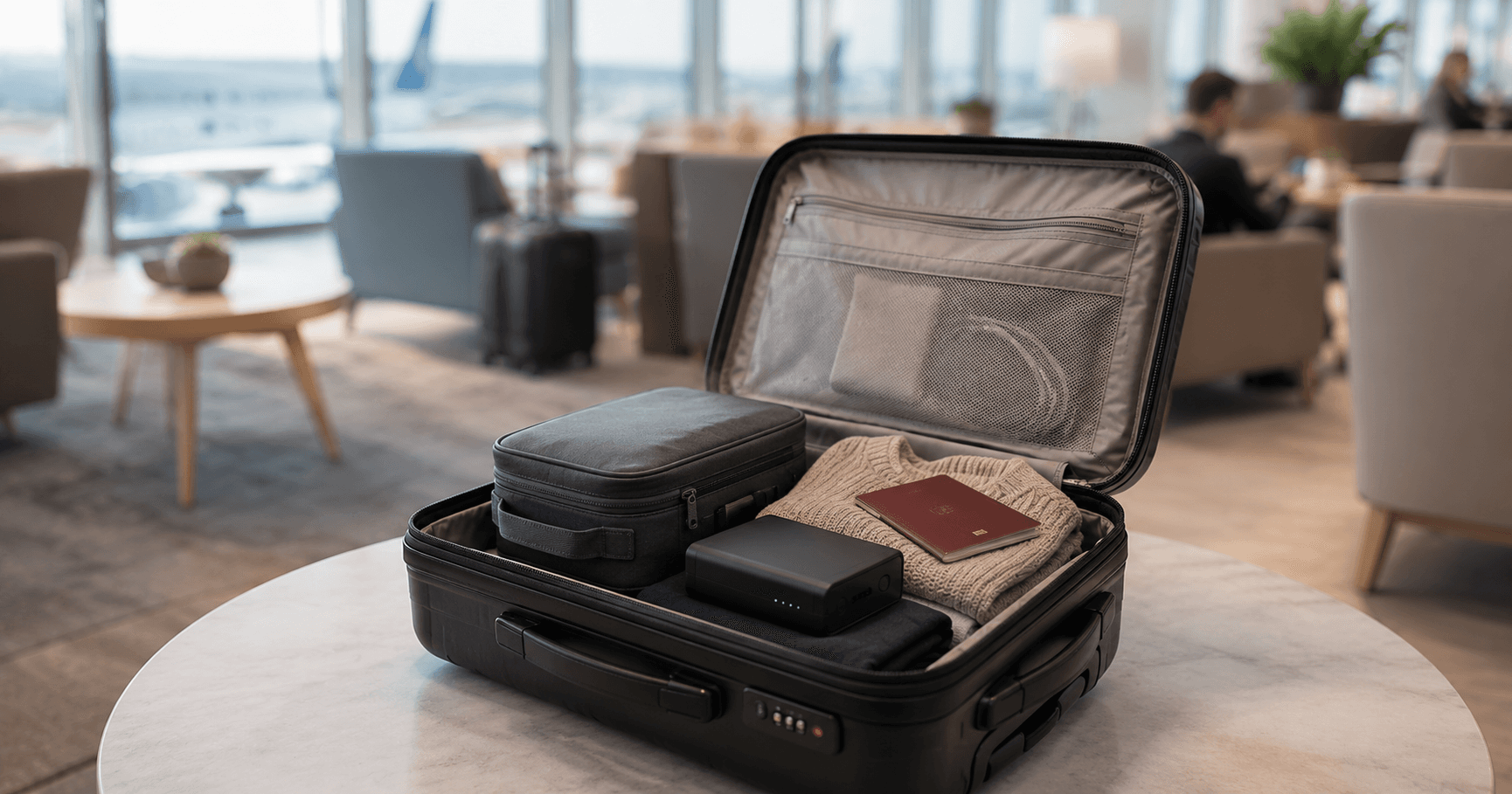
Traveling with sleep apnea sounds intimidating the first time, but millions of people fly, camp, cruise, and road-trip with their machines every year without missing a night of therapy. This sleep apnea travel guide walks you through every decision — from picking a smaller travel CPAP to clearing airport security, powering your device on a 220V grid, and keeping your insurance compliance data intact. The core idea is simple: a CPAP is a medical device, and the entire travel system is built to accommodate it. Once you know the rules, packing for a trip becomes a 10-minute checklist instead of a source of anxiety.
Choosing the right travel CPAP machine
A travel CPAP is a smaller, lighter version of your home machine designed for portability — most weigh under 1.5 pounds versus 3 to 5 pounds for a standard bedside unit. You do not strictly need a dedicated travel machine; your regular CPAP is perfectly legal and effective on the road. But if you fly often or backpack, a compact model saves real bulk and power.
The two benchmarks are the ResMed AirMini (roughly 0.66 lb, about the size of a soda can) and the Philips DreamStation Go. The AirMini is the smallest fixed-pressure and auto-CPAP on the market and pairs with a phone app instead of a screen. Both deliver the same prescribed pressure (typically 4–20 cm H₂O) as a full-size unit, so therapy quality does not suffer.
Here is how the most common travel options compare on the specs that matter for packing and power:
| Machine | Weight | Approx. power draw | Best for |
|---|---|---|---|
| ResMed AirMini | 0.66 lb | 10–20 W (no humidifier) | Flying, backpacking, smallest kit |
| Philips DreamStation Go | 1.86 lb | 15–30 W | Road trips, optional water humidifier |
| Your home CPAP | 3–5 lb | 30–60 W with humidifier | Driving trips where weight is no issue |
The lighter the machine and the lower its wattage, the longer any given battery lasts and the less you carry through three airports. That is the entire case for a travel unit — not better therapy, just less hassle.
Travel machine vs. your home unit
Ask three questions. First, how compact must your kit be — a backpacker counts every ounce, a road-tripper does not. Second, do you need a humidifier? Travel machines use waterless humidification (HME filters) instead of a water chamber, which removes the heaviest, most fragile part. Third, what runs off your battery longest? Smaller machines draw fewer watts, which stretches battery life dramatically. For a deeper comparison of models, weights, and battery compatibility, see our roundup of the best travel CPAP machines and the dedicated guide to the best battery for the ResMed AirMini in 2026.
Packing your CPAP and battery
Pack your CPAP in a dedicated case and carry it onto the plane — never check it. Checked baggage gets thrown, crushed, and occasionally lost, and a CPAP is a prescription medical device you cannot afford to be without on arrival. A purpose-built case protects the machine, organizes the hose and mask, and signals to security staff that the item is medical.
Your packing kit should include the machine, power supply, hose, mask, spare cushions, a week of HME filters or your humidifier chamber, a universal plug adapter, a DC cable, and a printed copy of your prescription. Distribute weight smartly: the machine and any lithium battery ride in your carry-on, while non-essential accessories can go in checked luggage.
Pack the mask cushion as if you cannot replace it, because in most of the world you cannot. A cracked cushion or a kinked hose can end your therapy for the whole trip, so a single spare cushion and an extra set of filters are cheap insurance. Coil the hose loosely rather than folding it sharply — a permanent crease restricts airflow. If you use a chinstrap or a nasal pillow style mask, bring the exact replacement parts, since generic equivalents rarely fit. Keep the prescription, a manufacturer FAA-compliance letter, and your doctor's contact details together in a sandwich bag inside the case so a security officer or customs agent can verify everything in seconds.

Distilled water on the road
Humidifiers need distilled water, and that is the single trickiest CPAP travel item because you cannot pack large liquids through security or count on finding distilled water in remote areas. You have three options: buy distilled water at a pharmacy or grocery store at your destination, switch to a waterless HME filter for the trip, or run the machine without humidification for a few nights. Running dry for a week causes only mild nasal dryness for most people and is completely safe. Our guides on using a CPAP without water and distilled water for CPAP cover the trade-offs in detail. For air travel specifically, an HME filter is the cleanest solution because it eliminates the water-supply problem entirely.
Choosing the right case or bag
Match the case to the trip. A slim zip case suits a single travel machine, while a larger organizer or backpack carries a full-size unit plus a battery and accessories. If you also pack a backup battery, look for a case with dedicated padded compartments so the lithium cell does not knock against the machine. Our breakdown of the best CPAP travel cases for 2026 compares hard shells, soft bags, and backpack-style options.
Airport and airline rules
A CPAP does not count as a carry-on or personal item on any major U.S. or international airline — it is classified as an assistive medical device, the same category as a wheelchair or oxygen concentrator. That means you can bring your CPAP bag in addition to your normal carry-on and personal item at no extra charge. This is true for American, Delta, United, Southwest, and the major international carriers.
At TSA security, take the CPAP machine out of its case and place it in a separate bin, just like a laptop. You do not need to remove the hose or mask. Officers may swab the device for explosive trace detection — this is routine and adds about 30 seconds. You are not required to show a prescription, but carrying a printed copy and a doctor's note prevents misunderstandings, especially abroad where staff may be less familiar with CPAP.
You can request that the bin not be sent through the open conveyor by asking for a separate inspection, and TSA Cares (a U.S. assistance line) can arrange help if you travel with multiple medical devices. A useful trick: place a clear plastic bag over the machine before it enters the bin so it never touches the same surface as shoes and belts — purely for hygiene, and TSA permits it. The whole process adds two to three minutes, so arrive a little earlier when you carry a CPAP for the first time at an unfamiliar airport.


EASYLONGER ES270 CPAP Battery (99.9Wh, FAA Carry-On)
$139.99
Check price on AmazonLithium battery rules for flying
Spare lithium batteries and power banks must travel in your carry-on, never in checked luggage — this is an FAA and international safety rule because of fire risk in the cargo hold. Batteries up to 100 watt-hours (Wh) are allowed without airline approval, and you may typically carry two batteries between 100 Wh and 160 Wh with prior airline approval. Most dedicated CPAP batteries, like the Medistrom Pilot and the 99.9 Wh EASYLONGER ES270, sit safely under 100 Wh. Check the Wh rating printed on the cell before you fly, and keep terminals covered to prevent short circuits. Our full walkthrough of CPAP airplane and TSA rules and the best CPAP travel batteries covers approved capacities and the in-flight use question.
Using your CPAP on the plane
You can use a CPAP during a long-haul flight, but you must run it on battery — aircraft seat power does not reliably deliver the wattage a CPAP needs, and airlines require self-contained power. Notify the airline at least 48 hours ahead if you intend to use the device in flight; some carriers require an FAA-compliance statement from the manufacturer, which ResMed and Philips provide free.
International voltage and adapter guide
Nearly every modern CPAP accepts 100–240V at 50–60 Hz, which means it works on any electrical grid worldwide with only a plug-shape adapter — not a heavy voltage converter. Confirm this by reading the fine print on your power supply; if it says "Input: 100–240V," you are covered everywhere from the U.S. (120V) to Europe and Australia (230V). Plugging a universal-voltage CPAP into a foreign outlet through a simple adapter is completely safe.
The mistake to avoid is buying a bulky transformer you do not need, or worse, an HVAC-style converter that can introduce a dirty waveform. Only the small minority of older, 110V-only machines require a converter. If yours is one of them, choose a quality unit and verify the wattage rating exceeds your machine's draw. Our international travel CPAP voltage guide lists plug types by country and flags the rare exceptions.
Plug shapes vary by region: North America uses Type A/B, continental Europe Type C/F, the UK and Ireland Type G, and Australia and New Zealand Type I. A single universal adapter covers all of them and costs about $15 — buy one rather than a country-specific set. One caution: many cheap "all-in-one" adapters bundle a voltage converter that defaults to a low-wattage setting meant for phone chargers. If your adapter has a converter switch, make sure it is in pass-through (adapter-only) mode so the full grid voltage reaches your universal-voltage CPAP. Choking a CPAP through a 50-watt converter setting can make it underperform or shut off mid-night.
Power banks and batteries abroad
Where outlets are scarce — long flights, overnight trains, off-grid lodging — a CPAP battery or USB-C power bank keeps therapy running. Match the battery's watt-hours to your machine's nightly draw: a typical travel CPAP without humidification pulls 10–30 watts, so a 100 Wh battery delivers roughly one to two full nights. Newer machines charge over USB-C Power Delivery, letting a single high-output power bank run both your phone and CPAP. See our guides on USB-C PD power for CPAP and the CPAP battery runtime calculator to size capacity precisely.

Anker Prime Power Bank (27,650mAh, 250W, 140W USB-C PD)
$179.99
Check price on AmazonRoad trips and DC power
In a car or RV, skip the inverter and run your CPAP straight off 12V DC through a dedicated DC cable — it is more efficient and avoids the waveform issues cheap inverters create. A DC cable wastes less energy than converting 12V to 120V AC and back to the machine's internal DC. If you must use an inverter, choose a pure sine wave model; a modified sine wave can make some CPAP motors run hot or noisy. Our CPAP DC power adapter guide and the pure sine vs. modified sine explainer cover wiring and inverter selection.
Camping, cruises, and off-grid stays
For tent and backcountry camping, a CPAP battery plus a folding solar panel can sustain therapy for a multi-day trip, and waterless humidification keeps your load light. Size the battery to roughly 100 Wh per night without humidification, then add a 60–100 W panel to recharge during daylight. On cruises, cabins have standard outlets but limited bedside access, so pack an extension cord and request a distilled-water refill from guest services — many cruise lines provide it free with advance notice. Note that cruise lines and many hotels forbid CPAP machines in checked or stored luggage and require them in the cabin, which is exactly where you want yours anyway. Notify the cruise line's special-needs desk before sailing so a power strip and water are waiting in your stateroom. Our CPAP camping setup, CPAP battery camping guide for 2026, and CPAP battery cruise ship guides break down each scenario, and backpackers should read the CPAP backpacking guide for ultralight power strategies.
Travel CPAP checklist
Use this pre-trip checklist 48 hours before you leave so nothing critical is forgotten. The bottom line: pack the machine and any lithium battery in your carry-on, bring the right adapter, and confirm your power plan matches the destination. Run the list once when you pack and once again the morning you leave — most forgotten items (the power cord, the prescription, the adapter) get left behind in the final rush out the door.
| Item | Why it matters |
|---|---|
| CPAP machine + case | Carry on; never check it |
| Power supply + cord | Universal voltage; check 100–240V label |
| Plug adapter | Matches destination outlet shape |
| Backup battery (under 100 Wh) | Carry-on only; FAA rule |
| DC cable | For car, RV, or 12V power |
| Hose, mask, spare cushions | Replacements are hard to find abroad |
| HME filters or humidifier chamber | Solves the distilled-water problem |
| Printed prescription + doctor's note | Smooths security and customs |
Staying compliant on the road
Insurance and DME suppliers track CPAP usage to confirm you meet adherence thresholds — typically four or more hours per night on 70% of nights within a 30-day window. Traveling does not pause that clock, so keep using your machine every night, including in flight or on the road, to protect your compliance and any rent-to-own equipment status. Most machines log usage internally and sync over cellular or Bluetooth when you reconnect, so a few offline nights still count once data uploads. If you cross time zones, do not worry about the clock — the machine records total hours of use per calendar night, not when you fall asleep, so a flight that shifts your bedtime by eight hours does not break adherence. The one habit that protects you is simply wearing the mask every night. A missed week abroad can drop you below the 70% threshold and trigger a supplier review or an out-of-pocket charge for rented equipment, which is far more expensive than the minor inconvenience of packing the machine. If you need a temporary machine or a spare battery, our guides on CPAP battery rental and whether insurance covers a CPAP battery explain your options. For a printable version of this list, see the CPAP battery travel checklist.
Related reading
- Best travel CPAP machines (battery powered)
- Best CPAP travel batteries
- Best CPAP travel case for 2026
- CPAP airplane and TSA rules
- International travel CPAP voltage guide
- CPAP battery camping guide for 2026
- CPAP battery cruise ship guide
- CPAP Battery Backup Guide
- Does insurance cover a CPAP battery?
- CPAP battery travel checklist
What to do next
Start with your power plan, because it is the one thing you cannot improvise at the gate or in a remote cabin. Confirm your machine reads "100–240V," buy the right plug adapter for your destination, and choose a battery rated under 100 watt-hours so it clears airline rules. If you're ready to pick a battery, check our best CPAP travel batteries guide for side-by-side comparisons, then print the checklist above and pack your CPAP in its carry-on case.