You find a sleep position that feels perfect — and three minutes later your CPAP alarm is going off because your mask is leaking. If that sounds familiar, the problem probably isn't your mask. It's your pillow. A standard pillow pushes against your mask the moment you roll onto your side, breaking the seal that your therapy depends on. The right best CPAP pillow solves that problem with purpose-built cutouts that keep the mask floating free, no matter what position you sleep in.
This guide covers the four best CPAP pillows in 2026 plus a soft-feel alternative, how to choose between them, and how to match your pick to your sleep position.
Why a Regular Pillow Causes CPAP Mask Leaks
A regular pillow causes leaks because it creates direct lateral pressure on your mask cushion, deforming the silicone seal. Here's the mechanism in plain terms.
CPAP masks maintain their seal through a flexible silicone or gel cushion that conforms to the contours of your face. That seal depends on even, gentle pressure — roughly 1–3 cmH₂O of machine pressure pushing it outward and the mask frame holding it lightly against your skin. When you sleep on your side and your face presses into a standard pillow, you add 5–20 lbs of gravitational force against one side of the mask. The silicone cushion collapses unevenly, the seal breaks, and pressurized air vents out — usually with a hissing sound that wakes you or your partner.
The effect is worse with full-face masks because the frame extends 2–3 inches from your face, giving the pillow more leverage. Nasal-pillow masks are somewhat more resistant because the cushion sits inside the nostrils, but even those can be dislodged when a stiff pillow catches the headgear tubes.
A CPAP pillow addresses this with recessed cutouts — typically semicircular notches on each side of the pillow — that your mask frame sits inside rather than against. The foam around the cutout supports your head, while the mask floats in open air.
What to Look for in a CPAP Pillow
The best CPAP pillow for you depends on four measurable factors: cutout depth, loft height, fill material, and firmness rating.
Cutout depth. This is the single most important spec. Nasal-pillow masks need at least 1.5–2 inches of cutout depth. Nasal masks need 2–2.5 inches. Full-face masks need at least 2.5–3 inches. Many budget pillows advertise CPAP compatibility but only cut 1–1.5 inches — not enough for any mask with a rigid frame.
Loft height. Standard CPAP pillows come in 3-inch and 4-inch heights. Side sleepers with wider shoulders generally need 4 inches to keep their spine aligned. Back sleepers and people with narrower frames do better at 3 inches. Some pillows, like the Lunderg, let you adjust height by removing foam layers, so one pillow can cover both.
Fill material. The vast majority of CPAP pillows use memory foam because it conforms slowly and doesn't spring back against the mask mid-night. Shredded memory foam (used in some EnduriMed models) is more adjustable but can shift around the cutout area. Solid foam cores hold their shape better over time.
Firmness. You need enough firmness that your head doesn't bottom out the pillow and land on the mask anyway. Most CPAP pillows rate between medium and medium-firm. If you're a larger person (200+ lbs), lean toward firm. If you're smaller or a light sleeper who moves frequently, medium is more comfortable.
Secondary factors worth checking: washable cover (most have one — confirm it's machine washable), pillow dimensions (standard CPAP pillows are typically 24×16 inches, fitting standard pillowcases with room to spare), and hose routing channels on the top edge, which some higher-end models include.
Best CPAP Pillows in 2026
These pillows are the most-reviewed and most-recommended options available this year, covering a range of mask types, sleep positions, and budgets.
EnduriMed CPAP Pillow — Best Overall
A note on the old favorite: the Contour CPAPMax 2.0, which used to hold this slot, is currently unavailable on Amazon (as of September 2026), so we've moved the EnduriMed up. It offers the deepest cutouts on this list (approximately 2.5 inches), enough clearance for most full-face masks. The main difference is the fill: EnduriMed uses shredded memory foam inside an adjustable shell, so you can remove fill to dial in the exact height you need. This is particularly useful if you're between standard loft heights or if your comfort needs change seasonally.
The tradeoff is that shredded foam can migrate toward the edges overnight, occasionally leaving the cutout area slightly less supported. Most users report this isn't a problem in practice, but it's worth knowing.
Specs: 24 × 17 inches | Adjustable loft (remove/add fill) | ~2.5" cutout depth | Shredded memory foam | Machine-washable cover
Best for: Side sleepers, full-face and nasal mask users, and anyone who wants height adjustability.

EnduriMed CPAP Pillow for Side Sleeping – Adjustable Memory Foam
$69.99
Check price on AmazonLunderg CPAP Pillow — Best for Combination Sleepers
The Lunderg is a newer entrant that has picked up strong reviews from people who shift between side and back sleeping. It features a butterfly or hourglass profile — narrower in the center, wider at the sides — that naturally accommodates head position changes without requiring you to manually reposition yourself in the cutouts. Height is adjustable with removable foam layers, so you can lower it for back sleeping or keep it taller for side sleeping.
Cutout depth is approximately 2.25 inches, which covers nasal and nasal-pillow masks well but is marginal for large full-face masks. Priced around $79, with a 4.2-star rating across roughly 3,800 reviews. The Lunderg also ships with two pillow cases in the box, which is a small but welcome touch.
Specs: 26 × 16 inches | Hourglass profile | Adjustable height (removable layers) | ~2.25" cutout depth | Memory foam | Two washable covers included
Best for: Combination side/back sleepers using nasal or nasal-pillow masks.

Lunderg CPAP Pillow for Side & Back Sleepers – Memory Foam, Adjustable Height
$79.00
Check price on AmazonIKSTAR CPAP Pillow — Best Budget Pick
IKSTAR offers the most affordable purpose-built CPAP pillow in the category, typically priced at $38 – $46. The cutouts are shallower than the premium options — approximately 1.75–2 inches — making this a reliable choice for nasal-pillow masks but less suited for full-face masks.
Where IKSTAR stands out is material quality for the price point. The memory foam is dense enough that you won't bottom out even at 170–180 lbs, and the cover washes well without pilling. If you're trialing CPAP therapy for the first time and aren't sure how much you'll need a specialty pillow, IKSTAR is a low-risk starting point.
Specs: 23 × 15 inches | 3-inch loft (single-sided) | ~1.75–2" cutout depth | Memory foam | Machine-washable cover
Best for: Budget shoppers; nasal-pillow mask users; CPAP therapy newcomers.
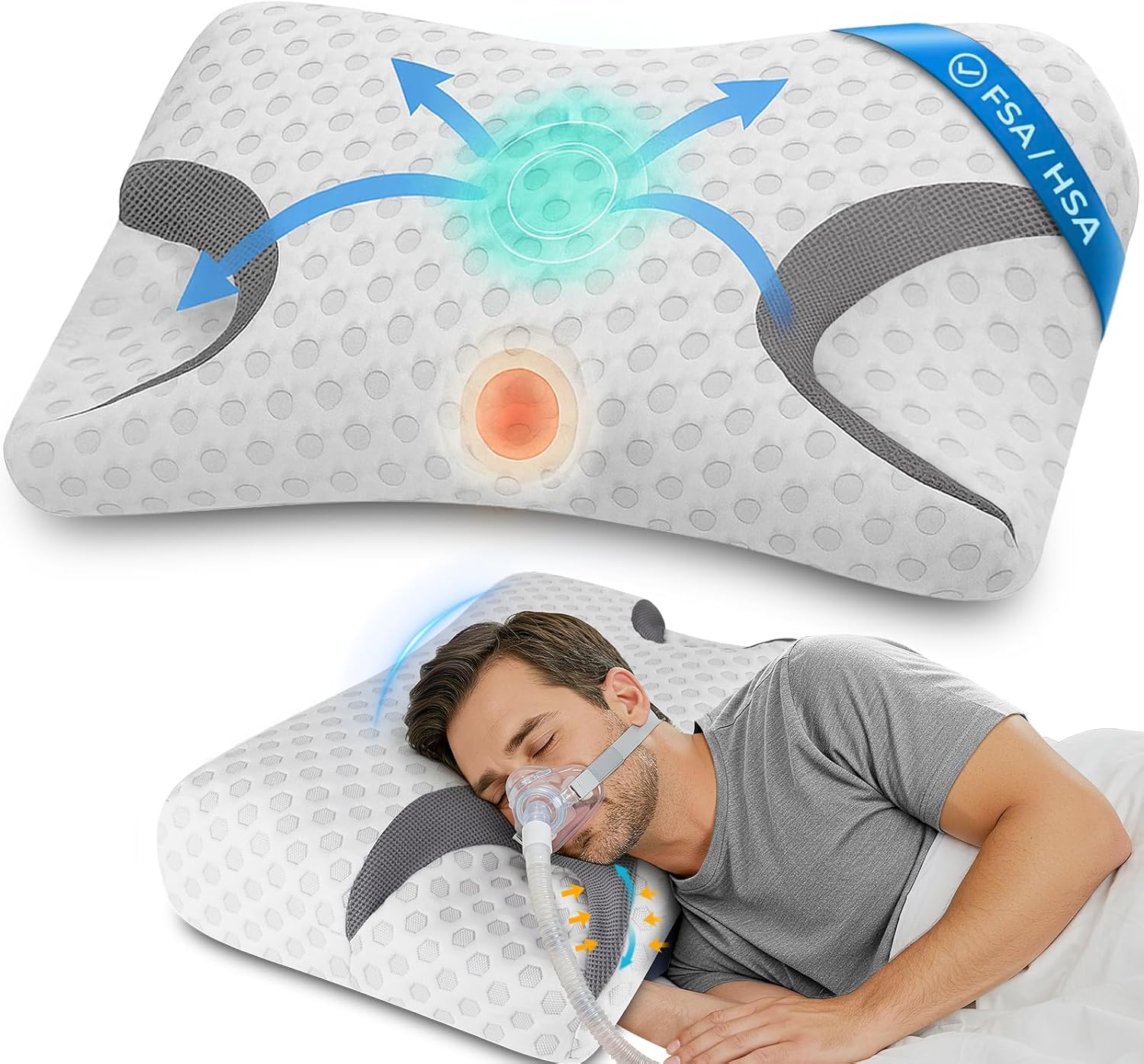
IKSTAR CPAP Pillow for Side Sleepers – Fits All CPAP Mask Types
$39.59
Check price on AmazonBeckham Hotel Collection CPAP Pillow — Best Soft-Feel Option
The Beckham is an outlier on this list because it prioritizes plush comfort over clinical precision. It uses a gel-fiber fill (not memory foam) and is machine-washable in full — cover and insert — which is a meaningful maintenance advantage. The cutouts are 2 inches deep, suitable for nasal and some nasal-mask setups.
If your primary complaint with other CPAP pillows is that they feel stiff and uncomfortable, the Beckham is worth considering. The softer fill does mean slightly more give, so you'll want to make sure your head doesn't sink deep enough to press the mask against the pillow center. Priced around $35 – $45.
Specs: 26 × 20 inches (king-sized option available) | Gel-fiber fill | ~2" cutout depth | Fully machine-washable | Available in standard and king
Best for: Comfort-first shoppers; nasal-pillow users; hot sleepers (gel fiber runs cooler than foam).
Quick Comparison
| Pillow | Price | Loft | Cutout Depth | Fill | Full-Face Mask? |
|---|---|---|---|---|---|
| EnduriMed | $39 – $70 | Adjustable | ~2.5" | Shredded memory foam | Yes (most) |
| Lunderg | ~$79 | Adjustable (layers) | ~2.25" | Memory foam | Marginal |
| IKSTAR | $38 – $46 | 3" | ~1.75–2" | Memory foam | No |
| Beckham Hotel Collection | $35 – $45 | ~4" | ~2" | Gel fiber | No |
CPAP Pillow Tips for Side vs Back vs Stomach Sleepers
Your sleep position determines which specs matter most — here's how to apply the comparison table above.
Side sleepers have the hardest time with CPAP masks because gravity pulls the entire weight of their head against the pillow, putting maximum stress on the mask seal. You need the deepest cutouts available (2.5 inches minimum for nasal masks, 2.75+ for full-face), and you need enough firmness that your head doesn't sink to pillow center. The EnduriMed, with its adjustable fill and ~2.5-inch cutouts, is the best fit on this list for this. Position the pillow so your mask frame sits squarely inside the cutout — not on the edge of it — before you fall asleep.
One technique that helps side sleepers: sleep with your arm under the pillow rather than folded at your chest. This slightly elevates your shoulder and reduces the degree to which your head presses laterally into the pillow, taking some pressure off the mask even before the cutout does its job.
Back sleepers have the easiest time with CPAP mask leaks because gravity keeps the mask centered on the face rather than pressing it to one side. For back sleepers, the CPAP pillow is more about comfort and hose management than leak prevention. A 3-inch pillow is typically sufficient. Look for a hose routing channel at the top of the pillow if your machine sits on the nightstand at face height — this keeps the hose from pulling upward on the mask as you breathe.
If you're a back sleeper who also snores or has positional apnea, note that back sleeping tends to worsen apnea events even with CPAP. Some users find that a contoured CPAP pillow with an elevated side loft naturally encourages them to shift to their side during sleep.
Stomach sleepers are the hardest case, and no CPAP pillow fully solves the problem. Stomach sleeping with a full-face mask is almost impossible — the frame simply can't sit properly when your face is pointed downward. Nasal-pillow masks are the most viable option for stomach sleepers, and even then, most people find CPAP therapy pushes them toward side or back sleeping over time.
If you must sleep on your stomach, try a very thin (2.5–3 inch) pillow with a cutout and position your face so the mask hangs off the pillow edge rather than resting on it. Some stomach sleepers report success with a wedge pillow that keeps them at a 15–20 degree angle — not fully face-down, not quite on their side.
Related reading
If you're optimizing your CPAP setup beyond the pillow, these guides cover the rest of your sleep environment:
- Sleep Apnea Travel Guide — How to pack and use your CPAP therapy away from home, including international travel considerations.
- CPAP Camping Setup — Running CPAP therapy without reliable power at campsites, including battery options and solar charging.
- CPAP on an Airplane: TSA Rules — What TSA actually requires for CPAP machines at security, and how to use your machine in-flight.
- Best Travel CPAP Machines (Battery-Powered) — Compact CPAP machines that pair well with a portable CPAP pillow for travel use.
What to do next
Start with your mask type. If you use a full-face mask and sleep on your side, the EnduriMed has the deepest cutouts on this list and its adjustable fill makes it the most forgiving starting point. If you use a nasal-pillow mask and want to keep costs down, the IKSTAR will do the job. If you're a combination sleeper with a nasal mask, the Lunderg's hourglass shape and removable layers are worth the extra cost.
Once you have a CPAP pillow, give it two weeks before judging it. Your leak rate will improve immediately, but your body will take a few nights to find its natural position within the cutouts. Check your CPAP machine's leak report data (most modern machines log this) to confirm your AHI and leak numbers are trending down. If they're not after two weeks, the issue is likely the mask itself rather than the pillow.