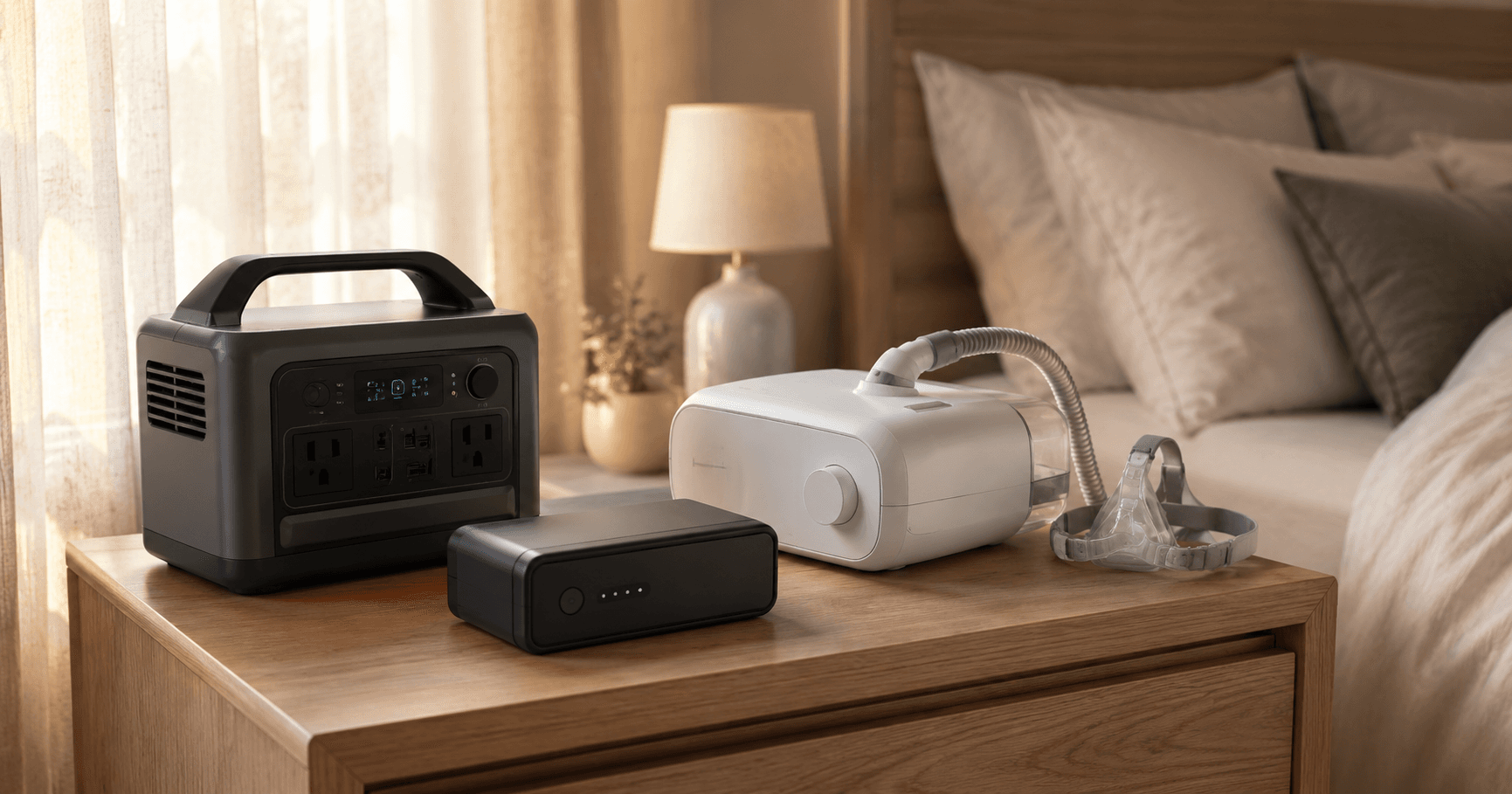
Most Zopec CPAP battery reviews cover one product at a time, which is useless when you are staring at seven different models trying to figure out which one actually fits your situation. A Zopec CPAP battery is a purpose-built lithium-ion backup designed specifically for sleep therapy machines, with integrated UPS protection in every model. Zopec makes the widest lineup of dedicated CPAP batteries on the market — from a 1-pound travel unit to an 8-night powerhouse — and every single one includes some form of automatic outage switchover.
But the differences between models are not obvious, and Zopec's own UPS tier system (Bronze, Silver, Gold, Platinum) is barely explained on their site. This guide breaks down every Zopec CPAP battery side by side, explains what the UPS tiers actually mean for your therapy, and gives you a clear decision path based on how you plan to use it. If you want to understand how a dedicated CPAP battery differs from a UPS or power station, start there first.
Why the Zopec CPAP Battery Lineup Stands Out
Zopec is one of the only manufacturers building batteries specifically for CPAP therapy with integrated UPS functionality in every model. That combination of purpose-built design and automatic outage protection is what separates the Zopec lineup from generic power stations.
Pure sine wave AC output. Every Zopec model with an AC outlet delivers clean sine wave power — the same waveform your wall outlet produces. This matters because CPAP blower motors and pressure sensors are calibrated for sine wave input. Modified sine wave inverters, the cheaper alternative found in many budget power stations, can cause motor whine, inaccurate pressure delivery, and overheating in sensitive medical devices.
AutoSwitch UPS in every model. Plug your CPAP into the Zopec battery, plug the battery into the wall, and if the power goes out at 3 AM the battery takes over automatically. You do not wake up. You do not lose therapy. The switchover speed and what stays powered during the transition varies by tier — more on that below — but every Zopec CPAP battery UPS has this feature built in. A CPAP battery with UPS function means your therapy never stops, even during unexpected outages. For full outage preparedness, see our complete power-outage preparedness guide.
Silent Peltier cooling. Zopec uses solid-state Peltier cooling instead of fans. The result is 100 percent silent operation — no fan noise competing with your CPAP's already-quiet motor. For a device sitting on your nightstand, this is a meaningful advantage over fan-cooled power stations.
Panasonic Li-Ion cells. All Zopec batteries use branded Panasonic lithium-ion cells rated for approximately 500 charge cycles, based on Panasonic's published cell specifications. That is not LiFePO4 territory (3,000+ cycles), but it is reliable chemistry from a known manufacturer with an 18-month warranty. For a deeper dive on battery chemistry tradeoffs, read our LiFePO4 vs Li-Ion for CPAP comparison.
Daisy-chaining support. Need more runtime? Zopec batteries can be linked together in series for extended multi-night capacity. This is particularly useful for extended camping trips or multi-day outage scenarios where a single battery would fall short.
Every Zopec CPAP Battery Compared — Full Specs Table
Zopec currently sells seven CPAP battery models spanning 98Wh to 576Wh. Here is every model laid out with the specs that matter for CPAP users.
| Model | Capacity | Weight | AC Outlets | UPS Tier | Runtime (no humidifier) | Runtime (w/ humidifier) | FAA OK? | Price |
|---|---|---|---|---|---|---|---|---|
| Explore Mini | 98Wh / 27Ah | 1.0 lb | 0 (DC + USB-C) | Bronze | 1–2 nights (8–16h) | ~4–6h | Yes | $329–349 |
| Voyage Smart | 150Wh / 40Ah | 2.0 lb | 1x 110V | None (no UPS) | 1.5–2 nights | ~6–8h | Yes | $299–329 |
| Explore 4000 | 120–130Wh / 40Ah | 2.0 lb | 1x 110V | Silver | 1.5–2 nights (12–16h) | ~5–7h | Yes | $389–489 |
| Explore 5700 | 160Wh / 54Ah | 2.5 lb | 1x 110V | Silver | 2–3 nights (16–24h) | ~7–8h | Yes (at limit) | $459 |
| Explore 5500 | 160Wh | ~3.0 lb | 2x 110V | Gold | 2–3 nights (16–24h) | ~8–10h | Yes (at limit) | ~$549 |
| Explore 8000 | 288Wh / 80Ah | 4.2 lb | 2x 110V | Gold | 3–4 nights (24–32h) | ~10–12h | No | $599–749 |
| Explore Oxygen | 576Wh / 160Ah | 7.5 lb | 2x 110V | Platinum | Up to 8 nights (64h) | ~8–12h | No | ~$999 |
A few things stand out immediately. The Explore Mini is the only model without an AC outlet — it connects to your CPAP via included DC cables (compatible with ResMed AirMini, ResMed AirSense 10, and ResMed AirSense 11). Every other model uses standard AC, which means universal CPAP and BiPAP compatibility.
The Voyage Smart is the odd one out — it has an AC outlet but no UPS function. It is Zopec's budget travel option for users who do not need automatic outage protection.
Runtime with humidification drops 50 to 80 percent across the board. This is not a Zopec-specific problem — it affects every CPAP battery on the market. Your heated humidifier and heated tube can add roughly 15 to 45 watts on top of the 15 to 25 watts your CPAP motor uses. For the math behind this, read our guide on how much runtime your humidifier really costs.
Not sure how much capacity you actually need? Use our CPAP battery sizing calculator to get a personalized estimate based on your machine and settings.
Understanding Zopec's CPAP Battery UPS Tiers (Bronze / Silver / Gold / Platinum)
Zopec's UPS tier system determines how your CPAP transitions from wall power to battery power during an outage. This is the most misunderstood part of the Zopec lineup, and it directly affects whether your therapy continues uninterrupted.
Bronze (Explore Mini)
The Bronze tier provides basic AutoSwitch functionality during a power outage, but with an important limitation: the Explore Mini outputs DC only. That means the Explore Mini works with supported CPAP machines via direct DC cables — no AC conversion involved. The switchover keeps your CPAP motor running, but if you use a heated humidifier, the Explore Mini will not power the humidifier during the transition because the Explore Mini cannot output enough wattage for humidification.
Best for: Travel-only use, users who run CPAP without humidification, or as a lightweight emergency backup.
Silver (Explore 4000 and Explore 5700)
Silver-tier batteries add an AC outlet and faster AutoSwitch. Your CPAP motor transitions seamlessly, and the AC output supports the full range of CPAP and BiPAP machines. However, the Silver tier may briefly interrupt humidifier operation during the switchover moment. Once on battery power, the humidifier runs normally — but the initial switch can cause a brief gap. The Zopec Explore 5700 CPAP battery is the most popular Silver-tier option, offering 160Wh at just 2.5 pounds.
Best for: Users who want UPS protection and can tolerate a momentary humidifier interruption, or those who run without humidification.
Gold (Explore 5500 and Explore 8000)
Gold-tier UPS provides seamless switchover that maintains power to your CPAP, humidifier, and heated tube simultaneously. There is no gap, no interruption, and no restart needed. The Explore 8000 transitions so quickly that your machine does not register any change in power source.
Best for: Users who require uninterrupted humidified therapy, especially those in areas with frequent power outages or brownouts.
Platinum (Explore Oxygen)
The Platinum tier is a true online UPS — your CPAP runs through the Explore Oxygen battery at all times, with wall power continuously charging the battery. There is zero switchover time because the battery is always in the power path. The Explore Oxygen can simultaneously power a CPAP with full humidification plus an oxygen concentrator, which is why Zopec calls it the "Oxygen" model.
Best for: Users on supplemental oxygen who need an oxygen concentrator running alongside their CPAP, or anyone who demands zero-interruption power under all conditions.
The bottom line: If you use a heated humidifier and want true uninterrupted backup, you need Gold tier or higher. If you run CPAP-only without humidification, Silver tier is perfectly adequate.
Which Zopec CPAP Battery Should You Buy? (Decision Guide)
Your ideal Zopec battery depends on three factors: where you use it, whether you run a humidifier, and how many nights of backup you need.
You fly frequently and want the lightest option
Pick the Zopec Explore Mini. At 1.0 pound with 98Wh capacity, the Explore Mini is FAA-compliant with margin to spare and fits in any carry-on. This Zopec Explore Mini review finding is consistent across user reports: the Explore Mini includes DC cables for the three most popular CPAP machines (ResMed AirMini, ResMed AirSense 10, ResMed AirSense 11), charges fully via USB-C PD in about 1.5 hours, and delivers 1 to 2 nights of runtime without humidification. For TSA rules for flying with CPAP batteries, we have a dedicated guide.

You want travel-friendly backup with UPS and AC power
Pick the Zopec Explore 5700. At 2.5 pounds and 160Wh, the Explore 5700 CPAP battery sits right at the FAA limit while delivering 2 to 3 nights of runtime without humidification. The Silver-tier UPS and AC outlet mean the Explore 5700 works with any CPAP or BiPAP machine and switches to battery automatically during outages. The $459 price point is competitive for this capacity and feature set.
You need uninterrupted humidified therapy at home
Pick the Explore 5500 or Explore 8000. Both carry Gold-tier UPS with seamless switchover that keeps your humidifier running through outages. The Explore 5500 (160Wh, ~$549) gives you 8 to 10 hours of humidified runtime — enough for one full night. The Explore 8000 (288Wh, $599–749) stretches that to 10 to 12 hours with humidification or 3 to 4 nights without. The tradeoff: the Explore 8000 exceeds the 160Wh FAA limit and cannot fly.
You use supplemental oxygen with your CPAP
Pick the Explore Oxygen. The Explore Oxygen is the only Zopec model (and one of very few batteries anywhere) designed to simultaneously power a CPAP with full humidification and an oxygen concentrator. At 576Wh and 7.5 pounds, the Explore Oxygen is not a travel battery — it is a home medical backup system with Platinum-tier true online UPS. Expect to pay around $999.
You want to spend as little as possible
Pick the Voyage Smart. At $299 to $329 with 150Wh capacity and an AC outlet, the Voyage Smart is Zopec's most affordable option. The catch: no UPS function. You have to manually switch to battery during an outage. If automatic switchover is not a priority — say, you only use the Voyage Smart for camping or planned travel — this is a solid value.
Zopec vs Medistrom CPAP Battery and Power Stations
Zopec is not the only option for CPAP battery backup. Here is how the Zopec lineup compares to the two most common alternatives: the Medistrom Pilot-24 Lite and generic power stations.
Zopec vs Medistrom CPAP Battery
Medistrom's Pilot-24 Lite is the closest direct competitor to Zopec's smaller models. The Medistrom Pilot-24 Lite is a DC-only CPAP battery with a 76Wh capacity designed for travel use.
| Feature | Zopec Explore Mini | Medistrom Pilot-24 Lite |
|---|---|---|
| Capacity | 98Wh | 76Wh |
| Weight | 1.0 lb | 0.8 lb |
| Output | DC + USB-C | DC only |
| UPS function | Yes (Bronze) | Yes (basic) |
| Runtime (no humidifier) | 1–2 nights | 1 night |
| Charging | USB-C PD 45W (1.5h) | Proprietary charger |
| Price | $329–349 | $169 – $199 |
The Zopec Explore Mini wins on capacity (29 percent more watt-hours), charging speed (USB-C PD vs proprietary), and included cable variety. The Medistrom Pilot-24 Lite is slightly lighter and has a longer track record as a travel CPAP battery. Read our full Medistrom Pilot-24 review for details.

Zopec vs Generic Power Stations
Power stations like the Anker SOLIX C300 DC or EcoFlow RIVER 2 offer more capacity per dollar, but they lack CPAP-specific features.
| Feature | Zopec Explore 5700 | Anker SOLIX C300 DC | EcoFlow RIVER 2 |
|---|---|---|---|
| Capacity | 160Wh | 288Wh | 256Wh |
| Weight | 2.5 lb | 6.37 lb | 7.7 lb |
| UPS function | Yes (Silver) | No | Yes (~30ms) |
| CPAP-specific design | Yes | No | No |
| Battery chemistry | Li-Ion (~500 cycles) | LiFePO4 (~3,000 cycles) | LiFePO4 (~3,000 cycles) |
| Price | $459 | $169–249 | $179–239 |
The cost difference is stark. The Zopec Explore 5700 costs 2 to 3 times more than a comparable-capacity power station. What you get for that premium is purpose-built UPS functionality, dramatically lower weight, and silent operation. What you give up is cycle life (500 vs 3,000+ cycles) and raw capacity per dollar. If you want to understand how many watts your CPAP actually draws, that guide will help you compare capacity needs.


In short: Zopec is the right choice if you value UPS protection, portability, and CPAP-specific design. A power station is the right choice if you want maximum capacity per dollar and do not mind the extra weight. See our top CPAP battery picks for 2026 for the full breakdown.
Real-World Runtime Tips and Zopec Battery Care
Zopec's rated runtimes assume ideal conditions — CPAP pressure at moderate settings, no humidification, room temperature around 70 degrees Fahrenheit. Real-world performance varies based on testing by CPAP community reviewers, and a few adjustments can significantly extend your battery life.
Turn off or reduce humidification. This is the single biggest lever you have. A heated humidifier with heated tube can add roughly 15 to 45 watts on top of your CPAP's base 15 to 25 watt draw. Dropping humidifier heat from level 5 to level 2 or 3 can cut that overhead in half. Turning humidification off entirely can double or even triple your battery runtime. For more, see our tips to extend your battery runtime.
Use EPR or pressure relief features. If your machine supports expiratory pressure relief (EPR on ResMed, Flex on Philips Respironics), enabling it reduces average motor power draw by lowering pressure during exhalation. The runtime gain is modest — roughly 10 to 15 percent — but it adds up over multi-night use.
Keep the battery at room temperature. Lithium-ion cells lose capacity in extreme cold and degrade faster in extreme heat, according to Battery University's published guidelines. Store and use your Zopec battery between 50 and 85 degrees Fahrenheit for optimal performance. If you are camping in cold weather, keep the battery inside your sleeping bag or tent rather than exposed to ambient temperatures.
Charge before storage. If you are storing a Zopec battery for more than a month, charge it to 50 to 70 percent first. Storing lithium-ion cells at full charge or near-empty accelerates capacity degradation. Zopec recommends charging to full and topping off every 3 months during extended storage.
Expect some degradation over time. Zopec batteries are rated for approximately 500 cycles, but some users report noticeable capacity loss after 2 years of frequent use — particularly those cycling the battery 25 or more times per month. This is normal lithium-ion behavior. Plan for roughly 80 percent of original capacity after 300 to 400 cycles.
Daisy-chain for extended trips. If one Zopec battery is not enough, Zopec's daisy-chaining feature lets you connect multiple Zopec batteries in series. Two Explore 5700 units give you 320Wh of combined capacity — enough for 4 to 6 nights without humidification or 14 to 16 hours with humidification enabled.
Related reading
- UPS vs CPAP Battery vs Power Station — What is the Difference?
- CPAP Battery Sizing Guide — Calculate Your Exact Capacity Needs
- Medistrom Pilot-24 Lite Review
- How Much Runtime Does Your CPAP Humidifier Cost?
- Best CPAP Backup Batteries for 2026
What to do next
Start by figuring out whether you need UPS protection or just portable runtime. If power outages are your main concern, the Zopec Explore 5500 or Explore 8000 with Gold-tier seamless switchover is the safest bet for humidified therapy. If you travel frequently and want the lightest possible setup, the Zopec Explore Mini at 1.0 pound is hard to beat. And if you are still unsure how much capacity your specific machine and settings require, run the numbers with our CPAP battery sizing calculator — it takes two minutes and removes the guesswork entirely.