
For multi-day outages, the best solar generator for CPAP is a 2–3 kWh LiFePO4 power station paired with 400W or more of solar panels. The BLUETTI Elite 200 V2 solar kit runs a ResMed AirSense 11 about 10 nights with the humidifier off, or 4 nights with it on high. On a sunny day, its 400W of panels refills about 2.5 of those humidified nights.
A "solar generator" is a marketing term, not a different machine. It means a battery power station with a built-in inverter, plus solar panels to recharge it. There's no engine and no fuel, so it can sit on your nightstand and run silently all night.
This guide is for outages that last longer than a night or two: hurricanes, ice storms, and planned wildfire shutoffs. If you only need one or two nights, a smaller battery is cheaper and lighter. Our best backup battery for CPAP guide covers that tier.
Quick picks: the best solar generators for CPAP
| Role | Product | Price (about) | AC nights: dry / low / high |
|---|---|---|---|
| Best overall solar generator | BLUETTI Elite 200 V2 + 2×200W panels | $1,299 | 10.8 / 6.9 / 4.0 |
| Best value 2 kWh (quietest, fastest UPS) | EcoFlow DELTA 3 Max | $879 | 10.7 / 6.9 / 4.0 |
| Most nights per dollar (3 kWh) | BLUETTI Elite 300 | $1,099 | 15.7 / 10.1 / 5.9 |
| Lightest 2 kWh bundle | Jackery Explorer 2000 v2 + 2×200W panels | $1,329 | 10.6 / 6.8 / 4.0 |
| Whole-home and most expandable | Anker SOLIX F3800 | $1,980 | 20.0 / 12.9 / 7.5 |
| Step-down bundle | Jackery Solar Generator 1000 v2 + 200W panel | $699 | 5.6 / 3.6 / 2.1 |
Prices are Amazon prices at the time of writing, and discounts on these stations are deep and change often. Nights are 8-hour nights on an AirSense 11 over AC, at 18W dry, 28W with the humidifier on low and 48W on high.
Comparison table
| Product | Capacity | Price (about) | AC nights (dry / low / high) | UPS | Solar in (max) | Weight | Expandable |
|---|---|---|---|---|---|---|---|
| BLUETTI Elite 200 V2 kit | 2,074 Wh | $1,299 | 10.8 / 6.9 / 4.0 | 15 ms or less | 1,000W | 53.4 lb | No |
| EcoFlow DELTA 3 Max | 2,048 Wh | $879 | 10.7 / 6.9 / 4.0 | under 10 ms | 500W | 44.8 lb | No |
| BLUETTI Elite 300 | 3,014 Wh | $1,099 | 15.7 / 10.1 / 5.9 | 10 ms | 1,200W | 58 lb | No |
| Jackery Explorer 2000 v2 kit | 2,042 Wh | $1,329 | 10.6 / 6.8 / 4.0 | 20 ms or less | 400W | 39.5 lb | No |
| Anker SOLIX F3800 | 3,840 Wh | $1,980 | 20.0 / 12.9 / 7.5 | under 20 ms | 2,400W | 132 lb (wheeled) | Yes, to 26.9 kWh |
| Jackery SG 1000 v2 | 1,070 Wh | $699 | 5.6 / 3.6 / 2.1 | under 20 ms | 400W | 23.8 lb | No |
| Anker SOLIX C2000 Gen 2 | 2,048 Wh | $900 | 10.7 / 6.9 / 4.0 | 10 ms | 800W | 41.7 lb | Yes, to 4,096 Wh |
| Jackery HomePower 3000 | 3,072 Wh | $1,349 | 16.0 / 10.3 / 6.0 | 20 ms or less | 1,200W | 59.5 lb | No |
| EcoFlow DELTA Pro 3 | 4,096 Wh | $2,784 | 21.3 / 13.7 / 8.0 | 10 ms | 2,600W | about 114 lb (wheeled) | Yes, to 48 kWh |
Specs are from each manufacturer's product page. The last three are alternates, covered briefly below.
How we picked
A good solar generator for CPAP has to do four things in a CPAP power outage lasting multiple days: hold at least two humidified nights in reserve, refill a night or more per sunny day, switch over without waking you, and stay quiet in a bedroom. We screened 2025–26 LiFePO4 models on those four points:
- Capacity: at least 1 kWh, and 2 kWh or more for the main picks. LiFePO4 chemistry for thousands of charge cycles and safer indoor use.
- Solar input: enough headroom to accept 400W or more of panels, which is the break-even point for a humidified CPAP.
- UPS switchover: a listed switchover of 20 ms or less.
- Noise and weight: manufacturer noise ratings at low loads, plus whether one person can carry it.
We then ran every station through the same runtime math, so the nights you see are directly comparable. The best power station for CPAP on paper isn't always the best buy, so we weighed price per Wh and what's in the box too.
How many nights do you need? Sizing a solar generator for CPAP
Size your station by nights, not by a vague "big enough." An AirSense 11 uses about 144 Wh per 8-hour night dry, 224 Wh with the humidifier on low, and 384 Wh with the humidifier on high. Our CPAP humidifier battery drain guide explains why the humidifier nearly triples the load.
A power station never delivers its full label capacity. Plan on these usable fractions:
- AC outlet: 70–80% usable. We use 75% in every calculation here. On 2–4 kWh stations, the inverter alone idles at about 10W or more, so the lower end of that range is realistic.
- 12V DC port: 85–90% usable. We use 88%. That's about 10–20% more runtime than AC.
Here's how that plays out for the six picks:
| Station | Capacity | AC nights (dry / low / high) | DC nights (dry / low / high) |
|---|---|---|---|
| Jackery SG 1000 v2 | 1,070 Wh | 5.6 / 3.6 / 2.1 | 6.5 / 4.2 / 2.5 |
| Jackery Explorer 2000 v2 | 2,042 Wh | 10.6 / 6.8 / 4.0 | 12.5 / 8.0 / 4.7 |
| EcoFlow DELTA 3 Max | 2,048 Wh | 10.7 / 6.9 / 4.0 | 12.5 / 8.0 / 4.7 |
| BLUETTI Elite 200 V2 | 2,074 Wh | 10.8 / 6.9 / 4.0 | 12.7 / 8.1 / 4.8 |
| BLUETTI Elite 300 | 3,014 Wh | 15.7 / 10.1 / 5.9 | 18.4 / 11.8 / 6.9 |
| Anker SOLIX F3800 | 3,840 Wh | 20.0 / 12.9 / 7.5 | 23.5 / 15.1 / 8.8 |
Worked example: a three-day hurricane outage with the humidifier on high. Three nights × 384 Wh = 1,152 Wh. Divide by 0.75 for AC losses and you need 1,536 Wh. A 2 kWh station covers it with margin, before a single panel goes up. Our hurricane preparedness guide covers the rest of that checklist.
Two adjustments to make before you buy:
- Heated tube: a heated tube like the ClimateLineAir 11 adds an estimated 5–15W, depending on room temperature. That can add 40–120 Wh per night.
- BiPAP and higher pressures: bilevel machines and high-pressure settings draw more. See our BiPAP battery backup guide and use your own machine's numbers.
For your exact machine and settings, plug the numbers into our CPAP battery runtime calculator, or work it out by hand with the CPAP battery sizing guide.
Solar recharge math: will the panels keep up?
Panels keep up with a humidified CPAP only at about 400W and above. A single 100W panel won't break even in a long outage if you use the humidifier on high.
The formula we use: panel watts × peak sun-hours × 0.70 = Wh banked per day. The 0.70 factor covers panel angle, heat, wiring and charge-controller losses. To turn banked energy into CPAP nights over AC, multiply by 0.85 for inverter loss and divide by your nightly Wh.
| Panel watts | Wh/day at 3 / 4 / 5 sun-hours | Nights refilled per day at 4 sun-hours (dry / low / high) |
|---|---|---|
| 100W | 210 / 280 / 350 | 1.7 / 1.1 / 0.6 |
| 200W | 420 / 560 / 700 | 3.3 / 2.1 / 1.2 |
| 400W | 840 / 1,120 / 1,400 | 6.6 / 4.2 / 2.5 |
| 500W (DELTA 3 Max cap) | 1,050 / 1,400 / 1,750 | 8.3 / 5.3 / 3.1 |
| 800W | 1,680 / 2,240 / 2,800 | 13.2 / 8.5 / 5.0 |
| 1,200W | 2,520 / 3,360 / 4,200 | 19.8 / 12.8 / 7.4 |
The bottom line: 400W of panels on a 4-sun-hour day refills about 2.5 humidified-high nights. That makes you net-positive: each sunny day banks more than one night uses, so the outage can run indefinitely.
These numbers assume good sun. Clouds, wildfire smoke and low winter sun can cut output by 20–50%, and hurricanes often bring several overcast days. That's why we size the battery to cover the first few nights on its own and treat solar as the refill. A solar generator for CPAP that relies on sunshine from night one will let you down in the first overcast stretch. In an ice storm, clear the panels of snow and expect far less. Our winter storm backup guide covers cold-weather charging limits.
This post is about choosing the station and panel wattage. For the setup itself (MPPT input windows, panel angle, cable runs), see our guide to solar charging a CPAP battery.
The best solar generators for CPAP in 2026 (reviews)
Our pick for the best solar generator for CPAP overall is the BLUETTI Elite 200 V2 kit, because it's the only 2 kWh bundle here with room to add panels. Each pick below is a LiFePO4 (LFP) station with a pure sine wave inverter and a UPS mode. They differ in capacity, solar input, noise, weight and whether the panels come in the box.
1. BLUETTI Elite 200 V2 solar kit: best overall solar generator
The BLUETTI Elite 200 V2 kit is the most complete package here: a 2,074 Wh station plus two 200W panels. It runs an AirSense 11 about 10.8 nights dry or 4.0 nights on humidifier high over AC. The included 400W of panels refill about 2.5 humidified-high nights on a 4-sun-hour day.
The 1,000W solar input is the other reason it wins. The kit's 400W uses less than half of it, so you can add panels later without buying a new station. BLUETTI lists a UPS switchover of 15 ms or less, a 30 dB silent mode and a 5-year warranty.
- Con: at 53.4 lb it's heavy for a bedroom-to-car carry, and it isn't expandable with extra batteries.
- Con: panels can ship separately from the station, so check both boxes arrive before storm season.

BLUETTI Elite 200 V2 Solar Generator + 2×200W Solar Panels (2073.6Wh)
$1,298.97
Check price on Amazon2. EcoFlow DELTA 3 Max: best value 2 kWh station
The EcoFlow DELTA 3 Max is the cheapest way into 2 kWh, at about $879 or $0.43 per Wh. It matches the Elite 200 V2 on nights (10.7 dry, 4.0 humidified-high) and beats it on bedroom manners. EcoFlow lists an under-10 ms UPS switchover and 25 dB or less at 600W, the quietest rating in this group.
At 44.8 lb it's manageable for one person, and EcoFlow lists a fast wall recharge: 0–80% in about 68 minutes. That speed matters when you get a few hours of grid power between outages.
- Con: solar input tops out at 500W on EcoFlow's US spec page. Some third-party reviews list a higher number; plan around 500W.
- Con: it isn't expandable. If you want to add batteries later, look at the DELTA 3 Max Plus instead.
- Con: no panels in the box. Budget for a 400–500W panel set on top of the station price.

EcoFlow DELTA 3 Max Portable Power Station (2048Wh LFP, 2400W)
$879.00
Check price on AmazonFor more EcoFlow options, see our EcoFlow for CPAP guide.
3. BLUETTI Elite 300: most CPAP nights per dollar
The BLUETTI Elite 300 is the cheapest 3 kWh station we found, at about $1,099, or roughly $0.36 per Wh. That buys 15.7 dry nights or 5.9 humidified-high nights over AC: close to a week of full-humidity CPAP with no sun at all.
It also has the best DC setup of the group. A 12V/30A DC output joins the usual car port, and it has a TT-30 outlet for an RV or a transfer inlet. BLUETTI lists a 10 ms UPS, and StorageReview measured an 8 ms switchover. Solar input is 1,200W.
- Con: 58 lb, and it isn't expandable.
- Con: it's quiet at CPAP loads, but the fans run during fast charging. One independent reviewer measured about 50 dB at 1 m. Charge it in another room if you can.
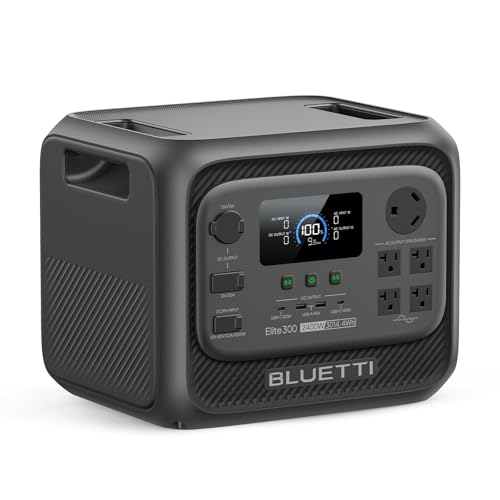
BLUETTI Elite 300 Portable Power Station (3014Wh LiFePO4, 2400W)
$1,098.99
Check price on AmazonOur BLUETTI for CPAP guide compares the rest of the lineup.
4. Jackery Explorer 2000 v2 solar kit: lightest 2 kWh bundle
The Jackery Explorer 2000 v2 kit pairs a 2,042 Wh station with two 200W panels, and the station weighs only 39.5 lb. That's the lightest of the 2 kWh picks, which matters if you'll carry it upstairs every night. It delivers 10.6 dry or 4.0 humidified-high nights over AC.
Jackery lists a UPS switchover of 20 ms or less, tested to UL1778, and a noise rating under 30 dB.
- Con: solar input maxes out at 400W, so the included panels already use all of it. You can't grow the array.
- Con: 20 ms is slower than the 10 ms units. Jackery says it's suitable for CPAP, but test it with your machine before you depend on it.

Jackery Explorer 2000 v2 + 2×200W Solar Panels (2042Wh, 2200W)
$1,329.00
Check price on Amazon5. Anker SOLIX F3800: whole-home and most expandable
The Anker SOLIX F3800 is for someone backing up more than a CPAP. Its 3,840 Wh gives 20 dry or 7.5 humidified-high nights on its own. Expansion batteries take it to 26.9 kWh, enough to cover a fridge and a furnace fan too.
It outputs 120V and 240V, so an electrician can connect it to a transfer switch or a well pump circuit. Solar input is 2,400W across two 1,200W inputs. Anker lists an under-20 ms UPS; reviewers measured about 32 dB at idle and 48 dB at a 4 kW load.
- Con: 132 lb on wheels. It won't live on a nightstand.
- Con: it's overkill if the CPAP is all you need to power.

Anker SOLIX F3800 Portable Power Station (3840Wh LFP, 6000W, 120/240V)
$1,979.99
Check price on Amazon6. Jackery Solar Generator 1000 v2: the step-down bundle
The Jackery Solar Generator 1000 v2 is the pick when a 2 kWh station is more than you need. Its 1,070 Wh covers 5.6 dry nights or 2.1 humidified-high nights, which suits a weekend outage or a short wildfire shutoff. The bundled 200W panel refills about 1.2 humidified-high nights per sunny day.
At 23.8 lb it's easy to move, and Jackery lists a quiet mode under 22 dB and an under-20 ms UPS.
- Con: a single 200W panel won't keep a humidified user net-positive. The 400W solar cap leaves room to add a second panel.

Jackery Solar Generator 1000 v2 + 200W Solar Panel (1070Wh, 1500W)
$699.00
Check price on AmazonAlso considered
- Anker SOLIX C2000 Gen 2 (about $900). 2,048 Wh, a 10 ms UPS, 30 dB and 800W solar input. Unlike the other 2 kWh picks, it expands to 4,096 Wh with the BP2000 battery. Choose it if you want to start at 2 kWh and grow later.
- Jackery HomePower 3000 (about $1,349). 3,072 Wh, 3,600W output, a TT-30 outlet and a UPS switchover of 20 ms or less. It's a Jackery alternative to the Elite 300 with 6.0 humidified-high nights. Sources disagree on warranty length, so check the listing.
- EcoFlow DELTA Pro 3 (about $2,784). 4,096 Wh, a 10 ms UPS, 2,600W solar, 240V output and expansion to 48 kWh. It's a strong whole-home alternate to the F3800, but stock was limited at the time of writing.
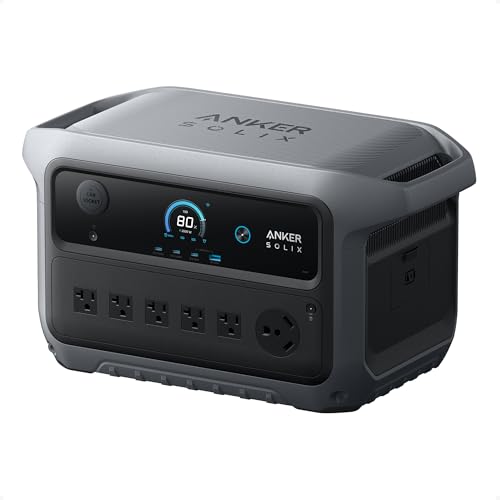
Anker SOLIX C2000 Gen 2 Portable Power Station (2048Wh LFP, 2400W)
$899.99 – $1,499
Check price on AmazonBundle vs buying panels separately
A bundle is simpler, but it isn't always cheaper, and the station's solar input cap should decide how many panels you buy. The BLUETTI Elite 200 V2 costs about $899 alone and about $1,299 with two 200W panels, so the two panels add about $400. Compare that with separate panel prices before you buy.
Before you buy panels for any station, check three things:
- Solar input cap. Watts above the cap are wasted. The DELTA 3 Max caps at 500W and the Jackery 2000 v2 at 400W. The Elite 200 V2 (1,000W), Elite 300 (1,200W) and F3800 (2,400W) leave room to grow.
- Voltage window. Panels wired in series add voltage. The total open-circuit voltage must stay inside the station's input range, or it won't charge. The station's spec page lists the range.
- Connector. Many stations use XT60 or Anderson inputs. A matching cable is often included in bundles and sold separately otherwise.
In short: buy the bundle when it maxes out or nearly maxes out the station's input, as with the Jackery 2000 v2. Buy the station bare when you want more panel wattage than the bundle includes.
UPS switchover, noise and weight: what matters for a bedroom
For a CPAP user, the three specs that matter most after capacity are UPS switchover time, noise and whether you can move the unit. All six picks use pure sine wave inverters, which is what CPAP power supplies expect. Our pure sine vs modified sine guide explains why.
UPS switchover. In UPS mode the station passes wall power through to your CPAP and switches to battery when the grid drops. Our picks list 20 ms or less. ResMed and Philips don't publish how long their machines ride through a gap, so we don't assume one. Instead, test it: run the CPAP from the station, unplug the station from the wall, and confirm therapy continues. Our UPS vs CPAP battery vs power station guide compares the three approaches.
Noise. At an 18–48W CPAP load, most of these stations run quietly or silently. The fans come on mainly during fast charging. Schedule charging for the daytime, or charge in another room.
Weight. Under 45 lb (Jackery 2000 v2, DELTA 3 Max, C2000 Gen 2) is carryable. Over 100 lb (F3800, DELTA Pro 3) means wheels and one fixed spot, usually near the panel run.
Run the CPAP on DC. These stations have a 12V car port, typically rated around 10A. With a 12V-to-24V converter for the AirSense 11, you skip the inverter and its idle draw, and gain roughly 10–20% more runtime. On a 2 kWh station that's about 0.7–0.8 extra humidified-high nights. The Elite 300 and DELTA Pro 3 also have a 12V/30A DC output. Our CPAP DC power adapter guide covers adapters for other machines.
Gas generator as backup: the hybrid plan (and CO safety)
As a generator for CPAP machine backup, a gas inverter model works best as a daytime charger, not an overnight power source. Run an inverter generator outdoors during the day to recharge the power station, then run the CPAP from the station at night. You sleep with no engine running, and cloudy days no longer drain your reserve.
Carbon monoxide is the risk that makes this rule non-negotiable. The CPSC warns that generator CO can kill in minutes. Both the CPSC and CDC say:
- Never run a generator indoors, or in a garage, basement, crawlspace or shed, even with doors or windows open.
- Run it outdoors, more than 20 feet from windows, doors and vents, and never near a bedroom window.
- Keep a working battery-powered or battery-backup CO alarm inside the home.
We don't recommend running a generator overnight, and we don't recommend plugging a CPAP straight into one while you sleep.
Why the Honda EU2200i. It's the reference clean-output inverter generator: Honda rates it at 48–57 dBA, and its CO-MINDER system shuts the engine off if CO builds up around it. Honda lists about 8.1 hours of runtime at 25% load on its 0.95-gallon tank, and 3.2 hours at rated load.
Fuel math. Many 2 kWh stations list an AC recharge of roughly 1–2 hours at full charge speed. Set the station's AC charge rate below the generator's rated output in the station app. Two to three hours of daytime running at that reduced rate refills most of a 2 kWh station, which covers about 4 humidified-high nights, on less than one tank. A few gallons of stabilized fuel, stored safely outside the living space, stretches a solar plan through a long stretch of cloudy days.

Honda EU2200i 2200 Watt Inverter Generator (EU2200ITAN)
$1,199.00
Check price on AmazonWith this hybrid setup, the solar generator for CPAP stays your overnight power source, and the gas generator becomes insurance against a week of clouds.
For a full outage checklist, including when to head to a shelter or hospital, see our CPAP power outage prep guide. Talk to your doctor or DME supplier about your plan, especially if you use oxygen or a BiPAP.
When a 2–4 kWh station is overkill
A 2–4 kWh solar generator is overkill if you use your CPAP dry and your outages rarely last more than one or two nights. In that case, roughly 400–1,000 Wh is enough. A dry AirSense 11 needs only about 192 Wh per night over AC once you allow for losses.
- Dry CPAP, 1–2 nights: a smaller battery from our best backup battery for CPAP list costs a fraction of these picks.
- Humidified CPAP, 2–3 nights: a 1 kWh station such as the EcoFlow DELTA 3 Plus (1,024 Wh), or the Jackery 1000 v2 bundle above.
- Whole-home backup: the Anker SOLIX F3800 or EcoFlow DELTA Pro 3 with a transfer switch. Hire a licensed electrician for any connection to your home's wiring.
Related reading
- CPAP power outage prep guide
- CPAP hurricane preparedness
- CPAP winter storm backup
- How to solar charge a CPAP battery
- CPAP battery sizing guide
What to do next
- Work out your nightly Wh. Use the CPAP battery runtime calculator with your real humidifier and tube settings.
- Pick your tier. Multiply by the nights you want to cover and divide by 0.75. A result of about 1.5 kWh (three humidified-high nights) points to a 2 kWh station; five or more humidified-high nights without sun points to 3 kWh or more.
- Charge and test before storm season. Fully charge the station, run your CPAP from it for a night, and test UPS mode by unplugging it from the wall.
- Buy the 12V CPAP converter. Running on DC adds roughly 10–20% more runtime.
- Set up a CO alarm if a generator is part of your plan, and pick an outdoor spot more than 20 feet from any door, window or vent.


