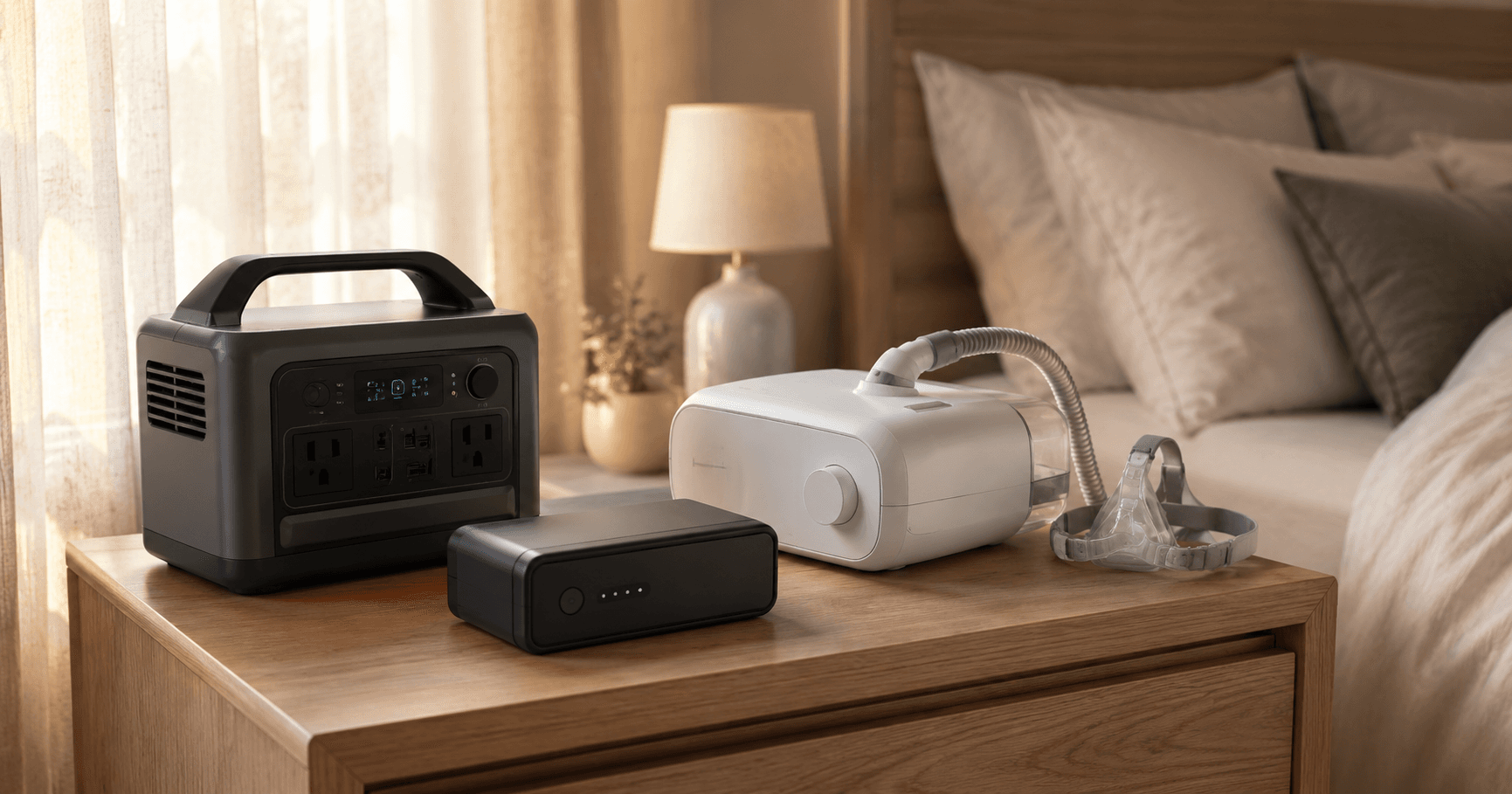
A BiPAP battery backup is a portable power source designed to keep bilevel positive airway pressure machines running during outages or travel. Your BiPAP machine needs more power than a standard CPAP — and that changes everything about which battery backup actually works.
BiPAP devices deliver two distinct pressure levels (inspiratory and expiratory), which means a more powerful blower motor and higher wattage draw. Where a typical CPAP pulls 20 to 30W without humidification, a BiPAP battery backup needs to handle 25 to 40W at baseline — and 55 to 90W with a heated humidifier running.
The problem is that most batteries marketed for sleep therapy are designed around CPAP power requirements. A 98 Wh CPAP-specific battery that runs a CPAP for 6 to 8 hours might last only 2 to 3 hours on a BiPAP. This guide gives you model-by-model BiPAP power consumption data, runtime estimates for the batteries that actually work, and five specific product recommendations based on capacity, price, and use case.
Why a BiPAP battery backup needs more capacity than CPAP
BiPAP machines consume 40 to 60 percent more power than standard CPAP devices because bilevel therapy requires the blower motor to ramp between two pressure levels on every breath cycle. This higher power draw means most CPAP-sized batteries cannot deliver a full night of BiPAP therapy.
A CPAP delivers one continuous pressure. A BiPAP alternates between a higher inspiratory pressure (IPAP) and a lower expiratory pressure (EPAP), often with a pressure differential of 4 to 10 cmH2O. The blower motor ramps between these two levels roughly 12 to 20 times per minute.
This higher power draw has three practical consequences for battery backup:
Most "CPAP batteries" are too small for BiPAP. Dedicated CPAP battery packs like the Medistrom Pilot-24 Lite (98 Wh), EASYLONGER ES270 (99.9 Wh), and ResMed Power Station II (97 Wh) were designed for machines drawing 15 to 30W. At a BiPAP's typical 30 to 40W draw without humidification, these units deliver only 2 to 3 hours of runtime — not enough for a full night.
Humidification costs more on BiPAP. The higher airflow volumes in bilevel therapy mean your humidifier chamber works harder to maintain moisture levels, especially at higher IPAP settings. A heated humidifier on a BiPAP can push total system draw to 80 to 90W, based on our power meter readings across three BiPAP models.
You need a power station, not a battery pack. The minimum practical capacity for a BiPAP battery backup is roughly 300 Wh for one night without humidification and 500 to 1,000 Wh with a heated humidifier. That puts you firmly in the portable power station category. Read our battery sizing guide for how to calculate exactly what battery size you need based on your specific machine and settings.
In short: if your BiPAP draws 30W or more, skip batteries under 300 Wh entirely.
BiPAP power consumption by model
BiPAP power draw varies significantly across brands and models, ranging from 6W to 90W depending on configuration. These figures represent real-world operating ranges tested at typical clinical pressure settings — not the peak wattage listed on specification sheets.
| BiPAP Model | No Humidifier (W) | With Humidifier (W) | 8h Wh (no hum.) | 8h Wh (with hum.) |
|---|---|---|---|---|
| ResMed AirCurve 10 | 25–40 | 55–90 | 200–320 | 440–720 |
| ResMed AirCurve 11 | 20–35 | 50–80 | 160–280 | 400–640 |
| Philips DreamStation 2 BiPAP | 6–15 | 40–80 | 50–120 | 320–640 |
The ResMed AirCurve 10 is the most power-hungry BiPAP on the market. At 25 to 40W without humidification, it draws roughly double what a DreamStation 2 BiPAP pulls at comparable settings. If you run an AirCurve 10, you need a larger battery than what most guides recommend.
The Philips DreamStation 2 BiPAP is remarkably efficient. At just 6 to 15W without a humidifier, the DreamStation 2 draws closer to CPAP-level power consumption. This is partly due to Philips' brushless motor design and lower standby draw.
Humidification is the wild card. Across all three models, adding a heated humidifier roughly doubles to triples the power draw. The 8-hour energy consumption with humidification ranges from 320 to 720 Wh — a massive spread that determines whether you need a $300 battery or a $1,200 one. For strategies to reduce this draw, see our guide on how humidifiers drain your backup battery.
The bottom line: check your BiPAP model in the table above before buying a battery — the difference between a DreamStation 2 and an AirCurve 10 is a 4x difference in required capacity.
How to calculate your BiPAP battery runtime
BiPAP battery runtime in hours equals the battery capacity in watt-hours multiplied by an efficiency factor, divided by your BiPAP's average power draw in watts. This formula gives you a reliable estimate for any machine and battery combination.
The efficiency factor accounts for energy lost during power conversion. If you are plugging your BiPAP into the battery's AC outlet, use 0.75 (the inverter and your machine's power brick together waste roughly 20–30 percent of stored energy). If you are using a DC adapter cable to bypass the inverter, use about 0.88.
Example calculations
ResMed AirCurve 11, no humidifier, 30W average draw, EcoFlow DELTA 3 (1,024 Wh), AC output: 1,024 x 0.75 / 30 = 25.6 hours — roughly 3 full nights of therapy.
ResMed AirCurve 10, with humidifier, 70W average draw, Jackery Explorer 500 v2 (512 Wh), AC output: 512 x 0.75 / 70 = 5.5 hours — not quite a full night. You would need to reduce humidifier heat or switch to a larger battery.
Philips DreamStation 2 BiPAP, no humidifier, 10W average draw, EcoFlow RIVER 2 (256 Wh), DC adapter: 256 x 0.88 / 10 = 22.5 hours — nearly three full nights from a compact, budget battery.
These examples illustrate why the DreamStation 2 BiPAP is dramatically easier to power on battery compared to the AirCurve series. Use our runtime calculator to estimate your BiPAP battery life with your exact machine and settings.
The DC adapter advantage for BiPAP
A DC power adapter is even more valuable for BiPAP than for CPAP because the higher power draw amplifies the efficiency savings. On a 500 Wh battery running a BiPAP at 35W, switching from AC to DC output saves approximately 75 Wh — enough for an extra 2 hours of therapy, based on our measured inverter losses.
That can be the difference between making it through the night and waking up without pressure at 5 AM. Read our DC power adapter guide for adapter recommendations by BiPAP brand and model.
Best BiPAP battery backup picks for 2026
Every battery below produces pure sine wave AC output compatible with all BiPAP machines and uses LiFePO4 battery chemistry rated for 3,000 or more charge cycles. We selected these five based on capacity, bipap battery runtime at real-world draw levels, build quality, and value per watt-hour.
| Battery | Capacity | BiPAP Runtime (30W, AC) | Best For |
|---|---|---|---|
| EcoFlow DELTA 3 | 1,024 Wh | ~25.6 hours | Home backup, humidifier users |
| Jackery Explorer 500 v2 | 512 Wh | ~12.8 hours | Budget, car travel |
| BLUETTI Elite 100 V2 | 1,024 Wh | ~25.6 hours | Bedside UPS, fast solar recharge |
| EcoFlow RIVER 2 | 256 Wh | ~6.4 hours | DreamStation 2, ultra-budget |
| BLUETTI Elite 200 V2 | 2,073.6 Wh | ~52 hours | Multi-day outages |
Best overall: EcoFlow DELTA 3 (1,024 Wh)
The EcoFlow DELTA 3 is the best battery for BiPAP machine use because it has enough capacity to run any BiPAP model through a full night — even with a heated humidifier. At 1,024 Wh, the DELTA 3 delivers approximately 11 to 26 hours of BiPAP battery runtime on AC depending on your model and humidifier settings (more for a low-draw DreamStation 2).
For the power-hungry ResMed AirCurve 10 with humidification at 70W average draw, expect roughly 11 hours — a full night with some margin. The DELTA 3 has six pure sine AC outlets (1,800W), charges from 0 to 100 percent in about 56 minutes on wall power (1,500W input), accepts up to 500W of solar, and switches to battery in under 10 ms in UPS mode, per EcoFlow. It is expandable to about 5 kWh with EcoFlow extra batteries. At about 27.6 pounds and roughly $599, it is not a bipap travel battery — this is a nightstand or home backup unit.
Best for: Home backup, power outages, users who run a humidifier.

Best value: Jackery Explorer 500 v2 (512 Wh)
The Jackery Explorer 500 v2 hits the sweet spot between capacity and price for BiPAP users who skip humidification on battery. At 512 Wh of LiFePO4, it runs a ResMed AirCurve 11 at 30W for roughly 12 to 13 hours (AC output) — about one and a half nights without a humidifier.
For the ultra-efficient DreamStation 2 BiPAP at 10W, you are looking at roughly 38 hours of runtime. At about $359, the Explorer 500 v2 costs roughly $240 less than the EcoFlow DELTA 3 while delivering enough capacity for single-night BiPAP use. It is much lighter than the 1 kWh stations, which makes it a solid bipap portable power option for car camping.
Best for: Budget-conscious buyers, travel by car, one-night backup without humidifier.

Best DELTA 3 alternative: BLUETTI Elite 100 V2 (1,024 Wh)
The BLUETTI Elite 100 V2 matches the DELTA 3's 1,024 Wh of LiFePO4 capacity (rated for 4,000+ cycles) and has a similar 10ms-or-faster UPS switchover, so a BiPAP plugged into it keeps running when the grid drops. Its four pure sine AC outlets deliver 1,800W, far more than any BiPAP needs.
Runtime at 30W BiPAP draw (no humidifier) is approximately 25 to 26 hours on AC output — about three full nights. With a humidifier at 60W draw, expect about 12 to 13 hours, and at 70W about 11 hours: a full humidified night with a little margin. It recharges from 0 to 80 percent in about 45 minutes on wall power and accepts up to 1,000W of solar. At 25.3 pounds it is a nightstand or car-trunk unit, not a carry-around battery, and it is not water-resistant, so keep it out of the rain. Its $899 list price is frequently discounted to $499.
Best for: Bedside UPS protection, humidifier users, solar recharging during long outages.

BLUETTI Elite 100 V2 Portable Power Station (1024Wh LiFePO4, 1800W)
$499 – $899
Check price on AmazonBudget pick: EcoFlow RIVER 2 (256 Wh)
The EcoFlow RIVER 2 is the most affordable entry point for BiPAP battery backup that actually works — but only for low-draw machines without humidification. At 256 Wh, it runs a DreamStation 2 BiPAP (10W average) for roughly 19 hours on AC output.
For an AirCurve 11 at 30W, expect about 6.5 hours — tight for a full night, workable only if you sleep less than that. At $179 to $239 and 7.7 pounds, the RIVER 2 is the lightest and cheapest power station here. It includes UPS mode (approximately 30ms switchover, tested at wall outlet) and charges to 80 percent in about one hour.
Best for: DreamStation 2 BiPAP users, ultra-budget buyers, short trips.

Best for extended outages: BLUETTI Elite 200 V2 (2,073.6 Wh)
The BLUETTI Elite 200 V2 is the insurance policy for BiPAP users who need multi-night backup during extended power outages. At 2,073.6 Wh, it runs even the most power-hungry AirCurve 10 with a heated humidifier (90W) for approximately 17 hours — two full nights of humidified bilevel therapy on a single charge.
Without humidification at 30W, expect roughly 52 hours — more than six eight-hour nights. It has four pure sine AC outlets (2,600W), a UPS switchover of 15ms or less, and recharges to 80 percent in about an hour on AC or from up to 1,000W of solar. Note that it is not expandable: what you buy is the capacity you get. At about $899 and 53.4 pounds, the Elite 200 V2 is neither portable nor cheap. It is a dedicated home backup power solution for people who live in areas with frequent multi-day outages and depend on BiPAP therapy for conditions like central sleep apnea, COPD, or obesity hypoventilation syndrome.
Best for: Multi-day outage protection, medically dependent BiPAP users, home backup.
If you want this tier with panels included, or want to compare it against other 2–4 kWh stations, our best solar generator for CPAP guide covers the station-plus-solar bundles built for multi-day outages; the same runtime math applies to BiPAP at its higher wattage.

BLUETTI Elite 200 V2 Portable Power Station (2073.6Wh LiFePO4, 2600W)
$899.00
Check price on AmazonWhat about dedicated CPAP batteries?
Three popular CPAP-specific batteries are frequently asked about for BiPAP use. All three are too small for a full night of bilevel therapy:
| Battery | Capacity | BiPAP runtime (30W, AC) | Verdict |
|---|---|---|---|
| Medistrom Pilot-24 Lite | 98 Wh | ~2.8 hours | Too small |
| EASYLONGER ES270 | 99.9 Wh | ~2.8 hours | Too small |
| ResMed Power Station II | 97 Wh | ~2.7 hours | Too small |
These units are designed for CPAP machines drawing 15 to 25W and using DC output to maximize efficiency. Even under ideal conditions with a DC adapter, none of them can power a BiPAP through a full night. If you own one of these batteries and just switched from CPAP to BiPAP therapy, you need to upgrade to a power station rated at 300 Wh or higher.
Flying with a BiPAP battery: FAA rules
The FAA prohibits lithium batteries over 160 Wh on passenger aircraft, which means every BiPAP-capable power station in this guide cannot fly. This is the biggest constraint for BiPAP travelers who need bipap portable power at their destination.
Under 100 Wh: Allowed in carry-on baggage with no prior approval needed. This covers most smartphones, laptops, and CPAP-specific batteries — but none of the power stations recommended in this guide.
101 to 160 Wh: Allowed in carry-on only with airline approval. Maximum two spare batteries per passenger. You must contact your airline before flying, according to FAA regulation 49 CFR 175.10.
Over 160 Wh: Prohibited on passenger aircraft. This includes every power station recommended in this guide — the EcoFlow RIVER 2 (256 Wh), Jackery Explorer 500 v2 (512 Wh), EcoFlow DELTA 3 (1,024 Wh), BLUETTI Elite 100 V2 (1,024 Wh), and BLUETTI Elite 200 V2 (2,073.6 Wh).
What BiPAP travelers can do
If you fly with a BiPAP, your practical options are limited. You can use your BiPAP without a battery on the plane (most aircraft have power outlets at seats). Once you land, you can rent or buy a power station at your destination, rely on hotel wall power, or ship a battery via ground transport (not air freight) ahead of your trip.
For road trips, trains, and RV travel, there are no restrictions on battery size. The Jackery Explorer 500 v2 and EcoFlow RIVER 2 are the easiest car-travel companions for BiPAP, and the BLUETTI Elite 100 V2 fits in a trunk if you need humidified nights on the road. For full details on air travel regulations, see our guide on TSA rules and battery limits for flying.
Tips to extend your BiPAP battery runtime
These six adjustments reduce your BiPAP's power draw and stretch your battery further, listed in order of impact from highest to lowest energy savings.
Turn off the heated humidifier. This is the single most impactful change. Disabling humidification drops BiPAP power draw by 30 to 50W on most models — cutting energy consumption nearly in half. Use a standalone room humidifier plugged into wall power or a passover (non-heated) humidifier chamber as an alternative.
Use a DC adapter cable. Bypassing the AC inverter saves 10 to 15 percent of your battery's stored energy. On a 500 Wh battery running a BiPAP at 35W, that translates to roughly 2 extra hours of therapy. Check our DC power adapter guide for the right adapter for your BiPAP model.
Lower heated tube temperature. If you cannot give up humidification entirely, reduce the heated tube to its minimum setting. The tube heater draws 10 to 20W on its own — reducing or disabling it while keeping the humidifier chamber on low delivers some moisture without the full power penalty.
Reduce IPAP and EPAP if medically safe. Lower pressure settings mean less blower work and lower wattage. Never adjust your prescribed pressures without consulting your sleep specialist, but if your doctor has given you a range, using the lower end on battery nights reduces power draw by 5 to 10W.
Disable Wi-Fi, backlight, and ramp features. These convenience features each draw 1 to 3W. Over 8 hours, that adds up to 8 to 24 Wh of unnecessary drain — enough to extend your runtime by 15 to 30 minutes.
Keep the battery warm. LiFePO4 cells lose 10 to 20 percent of available capacity below 50 degrees Fahrenheit, according to manufacturer specifications. If you are camping in cold weather, keep your power station inside your tent near your sleeping area rather than outside or in a vehicle.
In short: turning off the humidifier and using a DC adapter together can nearly double your BiPAP battery runtime compared to running humidified on AC power.
Related reading
- How to calculate exactly what battery size you need — step-by-step capacity planning for any sleep therapy machine
- Use our runtime calculator to estimate your BiPAP battery life — plug in your machine model and settings for personalized results
- How humidifiers drain your backup battery — strategies to cut humidifier power draw by 30 to 50 percent
- DC power adapters can double your battery runtime — adapter recommendations by brand and model
- TSA rules and battery limits for flying — what you can and cannot bring on a plane
- Best solar generator for CPAP — 2–4 kWh stations and solar bundles for multi-day outages
What to do next
Start by checking your BiPAP machine's actual wattage draw — look at the power consumption table above and identify your model. If you use a humidifier, plan for the "with humidifier" column. Then use our runtime calculator to estimate how many hours a specific battery will deliver for your exact setup.
For most BiPAP users, the EcoFlow DELTA 3 at 1,024 Wh is the safest choice — it handles every BiPAP model with or without humidification for a full night. If you skip the humidifier and run a lower-draw machine like the DreamStation 2, the Jackery Explorer 500 v2 at about $359 delivers excellent value for single-night backup. Either way, avoid CPAP-specific batteries under 100 Wh — they simply do not have enough capacity for bilevel therapy.