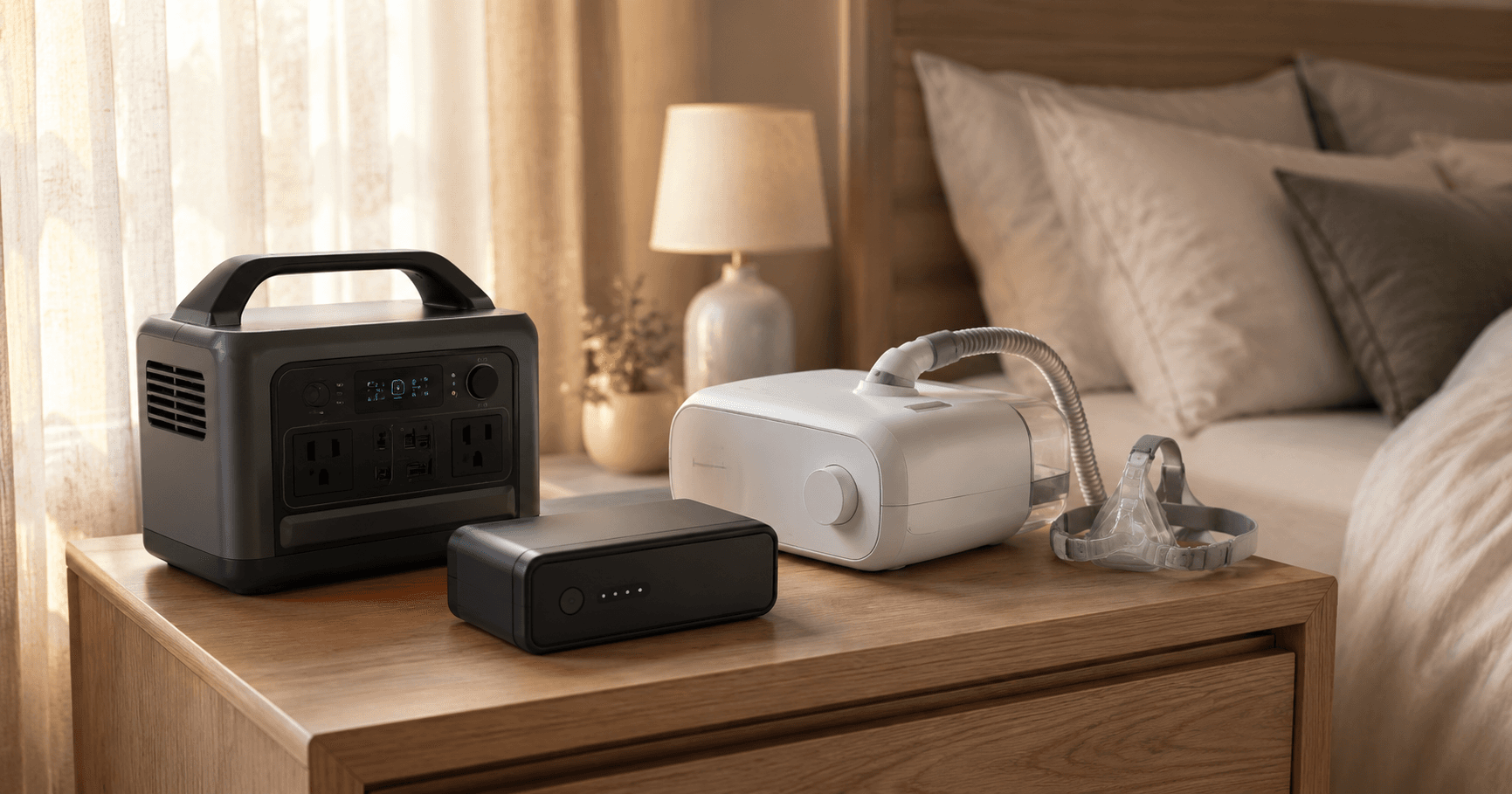
The best Jackery for CPAP is the Explorer 1000 v2 (1,070 Wh). It runs a ResMed AirSense 11 about 5 dry nights or 2 humidified nights per charge. The Explorer 500 v2 covers one full humidified night. The 288 to 293 Wh Explorer 300 models cover one dry night only. Use the 12V car port with a DC converter for about 15 percent more runtime.
Jackery sells nine power stations in the US right now, has retired several more, and changed battery chemistry and UPS behavior between generations. This guide covers nights per charge for each model, the DC trick that needs the right converter, which units can sit between the wall and your machine, and what you can carry onto a plane. If you are also weighing EcoFlow, our Jackery vs EcoFlow for CPAP comparison covers that head-to-head.
How long will a Jackery run a CPAP? The 60-second answer
A Jackery runs a CPAP for as many 8-hour nights as its watt-hour rating, times inverter efficiency, divided by your machine's draw, divided by eight. Here is that math done for every current and recent Jackery, across the three most common machines at their real settings.
Nights are 8-hour nights through the AC outlet at a mid-range 75 percent inverter efficiency. The number in parentheses is a conservative estimate (70 percent efficiency and 85 percent usable capacity) that covers a cold room or an older battery.
| Model | Wh | AirSense 11 dry (18W) | AirSense 11 humidifier low (28W) | AirSense 11 humidifier high (48W) | AirMini (11W) | DreamStation 2 dry (15W) | DreamStation 2 high (53W) |
|---|---|---|---|---|---|---|---|
| Explorer 100 Plus (USB-C only) | 99 | 0.5 (0.4) | 0.3 (0.3) | 0.2 (0.2) | 0.8 (0.7) | 0.6 (0.5) | 0.2 (0.1) |
| Explorer 240 v2 | 256 | 1.3 (1.1) | 0.9 (0.7) | 0.5 (0.4) | 2.2 (1.7) | 1.6 (1.3) | 0.5 (0.4) |
| Explorer 300 v2 | 288 | 1.5 (1.2) | 1.0 (0.8) | 0.6 (0.4) | 2.5 (1.9) | 1.8 (1.4) | 0.5 (0.4) |
| Explorer 300 (original) | 293 | 1.5 (1.2) | 1.0 (0.8) | 0.6 (0.5) | 2.5 (2.0) | 1.8 (1.5) | 0.5 (0.4) |
| Explorer 500 v2 | 512 | 2.7 (2.1) | 1.7 (1.4) | 1.0 (0.8) | 4.4 (3.5) | 3.2 (2.5) | 0.9 (0.7) |
| HomePower 1000 v2 | 1,024 | 5.3 (4.2) | 3.4 (2.7) | 2.0 (1.6) | 8.7 (6.9) | 6.4 (5.1) | 1.8 (1.4) |
| Explorer 1000 v2 | 1,070 | 5.6 (4.4) | 3.6 (2.8) | 2.1 (1.7) | 9.1 (7.2) | 6.7 (5.3) | 1.9 (1.5) |
| Explorer 1500 v2 | 1,536 | 8.0 (6.3) | 5.1 (4.1) | 3.0 (2.4) | 13 (10) | 9.6 (7.6) | 2.7 (2.2) |
| Explorer 2000 v2 | 2,042 | 11 (8.4) | 6.8 (5.4) | 4.0 (3.2) | 17 (14) | 13 (10) | 3.6 (2.9) |
| HomePower 3000 | 3,072 | 16 (13) | 10 (8.2) | 6.0 (4.8) | 26 (21) | 19 (15) | 5.4 (4.3) |
The machine draws come from our own planning figures: AirSense 11 at 18W dry, 28W with the humidifier on low and 48W on high; AirMini at 11W with the passive HumidX; DreamStation 2 at 15W dry and 53W with the humidifier on high. Our CPAP battery runtime calculator lets you swap in your own machine and settings, and the CPAP humidifier battery drain guide explains why the heater nearly triples the load.
The two-step version for anyone sizing by hand: an AirSense 11 uses about 144 Wh per 8-hour night dry, 224 Wh with the humidifier on low, and 384 Wh with the humidifier on high. Divide by 0.75 for AC losses, so a humidified-high night needs about 512 Wh of battery.
In short: no 300-class Jackery reliably covers a full humidified night over AC. The Explorer 500 v2 is the smallest Jackery that gives one full humidifier-high night at the mid estimate (8.0 hours) but misses on the conservative one (6.4 hours). The Explorer 1000 v2 is the smallest that covers a humidified night with margin on any estimate.
The Jackery lineup for CPAP in 2026: what is current, what is gone
Jackery's US store lists nine standard power stations as of October 2026: the Explorer 300, Explorer 300 v2, Explorer 300D, Explorer 1000 v2, HomePower 1000 v2, Explorer 1500 v2, Explorer 1500 Ultra, Explorer 2000 v2 and HomePower 3000. The Explorer 500 v2 has no US product page but still sells on Amazon US.
Gone or sold out: the Explorer 240 v2 and Explorer 100 Plus show "Sold Out" on jackery.com, the Explorer 300 Plus and 600 Plus US pages no longer exist, and the original Explorer 500, 1000 and 1500 have been replaced by v2 versions. A used original Explorer 1000 is a 1,002 Wh NMC unit, not the 1,070 Wh LiFePO4 1000 v2.
Specs that matter for CPAP use, from Jackery's product pages unless marked otherwise:
| Model | Capacity | Weight | AC output | 12V car port | UPS switchover | Chemistry |
|---|---|---|---|---|---|---|
| Explorer 300 (original) | 293 Wh | 7.5 lb | 300W, 2 outlets | Yes, 12V 10A | None published | Contradictory (see below) |
| Explorer 300 v2 | 288 Wh | 8.2 lb | 300W, 1 outlet | Yes, 12V 10A | 20 ms | LiFePO4, 4,000 cycles |
| Explorer 300D | 288 Wh | 5.5 lb | None (DC only) | Yes, 12V | n/a | LiFePO4, 4,000+ cycles |
| Explorer 500 v2 | 512 Wh | About 12.6 lb (EU spec; Amazon says 14 lb) | 500W, 2 outlets | Yes, 12V 10A | Under 10 ms (EU page) | LiFePO4, 6,000 cycles |
| Explorer 1000 v2 | 1,070 Wh | 23.8 lb | 1,500W, 3 outlets | Yes, 12V 10A | Under 20 ms | LiFePO4, 4,000 cycles |
| HomePower 1000 v2 | 1,024 Wh | Not published in our research | 1,500W | Not confirmed | Under 10 ms | LiFePO4, 6,000+ cycles |
| Explorer 1500 v2 | 1,536 Wh | About 32 lb (retailer figure) | 2,000W | Yes, 12V | "Fast UPS switching," no figure published | LiFePO4, 6,000+ cycles |
| Explorer 2000 v2 | 2,042 Wh | 39.5 lb | 2,200W, 3 outlets | Yes, 12V 10A | Under 20 ms | LiFePO4, 4,000 cycles |
| HomePower 3000 | 3,072 Wh | 59.5 lb | 3,600W | Yes, 12V 10A | 20 ms (retailer listing) | LiFePO4 |
Jackery's spec page lists the original Explorer 300 at 293 Wh and Amazon's listing says 292 Wh; we use 293 Wh, and the difference changes nothing in practice.


The Explorer 300 v2, 300D, 1500 v2 and HomePower 1000 v2 were not listed on Amazon US when we checked on October 24, 2026, so they have no product cards here. Buy those direct from Jackery.
Best Jackery for CPAP by scenario
The best Jackery for CPAP depends on one question: do you need to cover a humidified night, or a dry one? Pick your scenario below.
One dry night or car travel: Explorer 300 v2 (or the original 300 on sale)
The Explorer 300 v2 is the Jackery to buy for a single night without the humidifier. Its 288 Wh gives an AirSense 11 about 12 hours dry or 7.7 hours with the humidifier on low over AC, and it adds the three things the original lacks: confirmed LiFePO4 cells rated for 4,000 cycles, a 20 ms bypass-mode UPS, and 100W USB-C charging in both directions. Jackery's Explorer 300 v2 page lists a 15A AC input and about 4 hours from a car socket.
The original Explorer 300 is still worth buying when discounted below the v2: two AC outlets instead of one, and 7.5 lb instead of 8.2 lb. You give up the UPS rating and the chemistry certainty, covered below.
Skip the Explorer 240 v2 even if you find old stock: 256 Wh covers a dry night with little margin. Our best power stations under $200 for CPAP roundup has better options at that price.
One humidified night or two dry nights: Explorer 500 v2
The Explorer 500 v2 is the smallest Jackery that gets a humidified AirSense 11 through the night. From 512 Wh you get about 21 hours dry, 13.7 hours on humidifier low, and 8.0 hours on high over AC at the mid estimate. On the conservative estimate that last number drops to 6.4 hours, so if you run the humidifier at the top setting in a cold room, plan on a 1 kWh unit instead.
It is Amazon-only in the US as of October 2026; Jackery's own US store has no page for it. Amazon carries two listings for it; the cheaper one was $359 when we checked, the other $399. The EU spec sheet lists 6,000 cycles to 70 percent capacity and a UPS switchover under 10 ms, the fastest of any Jackery we found.
Outage prep for 2 to 5 nights: Explorer 1000 v2
The Explorer 1000 v2 is the best overall Jackery for CPAP, and the unit most people mean by "Jackery 1000 CPAP" today (the original 1,002 Wh Explorer 1000 is discontinued). From 1,070 Wh it delivers about 44.6 hours dry, 28.7 hours on humidifier low, and 16.7 hours on high over AC, which works out to 5.6, 3.6 and 2.1 nights. Even on the conservative estimate you get 1.7 humidified-high nights, so one full night with the heater maxed is never in doubt.
It also recharges fast enough to matter during a rolling outage: Jackery lists 1.58 hours from the wall, 1 hour in emergency charging mode, and 7.5 hours from 200W of solar. Its 30 dB quiet-charging mode and under-20 ms UPS make it workable on a nightstand. At 23.8 lb it is still a one-hand carry.
For camping, the same station bundled with Jackery's 200W panel refills about 1 to 1.5 nights per sunny day. Our CPAP battery camping guide covers how to set that up at a site without hookups.

Jackery Solar Generator 1000 v2 + 200W Solar Panel (1070Wh, 1500W)
$699.00
Check price on AmazonThe HomePower 1000 v2 (1,024 Wh, $699 list) is the bedroom-UPS version of this tier: 6,000-plus cycles, a sub-10 ms switchover, 3 kV surge protection and a 50-minute recharge. If the station will live plugged in beside the bed rather than travel, it is worth the premium. We could not find it on Amazon US, so compare prices direct.
Multi-day outage with the humidifier: Explorer 2000 v2 or HomePower 3000
Past three humidified nights you move into the 2 to 3 kWh class. The Explorer 2000 v2 (2,042 Wh, 39.5 lb) gives about 4.0 humidified-high nights or 11 dry nights. The HomePower 3000 (3,072 Wh, 59.5 lb) stretches that to 6.0 humidified or 16 dry nights, but it is a two-person lift.
Our best solar generator for CPAP guide ranks these two against the BLUETTI, EcoFlow and Anker equivalents and works through the panel math for keeping them topped up through a week-long outage. The short version: you need 400W or more of solar to break even with a humidifier running every night.

Jackery Explorer 2000 v2 + 2×200W Solar Panels (2042Wh, 2200W)
$1,329.00
Check price on Amazon
Jackery HomePower 3000 Portable Power Station (3072Wh LFP, 3600W)
$1,349.00
Check price on AmazonFlying: the Explorer 100 Plus, and only via USB-C
The Explorer 100 Plus (99.2 Wh) is the only Jackery that can fly. FAA rules allow lithium batteries up to 100 Wh in carry-on without airline approval, 101 to 160 Wh with approval, and nothing larger. Every other Jackery starts at 256 Wh, so it cannot go in carry-on or checked luggage. Jackery states UN 38.3 compliance for the 100 Plus and cites the 100 Wh rule itself; that is not the same as an FAA approval, which does not exist for any product.
The catch is that the 100 Plus has no AC outlet and no car port. It outputs 100W over USB-C PD only, so for CPAP it powers a ResMed AirMini through a USB-C PD trigger cable. It was sold out on jackery.com when we checked. Our CPAP on airplane TSA rules guide and USB-C PD CPAP power guide cover the cable side; the best battery for ResMed AirMini roundup has purpose-built alternatives.
Scenario summary
| Scenario | Best Jackery for CPAP | AirSense 11 nights (dry / low / high) | Weight | Amazon price (about) |
|---|---|---|---|---|
| One dry night, car travel | Explorer 300 v2 | 1.5 / 1.0 / 0.6 | 8.2 lb | Not on Amazon US; buy direct |
| One dry night, lowest price | Explorer 300 | 1.5 / 1.0 / 0.6 | 7.5 lb | $259 |
| One humidified night | Explorer 500 v2 | 2.7 / 1.7 / 1.0 | About 12.6 lb | $359 |
| 2 to 5 nights of outage | Explorer 1000 v2 | 5.6 / 3.6 / 2.1 | 23.8 lb | $499 |
| Bedside UPS, fastest switch | HomePower 1000 v2 | 5.3 / 3.4 / 2.0 | Not published | $699 list, direct |
| Multi-day with humidifier | Explorer 2000 v2 kit | 11 / 6.8 / 4.0 | 39.5 lb | $1,329 with 2x200W panels |
| Week-long with humidifier | HomePower 3000 | 16 / 10 / 6.0 | 59.5 lb | $1,349 |
| Flying (AirMini only) | Explorer 100 Plus | 0.8 AirMini nights | About 2.1 lb | Sold out at Jackery |
Prices are Amazon prices at the time of writing and move often, especially around Jackery's frequent sales.
DC vs AC on a Jackery: the 12V car port trick (and its limits)
Running your CPAP from a Jackery's 12V car port instead of the AC outlet gives you about 15 to 17 percent more runtime, because you skip the inverter. Our planning figures are 88 percent efficiency over DC versus 75 percent over AC. On an Explorer 300 v2 that turns a 12-hour dry night into about 14 hours, and a 4.5-hour humidified-high night into about 5.3 hours.
The limit is voltage. Every Jackery with a car port outputs 12V at 10A (120W). No Jackery has a 24V DC barrel or a regulated 24V output. A ResMed AirSense 10 or 11 and a Philips DreamStation 2 both need 24V, so you cannot plug them straight into the car port with a cigarette-lighter cable. You need a 12V-to-24V step-up converter made for your machine.
The HKY converter for the AirSense 11 is the one we recommend; ResMed's own Air11 DC/DC converter does the same job if you prefer a first-party part.
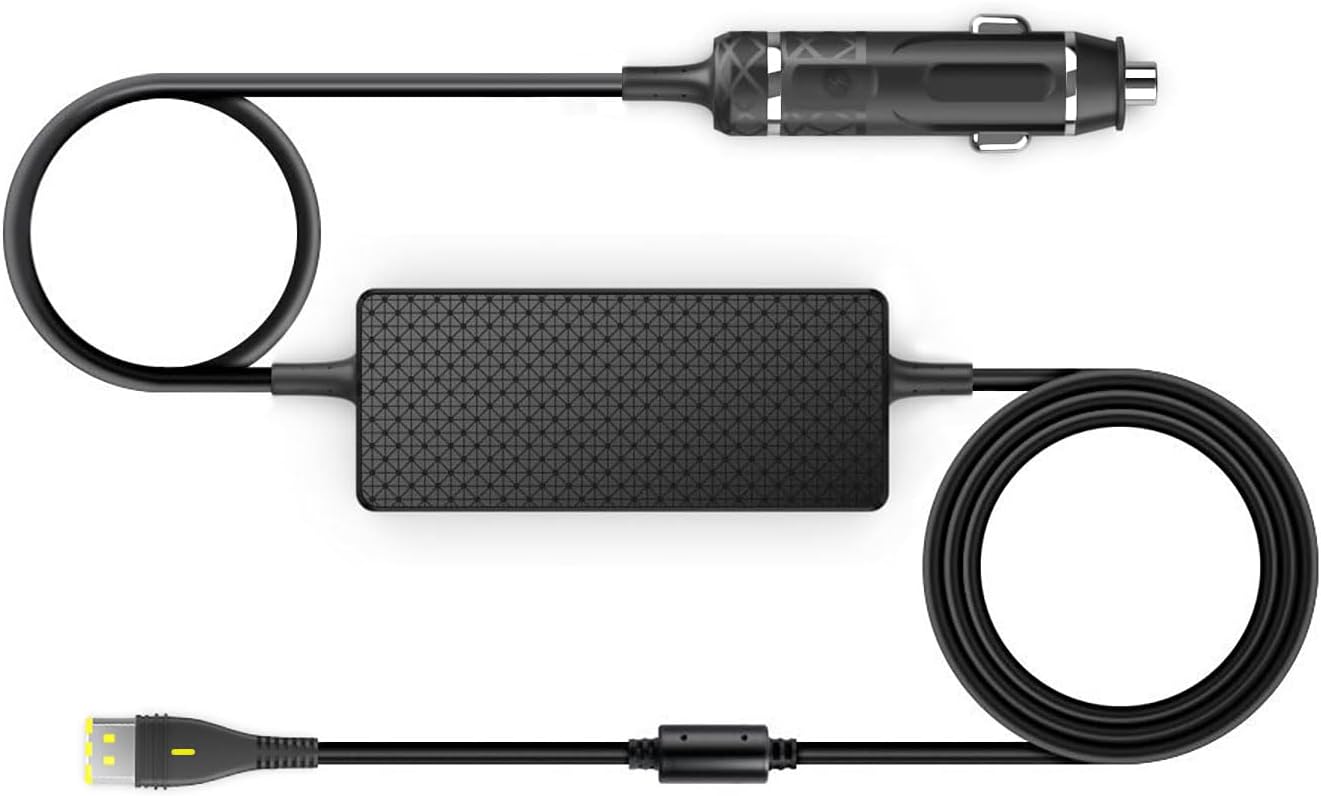
For a DreamStation 2 or any machine that takes a 12V cigarette-lighter adapter directly, the EASYLONGER car adapter covers four cable types from one 84W unit.

EASYLONGER Universal CPAP Car Adapter (84W, 4 DC Cables)
$42.99
Check price on AmazonAn AirMini is the easy case: it runs from a 12V car-port converter or a USB-C PD trigger cable with no step-up needed. Our CPAP DC power adapter guide matches every common machine to the right cable.
There is a second reason to use DC on a Jackery, and it is the one that bites CPAP users most often: Energy Saving Mode. Jackery's Explorer 300 v2 FAQ states that with the mode enabled, the unit "will automatically shut down all outputs after 6 hours if the power consumption remains below 25W for AC or 2W for USB/DC ports."
An AirSense 11 on dry mode pulls 18W, under that 25W AC threshold, so a user who leaves the switch on can wake at 3 a.m. with the inverter off and the mask dead. Slide the Energy Saving switch off before the first night. On the 12V port the threshold is only 2W, which any CPAP clears, so the DC path is also safe from the shutoff. Other Jackery models carry the same switch; check your unit's manual for its exact thresholds.
The Explorer 300D: Jackery's DC-native option
The Explorer 300D, released in August 2026, is the Jackery built for exactly this path. It is a 288 Wh LiFePO4 pack with no inverter at all: a 12V car port, a 140W USB-C cable built into the handle, and two more USB-C ports, in a 5.5 lb body. For a CPAP user who already owns the DC converter it is the lightest 288 Wh Jackery by nearly 3 lb and skips inverter loss on every night.
Two cautions. The 140W figure is the USB-C output; the car port is the same 12V 10A as every other Jackery, so a 24V machine still needs the converter. And no CPAP review of the 300D existed when we researched this. Jackery's own compatibility answer is that it depends on the CPAP's input requirements. Test a full night at home before you take it anywhere.
Jackery Explorer 300 vs 300 v2 for CPAP: LiFePO4, cycles and weight
For nightly Jackery Explorer 300 CPAP use, the Explorer 300 v2 is the safer buy for a battery you will cycle every night, because its LiFePO4 chemistry is confirmed and rated for 4,000 cycles to 70 percent capacity. The original Explorer 300's chemistry is not clear from Jackery's own listing.
Here is the problem. Jackery's current US page for the original Explorer 300 describes it as LiFePO4 with 4,000-plus cycles in its bullet list, but the body copy, independent spec sheets for the 2021 unit such as GearJunkie's, and the launch-era documentation all list lithium NMC cells rated for about 500 cycles. The bullet block reads like a copy of the 300 v2 marketing. If you want guaranteed LiFePO4, buy the 300 v2. If you buy the original, treat it as a 500-cycle battery until proven otherwise.
For a CPAP user cycling the battery most nights, that is a few hundred cycles a year: noticeable capacity loss within two years on NMC, a decade on LiFePO4. Our LiFePO4 vs lithium-ion CPAP battery guide goes through the numbers and the thermal-safety difference.
The trade-off is weight. LiFePO4 is less energy-dense, so the 300 v2 weighs 8.2 lb against 7.5 lb for the original, and drops to a single AC outlet. Across the rest of the lineup there is no decision to make: every v2, HomePower and 300D unit is LiFePO4, with 4,000 cycles on the 300 v2, 1000 v2 and 2000 v2 and 6,000 or more on the 500 v2, 1500 v2 and HomePower 1000 v2.
UPS and pass-through: which Jackery can sit between the wall and your CPAP
The best Jackery for CPAP backup beside the bed is one with a published switchover time; a unit without one cannot be trusted as a UPS. The idea is simple: the station stays plugged into the wall, your CPAP plugs into the station, and when the grid drops the station's battery picks up the load before the machine notices.
Jackery's published figures, by model:
- Under 20 ms: Explorer 1000 v2 and Explorer 2000 v2 (Jackery calls it "Seamless Power Switching" in bypass mode).
- Under 10 ms: Explorer 500 v2 (EU spec page) and HomePower 1000 v2.
- 20 ms: Explorer 300 v2 (Jackery's FAQ says "in just 20ms"), Explorer 240 v2 on the EU page, and HomePower 3000 per a Best Buy listing rather than Jackery's own sheet.
- No figure: Explorer 1500 v2 ("fast UPS switching," no number) and the original Explorer 300.
The original Explorer 300 allows pass-through, meaning you can run a load while it charges, but Jackery publishes no switchover time and makes no UPS claim for it. Pass-through is not a tested handoff. If your plan is a station that catches outages while you sleep, buy a v2 or HomePower unit.
A 20 ms gap should be shorter than the hold-up time of a typical CPAP power supply, so therapy should continue without a restart. The switchover figure is Jackery's claim, not our bench test. Test it yourself by pulling the station's wall plug mid-session on a night you can afford to wake up. Our UPS vs CPAP battery vs power station guide compares this approach with a dedicated UPS.
A station in bypass mode is always on, so fan noise and idle draw matter; the 1000 v2 and 2000 v2 list a 30 dB quiet mode, and the smaller units publish no noise figure. Note too that Jackery's own 300D FAQ says it does "not recommend using Jackery portable power stations for medical devices, life-support equipment." CPAP is therapy, not life support, but the disclaimer is a reminder that you, not Jackery, are responsible for testing the setup. Our CPAP battery safety guide covers what that testing should include.
Charging a Jackery back up between nights
Recharge speed decides whether a Jackery works for a multi-night outage with a few hours of grid or generator power in between. Jackery's published figures, from its product pages:
| Model | Wall (AC) to full | Car socket | Solar |
|---|---|---|---|
| Explorer 240 v2 | 2 h (1 h in rapid mode) | 5 h | Not published |
| Explorer 300 v2 | 15A fast input, time not published | About 4 h | 9.5 h on a 40W panel |
| Explorer 1000 v2 | 1.58 h (1 h emergency mode) | 12 h | 7.5 h on 200W |
| HomePower 1000 v2 | 50 min | Not published | Not published |
| Explorer 2000 v2 | 1.75 h | 24 h | Not published |
For solar between nights, plan on a SolarSaga 100W panel banking roughly 60 to 80 Wh per peak-sun hour in good conditions, or about 240 to 320 Wh on a 4-sun-hour day. That refills a dry AirSense 11 night (144 Wh plus losses, about 192 Wh) but only about half of a humidified-high night. The 200W panel in the Solar Generator 1000 v2 bundle roughly doubles that and matches Jackery's 7.5-hour full-recharge figure.

Car charging is slow above the 300 class: a long drive adds a night or two to the 1000 v2 or 2000 v2, not a full pack. Our solar charging CPAP battery guide covers panel angle, the 0.70 derating factor and how to chain charging during a multi-day CPAP power outage.
Related reading
- Jackery vs EcoFlow for CPAP for the two-brand comparison at the 300 Wh tier
- Bluetti for CPAP, EcoFlow for CPAP, Anker SOLIX for CPAP and Goal Zero for CPAP for the rest of the brand series
- Best solar generator for CPAP for the 2 to 4 kWh multi-day tier
- Best power stations under $200 for CPAP for budget alternatives to the Explorer 300
- CPAP DC power adapter guide for the converter that unlocks the 12V port
- CPAP battery runtime calculator to rerun these numbers for your machine
What to do next
- Find your row. Match your machine and humidifier setting in the nights table at the top, and read the conservative number in parentheses, not the mid one.
- Buy one size up if you humidify. The Explorer 500 v2 covers one humidified night at the mid estimate; the Explorer 1000 v2 covers it on any estimate. Cold rooms and heated tubes push you toward the larger unit.
- Order the 12V-to-24V converter with the station. It adds about 15 percent runtime and sidesteps the inverter entirely. Test a full night at home before you depend on it.
- Disable Energy Saving Mode before the first night. Jackery's 300 v2 FAQ says the unit shuts off all outputs after 6 hours under 25W on AC, and an 18W dry-mode CPAP sits under that line.
- Pull the wall plug once with the CPAP running from a v2 or HomePower unit, so you know the UPS handoff works before an outage tests it for you.