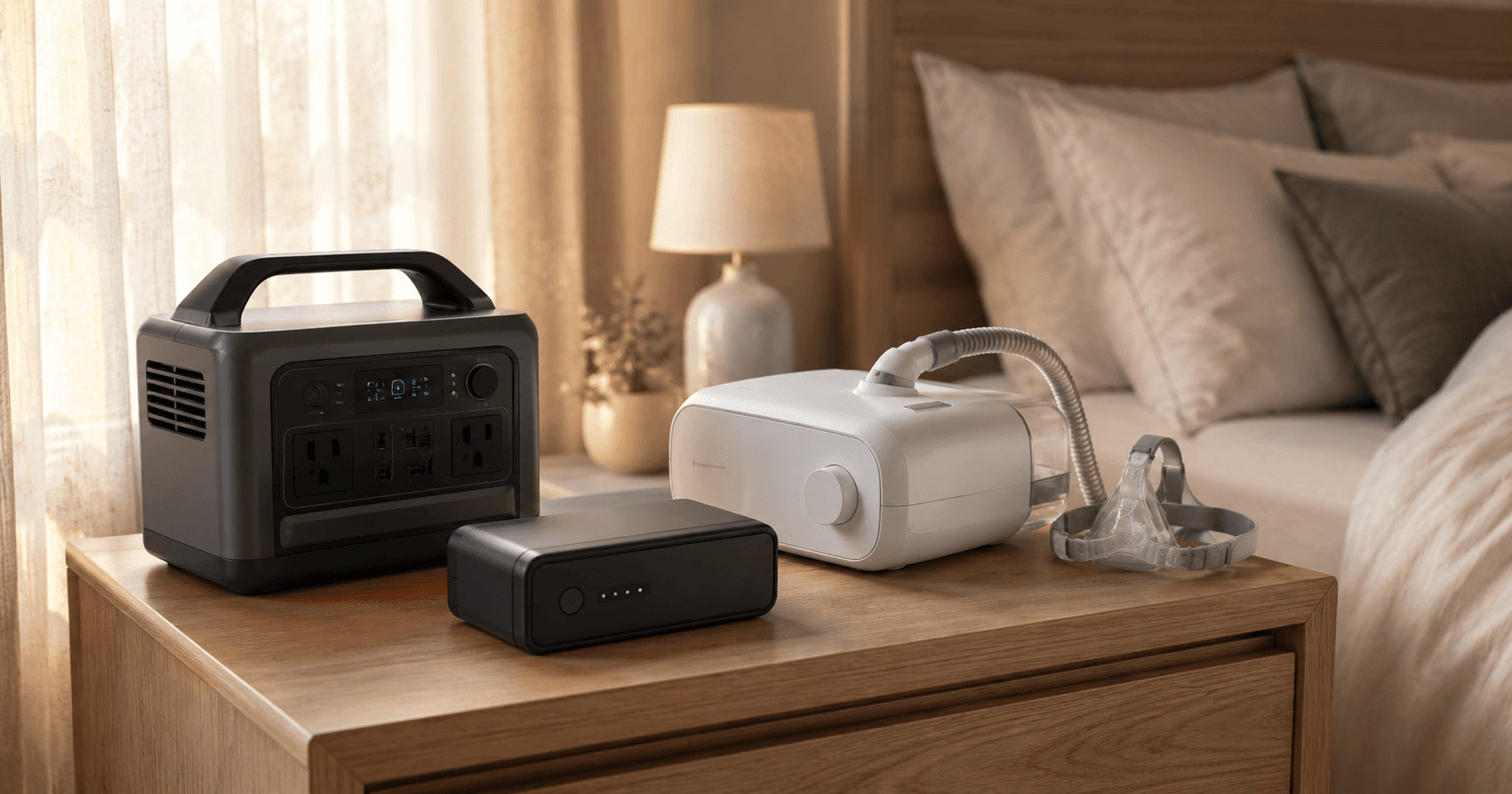
EcoFlow is one of the most popular power station brands for CPAP users, and for good reason: every model in the lineup outputs pure sine wave AC, charges fast enough to be useful in a multi-day outage, and offers a bedside UPS mode that switches to battery automatically in a blackout. The question most CPAP users actually have is narrower — which EcoFlow lasts all night, and which one is overkill? This guide walks through EcoFlow for CPAP by model, with runtime calculated directly from each unit's rated watt-hours and realistic CPAP power draw, so you can match the right battery to your machine instead of guessing.
Why EcoFlow works well for CPAP

EcoFlow power stations are a strong match for CPAP because they deliver pure sine wave AC power, the exact waveform a CPAP's electronics and blower motor are designed to receive. Cheaper "modified sine wave" inverters can cause buzzing, erratic flow data, or premature wear on sensitive medical electronics. Every EcoFlow covered here — RIVER 2, RIVER 2 Max, RIVER 2 Pro, and DELTA 3 — uses a true pure sine inverter, so your machine runs exactly as it would on wall power.
The second reason is the AC outlet plus DC output flexibility. You can plug your CPAP's standard power brick into the EcoFlow AC outlet, or, if your machine supports it, run a DC cable straight from the unit's car-style 12V port to bypass the inverter entirely. Running on DC skips the inverter conversion step and typically extends runtime by 15–25%, which matters a lot on a smaller battery like the RIVER 2.
EcoFlow also uses LiFePO4 (lithium iron phosphate) cells in the RIVER 2 series and the DELTA 3. The RIVER 2 series is rated for roughly 3,000+ cycles and the DELTA 3 for 4,000 cycles to 80% capacity. For a nightly bedside battery, that translates to years of service before noticeable degradation. The trade-off is that EcoFlow units run a small internal cooling fan under load. At the low wattage a CPAP draws the fan is usually quiet or off, but it is worth knowing before you put one on your nightstand — see the noise note in the model section below.
One important setup detail: leave X-Boost off when powering a CPAP. X-Boost is EcoFlow's feature that lets the inverter run higher-wattage resistive devices by lowering the output voltage instead of shutting off. It is great for a hair dryer, but a CPAP should get normal, full-voltage power, so disable X-Boost in the EcoFlow app before relying on the unit overnight.
Runtime by model and CPAP machine
How long an EcoFlow runs your CPAP comes down to two numbers: the battery's usable watt-hours and your machine's average power draw. The math is simple — usable watt-hours ÷ average watts = hours of runtime — and it is the most honest way to compare models without a marketing filter.
Start with usable capacity. A power station's rated watt-hours are not all reachable through the AC outlet; inverter overhead, idle draw, and your CPAP's power brick typically leave about 70–80% of the rating, so we multiply by 0.75. On a DC cable, expect closer to 85–90%.
- RIVER 2 — 256Wh rated, ~192Wh usable on AC
- RIVER 2 Max — 512Wh rated, ~384Wh usable on AC
- RIVER 2 Pro — 768Wh rated, ~576Wh usable on AC
- DELTA 3 — 1024Wh rated, ~768Wh usable on AC
Next, your CPAP's draw. We use a ResMed AirSense 11 as the reference: about 18W with the heated humidifier off, about 28W with the humidifier on low, and about 48W with it on high. A heated tube adds roughly 5–15W on top (our estimate). Your exact numbers depend on pressure setting, machine model, and humidity level — our CPAP power consumption guide explains how to find your own.
Here is the calculated runtime for each EcoFlow at those three draw levels (AC outlet, 8-hour nights):
| EcoFlow model | Usable Wh (AC) | Humidifier off (~18W) | Humidifier low (~28W) | Humidifier high (~48W) |
|---|---|---|---|---|
| RIVER 2 (256Wh) | ~192 Wh | ~10.5 hrs (1 night) | ~7 hrs (almost 1 night) | ~4 hrs (partial) |
| RIVER 2 Max (512Wh) | ~384 Wh | ~21 hrs (2.5 nights) | ~14 hrs (1.5 nights) | ~8 hrs (1 night) |
| RIVER 2 Pro (768Wh) | ~576 Wh | ~32 hrs (4 nights) | ~20.5 hrs (2.5 nights) | ~12 hrs (1.5 nights) |
| DELTA 3 (1024Wh) | ~768 Wh | ~43 hrs (5 nights) | ~27 hrs (3 nights) | ~16 hrs (2 nights) |
The pattern is clear. Without the humidifier, the RIVER 2 covers a single full night and the DELTA 3 stretches to roughly five nights. Turn the humidifier up to high and every estimate drops to well under half — the RIVER 2 no longer makes it to morning, while the DELTA 3 still covers two nights. This is the most important takeaway for sizing: the humidifier, not the model, is usually what decides whether you wake up to a working machine.
If your numbers fall between these scenarios, plug your real watts into our CPAP battery runtime calculator for a tailored figure. And if you are tempted to keep the humidifier running off-grid, read why that drains batteries so fast in our CPAP humidifier battery drain breakdown — turning the heater off and using a hose cover instead is the single biggest runtime win you can make.
Stretching runtime with DC and humidifier-off
Two adjustments dramatically extend any EcoFlow's CPAP runtime. First, run your machine on DC if it supports a 12V/24V CPAP cable — bypassing the inverter recovers much of the conversion loss, lifting usable energy from about 75% to about 85–90% of the rating. Second, turn the heated humidifier and heated tube off for battery nights. Together these two moves can more than double how many nights a single charge lasts.
The UPS mode advantage for bedside use
EcoFlow's UPS mode is the feature that makes it a genuine bedside CPAP backup rather than just a portable battery. In UPS mode the EcoFlow stays plugged into the wall and passes grid power straight through to your CPAP while keeping the battery topped off; when the grid drops, it switches to battery automatically. EcoFlow rates the DELTA 3's switchover at under 10 ms and the RIVER 2's at about 30 ms.
Look for a switchover of about 20 ms or less, which puts the DELTA 3 comfortably inside and the RIVER 2 a little outside. Even so, CPAP makers don't publish how long their machines ride through a power gap, and many CPAPs restart after any interruption, so test yours: with the CPAP running on the EcoFlow, unplug the EcoFlow from the wall and watch whether therapy continues. If your machine restarts, make sure auto-start (SmartStart on ResMed) is on so therapy resumes without you. This is the same protection a dedicated UPS gives a desktop computer, applied to your therapy.
To use it, plug the EcoFlow into the wall, plug your CPAP into the EcoFlow's AC outlet, and leave the station plugged in. The unit now acts as an always-charged buffer between the grid and your machine. One caveat worth understanding: EcoFlow's UPS is an "offline" or standby design, meaning there is a brief switchover rather than zero gap. For the vast majority of home outages this is exactly the behavior you want, but only your own test tells you how your machine handles it.
A practical bedside note: leave the unit's screen timeout short and X-Boost off so the only sound at night is the very quiet cooling fan, which on most units stays off entirely at CPAP-level wattage. Keep the EcoFlow on a hard surface with clearance around the vents so it can shed heat silently.
EcoFlow vs dedicated CPAP batteries
A dedicated CPAP battery (like a Medistrom Pilot or similar lithium pack) is smaller, lighter, and purpose-built, but an EcoFlow power station does far more for a similar or lower cost-per-watt-hour. The right choice depends on whether you prioritize portability or versatility.
Dedicated CPAP batteries win on weight and travel friendliness. A purpose-built pack might weigh 1.5–2 lbs and slip into a CPAP travel bag, and many are sized to clear airline carry-on watt-hour limits (under 100Wh, or 160Wh with airline approval). They are the better pick for tent camping and air travel where every ounce counts. The downside is that they only power your CPAP, often at modest capacity, and command a premium for the medical-specific form factor.
EcoFlow power stations win on versatility, capacity, and value. The same RIVER 2 that runs your CPAP overnight also charges phones, runs a CPAP plus a fan, powers a mini fridge of medication, or keeps a router online during an outage. You get UPS pass-through, fast recharging, and far more watt-hours per dollar. The trade-offs are size and weight — a DELTA 3 weighs about 27.6 lbs — and the fact that, unlike a sub-100Wh medical pack, the larger EcoFlows exceed airline carry-on battery limits.
The bottom line: if your priority is grab-and-go air travel, a small dedicated CPAP battery is hard to beat. If you want home outage protection, multi-night camping, hurricane readiness, and a battery that does more than one job, an EcoFlow is the better value. Our best CPAP backup batteries comparison puts both categories side by side.
Which EcoFlow model to buy for your CPAP

The right EcoFlow depends on one decision above all: do you run the heated humidifier on battery, and how many nights do you need to cover? Match your answer to the runtime table above and the choice gets simple.
- RIVER 2 (256Wh) — single night, humidifier off. The lightest and cheapest option, ideal as a bedside backup for home outages or one night of camping with the humidifier off. Covers roughly one full night at ~18W. Not enough if you insist on heated humidification overnight.
- RIVER 2 Max (512Wh) — one humidifier night or two dry nights. The sweet spot for most users. It covers a full night with the heated humidifier on high, or two-plus nights without, and still recharges quickly. If you want a single battery that handles humidified therapy through one outage, start here.
- RIVER 2 Pro (768Wh) — long-weekend coverage. Roughly 1.5 nights on high humidity or four dry nights — a good fit for weekend trips and longer outages where you want margin.
- DELTA 3 (1024Wh, about $599) — multi-night and whole-system backup. About two nights with the humidifier on high or five dry nights, plus six AC outlets (1,800W) to run other devices and the fastest UPS switchover here (under 10 ms, per EcoFlow). This is the hurricane and extended-outage pick, and it's expandable to about 5kWh with EcoFlow extra batteries if you need even more.
On recharge speed, EcoFlow is a standout. The DELTA 3 charges from 0–100% in about 56 minutes on AC, and the RIVER 2 series fully recharges in about an hour — so if the grid blinks back on, or you reach a generator or wall outlet during the day, you can top up before the next night. The RIVER 2 series and DELTA 3 also accept solar input (from about 110W on the RIVER 2 up to 500W on the DELTA 3), which turns any of them into a renewable multi-day solution; see our solar charging guide for CPAP for panel sizing.
A word on noise, since these sit beside your bed. EcoFlow units use an internal cooling fan that spins up under heavy load or during fast charging, but a CPAP's 18–48W draw is light enough that the fan usually stays off or barely audible overnight. The exception is recharging: if you top the unit up while sleeping, the fan will run, so schedule charging for the daytime when possible. Place the EcoFlow on a hard, ventilated surface rather than soft bedding so it can dissipate heat passively and keep the fan idle. With humidifier off, X-Boost off, and no active charging, a bedside EcoFlow is effectively silent.
For everyone, the universal settings are the same: X-Boost off, UPS pass-through for bedside use, humidifier off to maximize runtime, and DC power if your machine supports it. Those four choices matter more than which model you buy.
Related reading
- CPAP Battery Backup Guide
- Jackery vs EcoFlow for CPAP
- CPAP Battery Sizing Guide
- Best CPAP Backup Batteries of 2026
- Bluetti for CPAP
What to do next
Pick your model based on one question: do you need the heated humidifier overnight? If yes, size up to at least the RIVER 2 Max; if you run dry, the RIVER 2 covers a night and the DELTA 3 covers several. Set X-Boost off, keep the station plugged in as a UPS, and test the switchover with your own machine before you rely on it. If you're ready to pick a battery, check our best CPAP backup batteries guide for side-by-side comparisons.