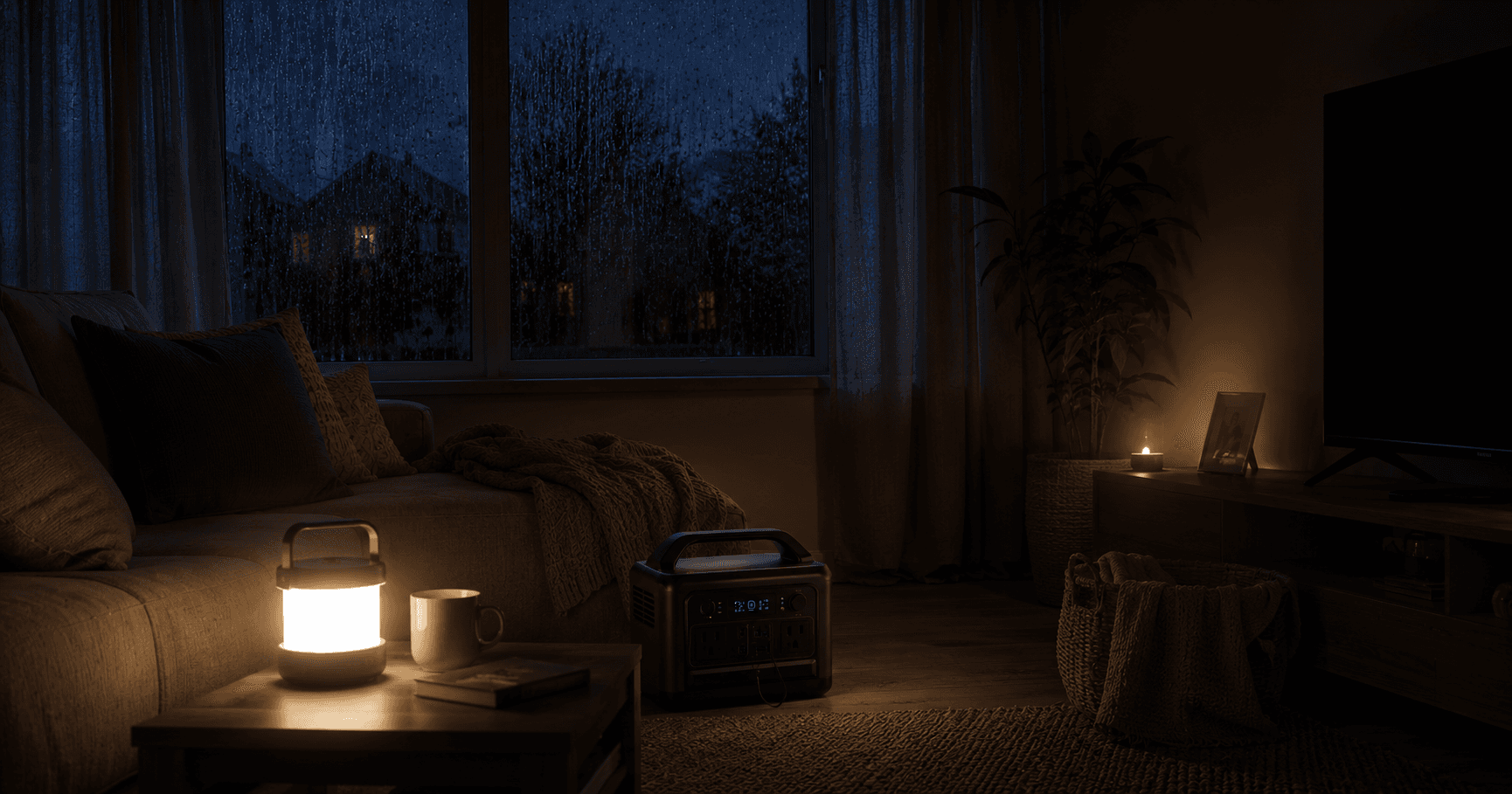
Why CPAP users need a hurricane plan
CPAP hurricane preparedness is the difference between sleeping safely through a multi-day outage and lying awake gasping during an untreated apnea night. Hurricanes routinely knock out grid power for 3 to 10 days, and in major storms like Ian (2022) or Helene (2024) some neighborhoods waited two weeks for restoration. If you have obstructive sleep apnea, every one of those nights without therapy carries real risk.
Skipping CPAP for even a single night raises blood pressure, triggers oxygen desaturation, and brings back loud snoring and daytime drowsiness — exactly when you need to be alert to drive, clear debris, or evacuate. For drivers with commercial licenses or anyone recovering from a cardiac event, untreated apnea during a disaster is genuinely dangerous, not just uncomfortable.
The core problem is simple: a CPAP is a medical device that needs continuous electricity, and the grid is the first thing a hurricane destroys. The bottom line: you cannot rely on the wall outlet, so you need a charged battery, a way to recharge it, and a written plan before the National Weather Service posts a watch.
Unlike a brief flicker, a hurricane outage is a multi-day event. That changes the math entirely. A small bedside UPS that covers a 2-hour blackout is useless on night four. Planning for 72 hours of autonomy — and ideally a recharge path beyond that — is the standard this guide uses throughout. If your region also faces ice and snow, the same principles appear in our CPAP winter storm backup guide.
There is also a timing trap specific to storms. Power often fails before the hurricane makes landfall, when feeder lines go down in the outer rain bands, and stays out long after. That means you may be running on battery for a day before the worst even arrives. Build your plan around the full window — typically pre-landfall through restoration — rather than just "the night of the storm." The households that struggle most are the ones who charged a single small battery the morning the storm hit and assumed power would return in a day.
Battery sizing for multi-day outages


For bedside UPS-style protection during the first hours of an outage, the Bluetti Elite 30 V2 (288Wh, 600W AC outlet) delivers 10ms UPS pass-through and around 8-10 hours of CPAP runtime — a plug-and-forget complement to a larger power station, at about $199–249.

Bluetti Elite 30 V2 Portable Power Station (288Wh, 600W LiFePO4)
$249.99
Check price on AmazonBattery sizing for a hurricane comes down to one calculation: usable watt-hours divided by your machine's real overnight draw. A power station's rated capacity is not all usable — after inverter and power-brick losses on the AC outlet, plan on about 70-80% of the label (roughly 85-90% if you run DC-direct). So a 512Wh unit like the Jackery Explorer 500 v2 delivers around 385Wh to your CPAP through its AC outlet.
The other half of the equation is your draw. Manufacturers rate CPAPs at 30-60W, but average overnight consumption without humidification is far lower — typically 15-30W — because the blower idles between breaths. Turn on a heated humidifier and heated tube and that average jumps to roughly 50-70W at high settings. The single biggest lever you have is humidification, which we break down in our CPAP humidifier battery drain guide.
How many nights each battery size covers
Here is the runtime math for an 8-hour night, assuming you disable heated humidification (a must in a multi-day outage):
| Battery (rated) | Usable Wh (~75%, AC outlet) | ~25W draw, no humidity | ~75W draw, full humidity |
|---|---|---|---|
| 240Wh | ~180Wh | ~1 night | ~2.4 hours |
| 288Wh (Elite 30 V2) | ~215Wh | ~1 night | ~2.9 hours |
| 512Wh (Explorer 500 v2) | ~385Wh | ~2 nights | ~5 hours |
| 1024Wh (DELTA 3) | ~770Wh | 3-4 nights | ~10 hours |
| 2048Wh (DELTA 3 Max) | ~1,535Wh | 7-8 nights | ~20 hours |
In short: a 240Wh battery covers about 1 dry night, a 500Wh unit covers about 2, and a 1000Wh station like the EcoFlow DELTA 3 covers 3-4. For a hurricane, target at least 500Wh of dedicated CPAP capacity, and prefer 1000Wh if you can charge it back up. To dial in your exact number, run your machine's wattage through our CPAP battery runtime calculator or the detailed battery sizing guide.
If your area routinely waits a week or more for restoration, the 2 kWh tier covers most of that window on one charge, and a solar bundle refills it once the skies clear. Our best solar generator for CPAP guide compares the 2–4 kWh stations and panel bundles built for multi-day outages.

EcoFlow DELTA 3 Max Portable Power Station (2048Wh LFP, 2400W)
$879.00
Check price on AmazonStack capacity with a bedside UPS
A smart hurricane setup pairs a large station with a compact UPS-capable unit like the Bluetti Elite 30 V2. It sits between the wall and your CPAP and switches over in about 10 milliseconds when grid power drops — so the night the storm hits, you never wake up. You then move to the big station for the long haul. This two-tier approach is the same logic we cover in UPS vs CPAP battery vs power station.
Solar and car charging fallbacks

A battery only buys you a fixed number of nights — a recharge source buys you indefinite survival. Once the storm passes and skies clear, solar and your car become your two lifelines. The bottom line: plan to recharge, because only a large (2 kWh-plus) station covers a 7-day outage on one charge, and only if you run dry.
Solar charging after the skies clear
A 100W folding panel like the Jackery SolarSaga 100W produces roughly 60-80Wh per peak-sun hour in real conditions (panels rarely hit their rated output). On a clear post-hurricane day you might harvest 250-400Wh — enough to refill a 240Wh battery or significantly top up a 500Wh one. Two panels in series roughly double that.
The catch is timing: hurricanes bring days of overcast, so solar is a recovery tool, not a storm-night tool. Charge fully from the grid before landfall, ride the battery through the worst, then use sun to extend. We cover panel pairing, controllers, and real-world yields in the solar charging for CPAP battery guide.
Car charging when there is no sun
Your vehicle is the most reliable charger during an outage. Plug your power station's car-charge cable into the 12V socket with the engine idling, and most stations pull 100-120W, recharging a 500Wh unit in about 4-6 hours. That single tank of fuel can deliver several more nights of therapy.
Two safety rules are non-negotiable: idle the car outside in open air — never in a garage or near windows — because of carbon monoxide, and keep at least a half tank of fuel before the storm since gas stations lose power too. Some newer machines also run directly off 12V with the right adapter; see our CPAP DC power adapter guide for cordless car-to-CPAP options that skip the inverter entirely and save 10-15% energy.
Generators: helpful but not for direct CPAP use
A portable gas generator can recharge your power station quickly, but you should almost never plug a CPAP straight into one. Inexpensive generators produce "modified" or noisy power that can damage sensitive blower electronics or trigger fault codes. Instead, use the generator to charge your battery during the day, then run the CPAP off the clean battery output at night. This also means you are not listening to a generator run all night and you are not refueling at 3 a.m.
If you do connect anything directly to a generator, confirm it is an inverter generator that produces a pure sine wave — the same standard CPAPs require from any power source. Our pure sine vs modified sine for CPAP guide explains why this matters and how to check your station's spec. As with a car, run the generator outdoors, at least 20 feet from windows and doors, with a working battery-powered carbon-monoxide alarm nearby.
Emergency CPAP checklist
A hurricane checklist works only if you complete it before the cone of uncertainty includes your county — typically 3-5 days out. Print this and tape it inside a kitchen cabinet so it survives a phone-battery death.
72 hours before landfall:
- Fully charge every battery, power station, and the CPAP's internal/backup cell.
- Top off your vehicle's fuel tank and locate your 12V car-charge cable.
- Fill clean containers with distilled water, or stage waterless-mode supplies (see running CPAP without water).
- Replace your CPAP filter so you start the outage clean — stock spares from the best CPAP filters guide.
24 hours before:
- Confirm your humidifier and heated-tube settings can be switched off quickly.
- Stage the bedside UPS and big station near your bed with all cables.
- Pack a go-bag with mask, hose, machine, batteries, and chargers in case you evacuate.
During the outage (each day):
- Disable heated humidification; run dry to stretch runtime 2-4x.
- Recharge from car or solar during daylight, before the next night.
- Keep machines off the floor and away from flood water; store batteries at room temperature.
Keep a written copy of your prescribed pressure setting and machine model with the kit. If your gear is damaged or lost, an evacuation shelter or battery rental service can set you up faster when you can quote exact specs. For a fully portable evacuation-ready setup, see our CPAP battery travel checklist.
What to do if you run out of battery power
If your battery dies mid-outage, you still have options — and you should never panic about a single missed night. In short: untreated apnea for one night is uncomfortable and slightly risky, but it is not an emergency for most people; conserve, improvise, and prioritize charging by morning.
First, conserve immediately. Switch the machine fully off rather than leaving it idling, and reserve any remaining charge for actual sleep. Drop your humidifier to off and, if your device allows, lower the pressure ramp and disable auto-features that spin the blower harder.
Second, find power. A running car can recharge enough capacity in 2-3 hours for a partial night. Neighbors with generators, a community shelter, a workplace, a pharmacy, or a hospital lobby can all provide an outlet to top up — call ahead during a disaster.
Third, sleep safer without the machine for one night. Sleep on your side, not your back, to reduce airway collapse, elevate your head with extra pillows, and avoid alcohol and sedatives, which worsen apnea. These are stopgaps, not substitutes. If you have heart failure, severe daytime symptoms, or oxygen desaturation, treat a prolonged outage as a medical-priority situation and seek a powered location. For the full clinical picture and conservation tactics, read our CPAP power loss safety guide and how long a CPAP battery lasts in an outage.
It also helps to know your local resources in advance. Many counties operate "special needs" or medical shelters during declared hurricanes specifically for people who depend on powered equipment like CPAP, oxygen concentrators, or dialysis. Registering before the season starts — usually through your county emergency-management office — gets you on a priority list and, in many areas, transportation assistance. Hospitals and 24-hour pharmacies are also reliable fallbacks, since both maintain backup generators and rarely turn away someone needing to charge a medical device.
Finally, document the gap. If you miss multiple nights of therapy during a federally declared disaster, note the dates; that record can support an insurance or replacement claim if your equipment was damaged, and it gives your sleep physician context for any symptom flare-up afterward. A short outage is recoverable — the goal of every step above is simply to keep the missed nights to a minimum and never let a dead battery turn into a week of untreated apnea.
Related reading
- CPAP Battery Backup Guide
- How Long Will a CPAP Run During a Power Outage?
- Solar Charging a CPAP Battery
- Best Solar Generator for CPAP
- CPAP Winter Storm Backup Plan
- CPAP Power Outage Prep Guide
What to do next
Your single next step today — before any storm is named — is to size and buy a battery you can fully charge tonight. Aim for at least 500Wh of dedicated CPAP capacity, add a 100W solar panel and a car-charge cable for recharging, and write down your pressure setting where you can find it in the dark.
If you're ready to pick a battery, check our best CPAP backup batteries guide for side-by-side comparisons.
Affiliate disclosure
This site may include affiliate links. If you buy through links, we may earn a commission at no extra cost to you. We only recommend products we've researched and believe are genuinely useful for CPAP users.