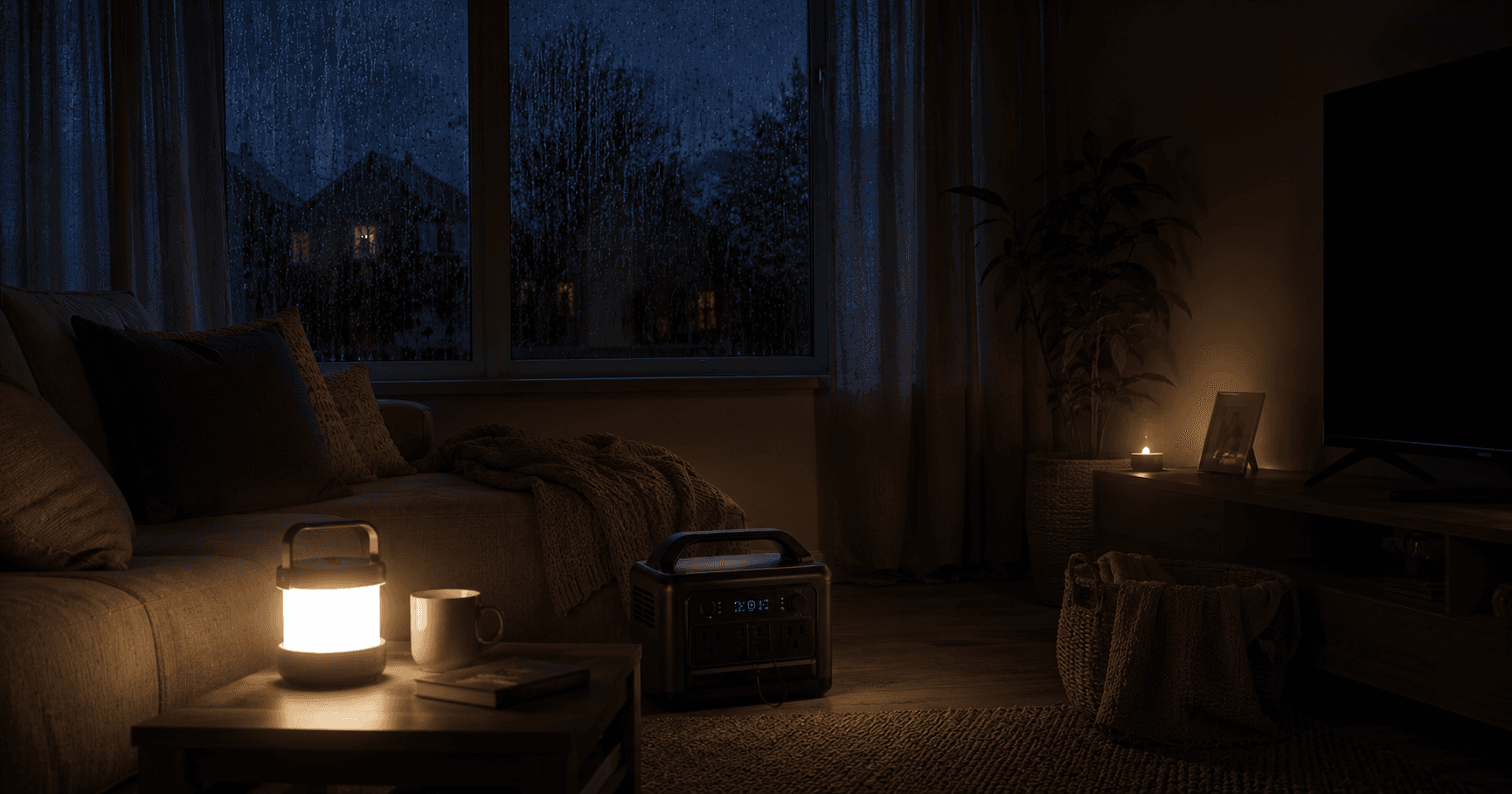
If you rely on CPAP therapy and live anywhere in California or the fire-prone West, a Public Safety Power Shutoff (PSPS) is the one outage you can almost guarantee will happen — and the one most likely to last several nights in a row. A CPAP PSPS plan is different from preparing for a thunderstorm: these are planned, multi-day events where the grid stays dark on purpose, often for 24 to 72 hours, sometimes longer. This guide shows you how PSPS events work, how to size a backup battery for two to five nights, how to recharge with solar when the grid is down, and how to handle the wildfire smoke that almost always arrives at the same time.
What PSPS means for CPAP users
A Public Safety Power Shutoff is a deliberate, preemptive blackout that a utility triggers when hot, dry, windy "red flag" conditions make power lines a wildfire ignition risk. Utilities including PG&E, Southern California Edison, and San Diego Gas & Electric de-energize circuits before a fire can start, then inspect every mile of line before restoring power. For a CPAP user, the key word is preemptive: the grid goes down while the weather is still fine, and it stays down well after the wind dies.
That changes your math. A backup battery that comfortably covers a single stormy night is not enough for a PSPS, where you may face three, four, or five consecutive nights without an outlet. You cannot count on plugging back in at dawn.
Skipping CPAP therapy during those nights is not a minor inconvenience. Untreated obstructive sleep apnea raises blood pressure, strains the heart, and leaves you dangerously fatigued — exactly when you may need to evacuate, drive through smoke, or make fast decisions. Treat your CPAP as life-sustaining equipment, because functionally it is.
The good news: PSPS events are forecastable. Utilities issue watches days ahead and warnings 24 to 48 hours before de-energization. That advance notice is your window to top off batteries, fuel a recharge plan, and stage your gear. The rest of this guide is about using that window well.
How long PSPS events typically last
Plan for two to five nights. Most PSPS events restore power within 24 to 48 hours after the dangerous weather passes, but multi-day shutoffs are common and a handful have stretched past a week in remote, heavily wooded circuits.
The duration has two parts. First is the weather window — the hours the wind and low humidity actually persist, usually 12 to 48 hours. Second, and the part people underestimate, is the inspection-and-restoration phase that follows. Before re-energizing, utilities must patrol every de-energized line, often by helicopter and ground crew, to confirm no tree limbs or damage occurred. That inspection alone routinely adds 12 to 24 hours after the wind calms.
Here is a realistic planning table for how many CPAP nights to prepare for:
| PSPS scenario | Typical grid-down time | CPAP nights to plan for |
|---|---|---|
| Short single-event shutoff | 12–24 hours | 1–2 nights |
| Standard multi-day PSPS | 24–48 hours | 2–3 nights |
| Extended / repeated shutoff | 48–96 hours | 3–5 nights |
| Severe / remote-circuit event | 4–7+ days | 5+ nights (plan recharge) |
The bottom line: size for the standard multi-day case at minimum (2–3 nights), and have a recharge method ready for anything longer. For a deeper look at the runtime side of that equation, see our how long a CPAP battery lasts during a power outage breakdown. If you are weighing capacity against your specific machine, the CPAP battery sizing guide walks through the full calculation.
Battery sizing for PSPS events
For PSPS, size your battery in watt-hours (Wh) and plan around two to five nights of runtime. A ResMed AirSense 11 draws about 18W with the humidifier off, about 28W with the humidifier on low, and about 48W with it on high (a heated tube adds roughly 5–15W more, our estimate). Over an 8-hour night that is roughly 144 Wh dry, 224 Wh on low humidity, and 384 Wh on high. The single biggest lever you control is the humidifier: running it on high nearly triples your nightly energy use.
Start with the runtime formula. Through a power station's AC outlet, inverter losses leave you about 70–80% of the rated capacity, so we plan with 75%. Running on DC skips the inverter and gets you closer to 85–90%.
Runtime (hours) ≈ (rated Wh × 0.75) ÷ CPAP watts (AC outlet)
A 512Wh station running an AirSense 11 dry delivers roughly (512 × 0.75) ÷ 18 ≈ 21 hours, which is about 2.7 eight-hour nights. Scale that up (AC outlet, 75% usable, 8-hour nights):
| Battery capacity | Dry (≈18W) | Humidifier low (≈28W) | Humidifier high (≈48W) |
|---|---|---|---|
| 300 Wh | ~12.5 hours (~1.5 nights) | ~8 hours (1 night) | ~4.7 hours (partial night) |
| 512 Wh | ~21 hours (~2.7 nights) | ~14 hours (~1.7 nights) | ~8 hours (1 night) |
| 1024 Wh | ~43 hours (~5.3 nights) | ~27 hours (~3.4 nights) | ~16 hours (2 nights) |
| 2048 Wh | ~85 hours (~10.7 nights) | ~55 hours (~6.9 nights) | ~32 hours (4 nights) |
Older machines and higher pressures draw more, so check your own machine's figure and scale the table down if needed. Keeping the humidifier and heated tube off is the difference between two nights and five on a 1024Wh station. We cover why in how your CPAP humidifier drains your battery. Saline nasal spray can ease dryness while you run without the humidifier on battery.
A compact 512Wh unit like the Jackery Explorer 500 v2 is the practical minimum for a 2–3 night PSPS if you run dry. Step up to a 1024Wh station like the EcoFlow DELTA 3 (LiFePO4, under 10 ms UPS switchover per EcoFlow) when you want 4+ nights of margin or expect to run the humidifier on low.


For the longest remote-circuit shutoffs, a 2 kWh class station gets you close to a week of dry nights on a single charge, and roughly four nights even with the humidifier on high. Our guide to the best solar generator for CPAP compares the 2–4 kWh stations and solar bundles built for that multi-day tier.

EcoFlow DELTA 3 Max Portable Power Station (2048Wh LFP, 2400W)
$879.00
Check price on AmazonTwo more sizing rules for fire season. First, use the machine's DC input where possible — running your CPAP off 12V DC through a dedicated adapter skips the inverter and squeezes 15–25% more runtime out of the same battery; see our CPAP DC power adapter guide. Second, buy a little more capacity than your single-night number suggests. Lithium batteries lose a few percent of capacity in cold or after years of cycling, and PSPS events have a habit of running one night longer than forecast.
Solar charging during PSPS shutoffs
Solar is what turns a 2-night battery into an indefinite one. When the grid is down for four or five days, recharging during daylight is the only realistic way to keep your CPAP running without driving to a powered location. The advantage of PSPS over storm outages is that PSPS weather is, by definition, sunny — hot, dry, clear skies are precisely the conditions that trigger a shutoff and also the best conditions for solar charging.
A 100W portable panel, such as the Jackery SolarSaga 100W, produces roughly 60–75 usable watt-hours per peak sun hour in good conditions. With 4–5 peak sun hours in a Western summer or autumn day, that is about 250–375 Wh banked per day — enough to replace a full pressure-only CPAP night and then some.

The honest caveat: wildfire smoke cuts solar output. Heavy smoke can knock panel production down 20–50%, so during a smoky stretch budget conservatively and pair more panel watts with your station. Two 100W panels, or a single 200W folding panel, give you headroom for hazy days and faster top-ups during the limited clear hours.
A simple PSPS solar routine:
- Charge overnight from the battery, recharge by day. Run your CPAP off the station at night, then move the station into the sun each morning.
- Angle the panel at the sun and reposition it midday. A panel flat on the ground loses a large share of its output.
- Charge before noon when smoke is often lighter. Air quality frequently worsens as the day heats up.
- Keep electronics out of direct heat. Charge the battery in shade with the panel in the sun, using the cable run — lithium stations throttle in extreme heat.
For panel sizing, mounting tips, and real-world charge curves, see our dedicated solar charging for CPAP batteries guide.
Wildfire smoke, air quality, and your CPAP
Here is the part most outage guides miss: PSPS and wildfire smoke arrive together. The same dry, windy conditions that trigger a shutoff also push smoke into your home, and your CPAP pulls room air directly into your airway all night. During smoke events, that air can be loaded with fine particulate (PM2.5).
Your CPAP's stock intake filter is designed to catch dust and pollen, not wildfire smoke. Swap to (or stock up on) finer hypoallergenic filters and change them far more often than usual — during heavy smoke, inspect daily and replace every few days, because a clogged filter both worsens air quality and makes your blower work harder, which drains your battery faster. Our best CPAP filters of 2026 roundup covers which fine-particulate filters fit common machines.
Combine filtering with source control: run a HEPA room air purifier in your bedroom whenever the grid allows (or off your power station during the day), keep windows and doors closed, and create a "clean room" where you sleep. The cleaner the room air, the cleaner the air your CPAP delivers. Stock at least a two-week supply of compatible filters before fire season — they are cheap, small, and the first thing to vanish from local shelves when smoke hits.
One practical note on the battery side: a smoke-clogged filter forces the CPAP blower to work harder to hit your prescribed pressure, and a harder-working blower pulls more watts. That means smoke does not just affect the air you breathe — it quietly shortens your runtime too. Fresh filters keep both your airway and your battery efficient, which is one more reason to change them aggressively during a PSPS rather than rationing them. If you ever notice your runtime dropping faster than your sizing math predicts, a dirty intake filter is a common culprit, and our why your CPAP battery isn't lasting guide covers the rest.
PSPS CPAP preparedness checklist
Use this checklist when a PSPS watch or warning is issued. The goal is to be fully staged before de-energization, not scrambling in the dark.
Before fire season (do once each spring):
- Register with your utility's Medical Baseline Allowance program as life-sustaining-equipment, which adds you to the priority PSPS notification list and lowers your electric rate.
- Confirm your utility has current phone, text, and email contacts so PSPS alerts reach you.
- Buy and test your backup battery and solar panel; confirm your CPAP runs off it.
- Source a 2-week supply of fine-particulate CPAP filters and a HEPA room purifier.
When a PSPS watch/warning is issued (24–72 hours out):
- Fully charge every battery and power station to 100%.
- Charge phones, headlamps, and a battery bank.
- Fuel the car (your car is also an emergency recharge source via a DC adapter).
- Pre-position the solar panel and cables where you can deploy them fast.
Each night of the shutoff:
- Run your CPAP off the battery with the heated humidifier and heated tube OFF to maximize runtime.
- Use the DC adapter rather than the AC inverter when your machine supports it.
- Recharge the station by solar each morning; charge before midday smoke builds.
- Check and replace the CPAP intake filter; inspect daily during heavy smoke.
Know your fallbacks:
- Local libraries, community centers, and PG&E "Community Resource Centers" often open during PSPS with free device charging.
- Your running car can recharge a power station in an emergency.
- If you have no power and no battery, contact your utility's medical baseline line — some programs offer backup-battery support or hotel assistance for medical-equipment customers.
For the broader emergency framework that this checklist plugs into, see our CPAP battery backup guide.
Related reading
- CPAP Battery Backup Guide
- CPAP Battery Sizing Guide
- How Long a CPAP Battery Lasts in a Power Outage
- Solar Charging for CPAP Batteries
- Best Solar Generator for CPAP
- Best CPAP Filters of 2026
What to do next
Your single most important next step is to register with your utility's Medical Baseline / life-sustaining-equipment program today — it costs nothing, lowers your rate, and guarantees you advance PSPS notice so your batteries are charged before the lights go out. Then size a battery for at least two to three nights and pair it with a solar panel so an extended shutoff never leaves you without therapy.
If you're ready to pick a battery, check our best CPAP backup batteries guide for side-by-side comparisons.