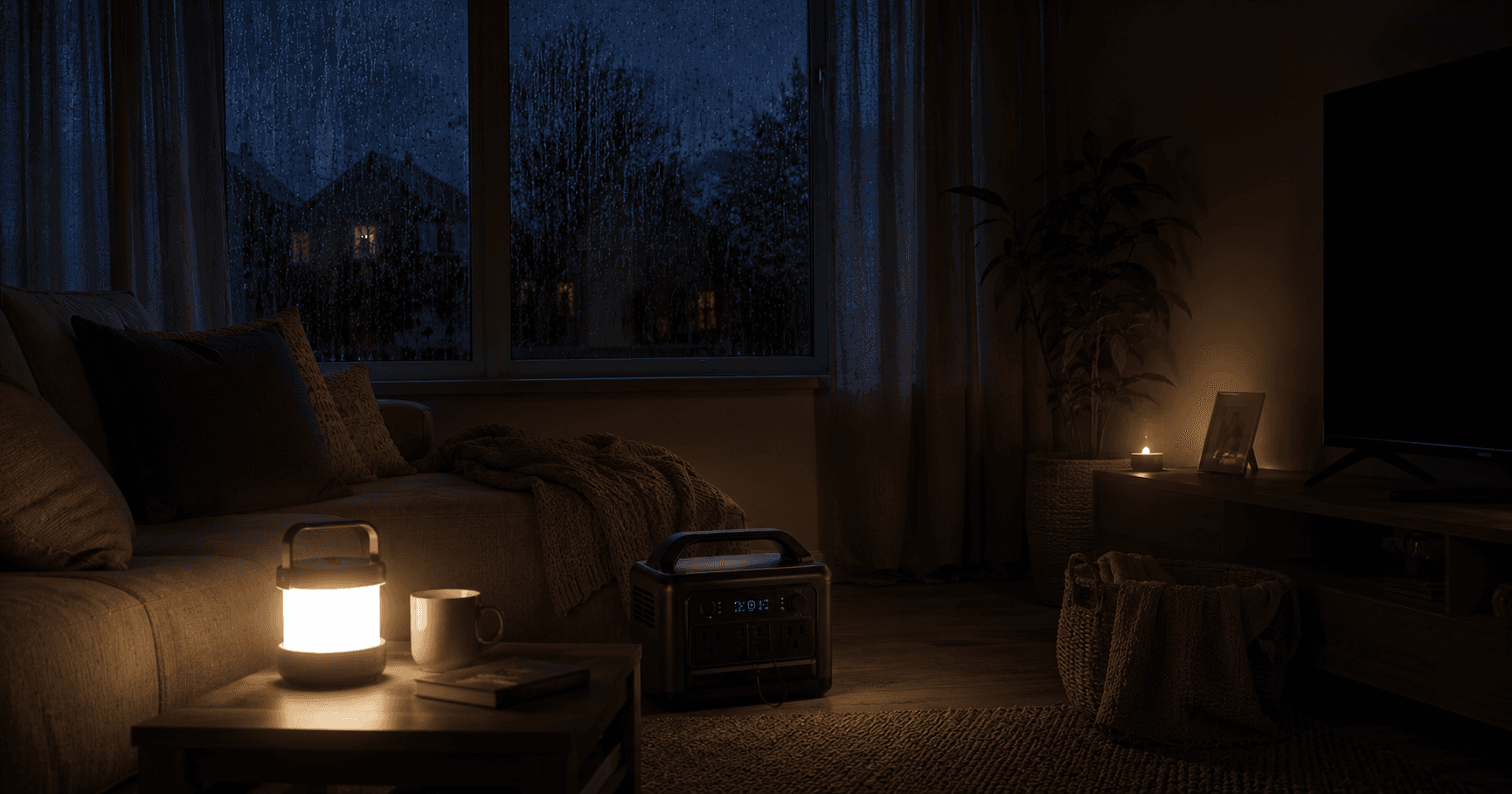
A winter storm is the one outage scenario where everything works against your CPAP at once. The grid goes down under ice-loaded power lines, the roads close so you cannot drive to a warming center, and the cold quietly drains the very batteries you were counting on. If you depend on therapy every night, a CPAP winter storm plan is not optional — it is the difference between sleeping through a three-day blizzard and lying awake gasping. This guide walks you through how cold weather changes battery behavior, how to size backup power for multi-night outages, how to keep your batteries (and yourself) warm and safe, and a printable emergency checklist you can act on before the first flake falls.
Why winter storms are dangerous for CPAP users
Winter storms are uniquely dangerous for CPAP users because they combine the longest outages of any weather event with the coldest conditions for battery performance. Ice storms in particular are notorious: a quarter-inch of ice can add 500 pounds of weight to a power line, and the resulting cascade of downed lines and snapped poles routinely keeps rural and suburban customers in the dark for three to seven days. Hurricanes get the headlines, but ice storms produce some of the most prolonged grid failures in the country.
For someone with obstructive sleep apnea, every night without therapy carries real consequences: fragmented sleep, morning headaches, spiking blood pressure, and dangerous daytime drowsiness right when you may need to shovel snow or drive on ice. Untreated apnea also stresses the heart, and cold weather already raises cardiac risk on its own.
The compounding problem is that winter strips away your usual fallbacks. You often cannot safely drive to a hotel or a relative's house. Stores sell out of generators and batteries within hours of a forecast. And the cold itself shrinks the runtime of whatever backup you do own. That is why your plan has to be built and charged before the storm, not improvised during it. If you have not yet read our broader CPAP power outage guide, start there for the fundamentals, then come back for the cold-weather specifics.
Cold weather effects on battery performance
Cold weather reduces a lithium battery's usable capacity by roughly 10–30%, and below freezing it can stop the battery from accepting a charge at all. This is the single most misunderstood fact in winter CPAP prep, so it is worth understanding the chemistry behind it.
Lithium-ion and LiFePO4 (lithium iron phosphate) batteries store energy through ions moving between electrodes. When temperatures drop, that movement slows: the internal resistance rises, voltage sags under load, and the battery delivers less of its rated watt-hours before shutting off. At around 32°F (0°C) you should expect to lose 10–20% of effective capacity; at 0°F (-18°C) the loss can approach 30% or more. A 500Wh power station that runs your CPAP with the humidifier on for 9 hours in a warm bedroom might give you only 6–7 hours if it has been sitting in a cold mudroom.
Discharging cold vs. charging cold
There is a critical distinction between using a battery in the cold and charging one. Discharging in the cold simply costs you runtime. Charging a lithium-ion battery below 0°C/32°F is genuinely harmful — it causes lithium plating on the anode, which permanently reduces capacity and can create internal short circuits. Most quality power stations include a battery management system (BMS) that refuses to charge below freezing to protect you, which is good for safety but means a cold battery may simply not refill.
LiFePO4 chemistry is more cold-tolerant in daily use and far safer thermally, but it shares the same charging limitation: standard LiFePO4 cells also should not be charged below freezing unless the unit has a built-in low-temperature cutoff or self-heating feature, which many newer models now include. For a deeper comparison of how the two chemistries behave, see our LiFePO4 vs. lithium-ion CPAP battery guide. The practical takeaway is the same for both: keep the battery indoors at room temperature, and never try to recharge a unit that is cold to the touch — let it warm up first.
Battery sizing for winter power outages
For winter outages, size your backup for at least three full nights of therapy, because ice-storm restoration routinely runs 72 hours or longer. That means doing the math on watt-hours, then padding it for cold-weather capacity loss.
Start with your machine's draw. A modern CPAP like the ResMed AirSense 11 pulls roughly 15–30 watts (about 18W at typical pressures) without the heated humidifier or heated tube running. To estimate runtime, multiply the battery's rated capacity by about 0.75 when running through the AC outlet (real-world inverter and power-brick losses; about 0.85–0.90 on a DC-direct cable) and divide by your machine's wattage:
Usable runtime (hours) ≈ (rated Wh × 0.75) ÷ watts
So a 500Wh station running a CPAP at 20W gives roughly (500 × 0.75) ÷ 20 ≈ 19 hours at room temperature — a little over two nights. Now apply a winter haircut: assume you lose 15–20% to the cold, and you are realistically closer to 15–16 hours. For three nights at 8 hours each (24 hours of therapy at 20W with the humidifier off), you want around 750–800Wh of capacity after conversion and cold losses. If you keep the humidifier on its low setting (about 28W total), plan on roughly 1,100Wh — or a smaller battery you can reliably recharge between nights.
The EcoFlow DELTA 3 (1,024Wh, LiFePO4) is a workhorse for this: it covers about four nights with the humidifier off (nearly three with it on low), even after a cold-weather haircut, switches to battery in under 10 ms (EcoFlow's UPS spec), and recharges from the wall in about an hour when power flickers back. The Zopec Explore Mini is a purpose-built CPAP UPS that switches over automatically when the grid drops.
If your area's ice storms tend to keep the lights out for a week, look at the 2 kWh tier instead: roughly double the DELTA 3's runtime on one charge. Our best solar generator for CPAP guide compares those 2–4 kWh stations and solar bundles for multi-day outages; just remember that short winter days mean panels refill far less than in summer.


The Bluetti Elite 30 V2 (288Wh, 600W AC outlet) is another strong bedside pick for winter outages — the standard AC outlet works with any CPAP, and 10ms UPS pass-through keeps therapy going the moment the grid drops. Its LiFePO4 cells also tolerate the cold better than older lithium-ion packs. About $199–249.

Bluetti Elite 30 V2 Portable Power Station (288Wh, 600W LiFePO4)
$249.99
Check price on AmazonFor a step-by-step walkthrough with your exact machine, run the numbers through our CPAP battery runtime calculator or read the full battery sizing guide.
Recharging mid-outage: generators and car charging (CO safety)
If your outage outlasts your battery, you will need to recharge — and this is where winter prep turns deadly serious. Never run a fuel-powered generator indoors, in a garage, in a basement, or near any window or vent. Gasoline and propane generators produce carbon monoxide (CO), an odorless gas that kills, and CO poisoning deaths spike during winter storms precisely because people bring generators inside to escape the cold. Place any generator at least 20 feet from the house, downwind, under a canopy that keeps snow off but does not trap exhaust, and install a battery-powered CO alarm in your bedroom.
Charging from your car is safer for CO only if you do it correctly: run the engine outside with the garage door fully open, or better, in the open driveway, and clear snow away from the tailpipe — a snow-blocked exhaust can back CO into the cabin. Use a quality inverter or the power station's car-charge cable, and never sleep in a running car. Our CPAP power loss safety guide covers these hazards in more depth.
The humidifier tradeoff in dry winter air
Winter air is brutally dry, and forced-air therapy can leave your nose and throat raw — so the humidifier is tempting exactly when battery power is scarcest. The heated humidifier and heated tubing are by far the biggest power draw on a CPAP. A heated humidifier adds roughly 10–30W depending on the setting, and with a heated tube too, total draw can reach about 50–70W at high settings (ResMed lists the AirSense 11's maximum at 73.2W) — up from roughly 15–30W dry, which cuts your runtime by half or more.
During an outage, the right move is to turn off the heated humidifier and heated tube and accept some dryness to preserve runtime — on a typical 250–300Wh battery, this single change can take you from 3–4 hours to 8–12 hours per charge. To soften the dryness, keep the bedroom warm so indoor humidity is less harsh, drink water before bed, and consider a saline nasal spray. If you genuinely cannot tolerate dry therapy, run the humidifier on its lowest setting only, and size your battery for the higher wattage. See our CPAP humidifier battery drain guide for exact runtime numbers at each setting.
Keeping your CPAP battery warm
The simplest way to protect winter runtime is to keep the battery indoors at room temperature (around 65–75°F) at all times — never in the garage, car trunk, or an unheated porch. A battery that lives where you live will deliver its full rated capacity; one that chills overnight in a cold room can lose 15–30% before you even plug in.
Place your power station next to the bed where the room is heated, not on a cold floor against an exterior wall. Cold air pools at floor level, so set the unit on a nightstand or a folded blanket a few inches up. If your home loses heat during the outage and the room itself drops toward freezing, insulate the battery: wrap it loosely in a wool blanket or sleeping bag, leaving the vents and any cooling fan clear so it does not overheat under load. The goal is to slow heat loss, not to seal the unit airtight.
Warming a cold battery before use
If a battery has gotten cold — say it traveled in your car — let it warm up indoors for at least an hour before charging it, and ideally before running your CPAP from it. Do not use direct heat: no oven, no space heater pointed at it, no heating pad on high. Rapid, uneven heating stresses the cells. Gentle room-temperature warming is all you need. And remember the rule from earlier: if the unit is cold to the touch, its BMS may refuse to charge until it warms above freezing, which is the battery protecting itself, not a defect.
Keeping yourself warm matters too. A cold bedroom is miserable and can be dangerous, so layer blankets, wear a hat, and close off unused rooms to concentrate heat. A warm sleeper breathes easier, and a warm battery lasts longer — the two goals reinforce each other.
Winter storm CPAP emergency checklist
Run through this checklist as soon as a winter storm or ice-storm warning is issued, then keep the supplies staged through the season. The bottom line: everything must be charged and indoors before the lights go out.
48–72 hours before the storm:
- Fully charge every battery and power station to 100%; top them off the night before.
- Charge your phone, a backup power bank, and any battery-powered CO alarm.
- Confirm your DC cable, AC inverter, and the correct adapter for your machine all work together (see our CPAP DC power adapter guide).
- Fill the car's gas tank — you may need it to recharge batteries or evacuate.
- Move all batteries and the CPAP indoors to a heated room.
The night the power goes out:
- Switch the CPAP to your backup battery and turn off the heated humidifier and heated tube to maximize runtime.
- Lower the room first, then insulate the battery if the room is cold, keeping vents clear.
- Keep a flashlight or headlamp and your mask within arm's reach.
During a multi-day outage:
- Recharge batteries from a generator (outdoors, 20+ feet from the house) or your car (engine running outside, tailpipe clear of snow) — never indoors.
- Rotate batteries: run one while another charges whenever grid power flickers back.
- Monitor the CO alarm and never sleep with a generator running near the home.
Stage and keep these supplies:
- One battery sized for 3+ nights, or a smaller battery plus a safe recharging plan.
- Distilled water, a spare mask and cushion, and a manual resuscitation backup if advised by your doctor.
For region-specific planning beyond winter, our CPAP hurricane preparedness guide covers the same battery math for warm-weather outages.
Related reading
- CPAP Battery Backup Guide
- LiFePO4 vs. Lithium-Ion CPAP Battery
- CPAP Humidifier Battery Drain Guide
- CPAP Battery Runtime Calculator
- Best Solar Generator for CPAP
What to do next
Your single most important next step is to charge your backup battery to 100% today and keep it indoors — a charged battery in a warm room is worth more than a bigger battery you forgot to top off. Then size your setup for at least three nights using the watt-hour math above, and build your generator or car-charging plan now, while you can think clearly and the hardware stores are still stocked. If you're ready to pick a battery, check our best CPAP backup batteries guide for side-by-side comparisons.
Affiliate disclosure
This site may include affiliate links. If you buy through links, we may earn a commission at no extra cost to you. We only recommend products we've researched and believe are genuinely useful for CPAP users.