The fear is real — but the danger isn't
"Power outage nearly suffocated me." "Will I die if the power goes out?" "Had my first power outage last night — realized how dependent I am on my CPAP."
These are real Reddit posts from real CPAP users. The fear of losing power while attached to a machine that helps you breathe is completely understandable. If you've ever woken up gasping after a brief power flicker, you know the panic.
But here's the truth: you will not suffocate if your CPAP loses power. Let's break down exactly what happens and what you should do about it.
What physically happens when the CPAP stops
When power is cut, your CPAP motor stops spinning. Air pressure drops to zero. Here's the sequence of events:
- Pressure stops immediately — the motor winds down in about 1–2 seconds
- You can still breathe — every CPAP mask has an exhalation port or anti-asphyxia valve designed specifically for this scenario. Air enters and exits through these openings.
- You'll probably wake up — the sudden silence of the motor and the change in air pressure triggers most people to wake within 30 seconds to a few minutes
- You feel uncomfortable — dry mouth, brief disorientation, mild gasping sensation
- You remove the mask or go back to sleep — neither option is dangerous
The key safety point: CPAP masks are engineered to allow breathing when the machine is off. This is a fundamental design requirement, not an afterthought.
Why it feels so scary
The gasping sensation you feel when the CPAP stops isn't suffocation — it's your body reacting to two things:
- Loss of positive pressure — your airway, which was being held open by CPAP pressure, may partially collapse (this is your sleep apnea returning temporarily)
- Sudden wakefulness — being jolted awake triggers an adrenaline response, making you feel like something terrible is happening
People with severe sleep apnea (AHI over 30) may experience more pronounced airway collapse and feel the effect more intensely. But even in severe cases, the body's natural arousal response wakes you up before any dangerous oxygen drop occurs.
What about people with severe sleep apnea?
If your AHI is very high (30+), you are right to take backup power seriously — not because one night without CPAP will kill you, but because:
- Poor sleep quality has cascading health effects (blood pressure spikes, daytime drowsiness, mood changes)
- You may not sleep well at all without CPAP, leaving you dangerously tired the next day
- Repeated untreated nights are the real danger — not a single power outage
For users with severe apnea, a backup battery isn't a luxury — it's a practical health tool.
Your action plan for power outages
Unexpected outage
- Stay calm — you woke up, you're breathing, you're fine
- Remove the mask if it feels uncomfortable
- Check your phone for outage information from your utility company
- Go back to sleep without the mask if the outage will last more than 30 minutes
- Elevate your head — sleeping at a slight incline (extra pillow or adjustable bed) reduces apnea severity without CPAP
- Sleep on your side — side sleeping significantly reduces airway collapse compared to sleeping on your back
- When power returns, restart your CPAP and resume therapy
Scheduled outage
If you know a power outage is coming (utility work, planned maintenance):
- Go to bed early — get 3–4 hours of CPAP therapy before the outage starts
- Set an alarm for 10 minutes before the outage begins if you want to remove the mask before the power cuts
- Use this as motivation to buy a backup battery — scheduled outages are the perfect test scenario
- If you have a battery, plug it in, set it to passthrough/UPS mode, and sleep without worrying
Frequent outages
If you experience regular outages (rural areas, storm-prone regions, unreliable grid):
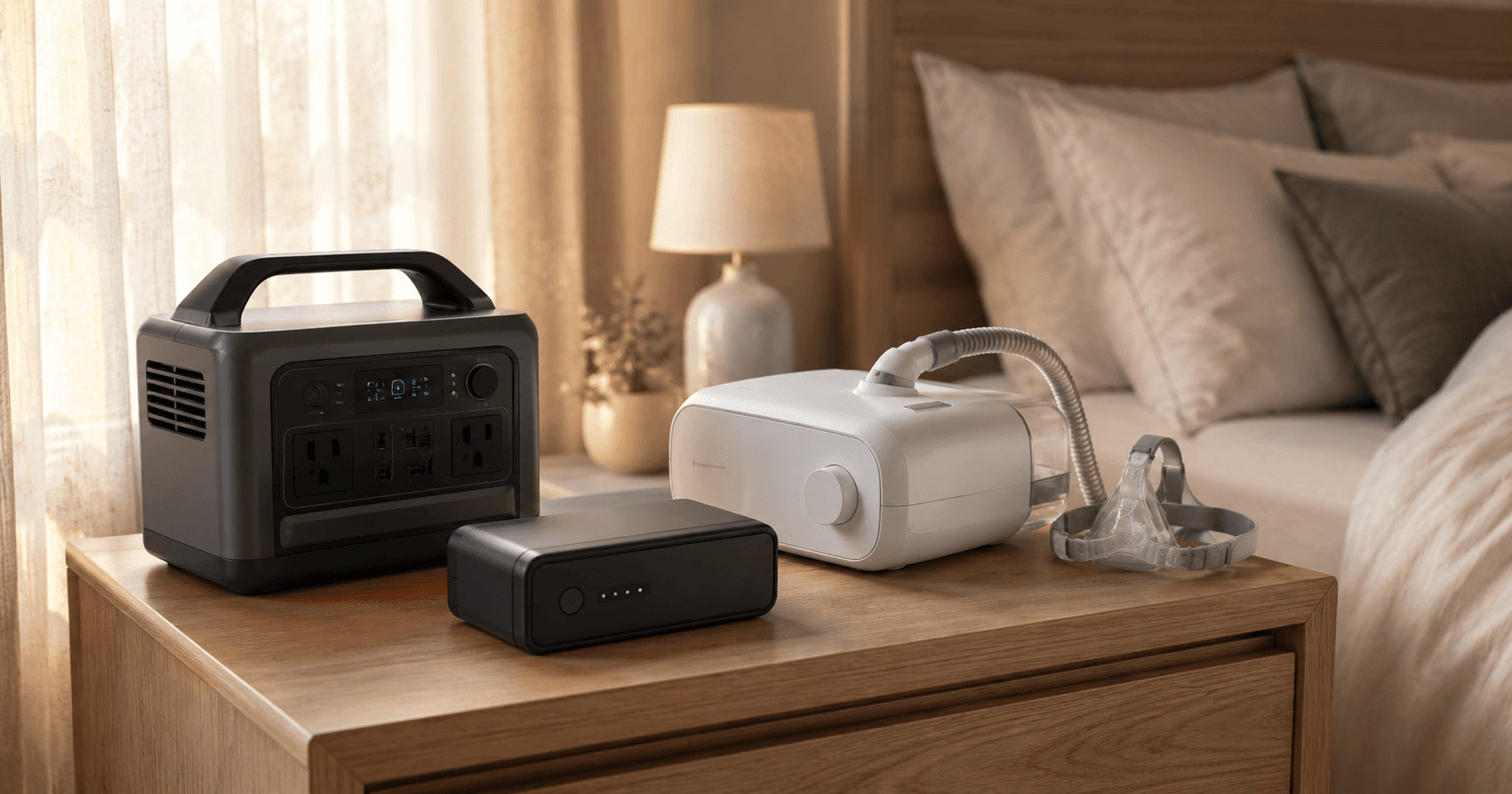
- Buy a backup battery — a bedside UPS covers a single machine, while a 1000Wh+ power station carries a CPAP with humidifier through multiple nights
- Keep it plugged in with passthrough charging — units like the Bluetti Elite 30 V2 or EcoFlow DELTA 3 act as a UPS, automatically switching to battery when wall power fails
- Test it periodically — run your CPAP from the battery for a full night once a month to verify everything works and the battery is healthy
The passthrough/UPS setup
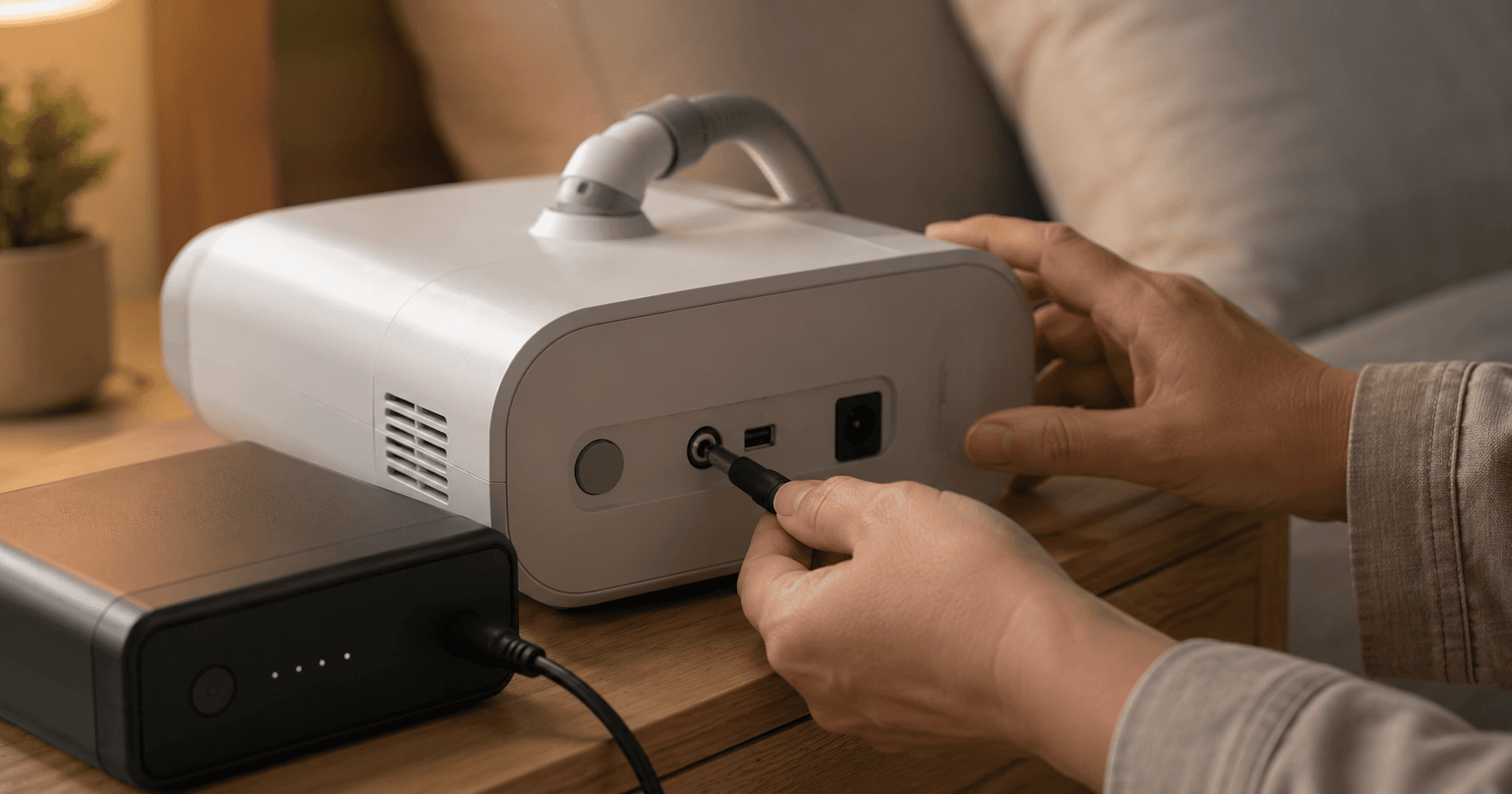
The best solution for home power outages is a power station with passthrough charging (also called UPS mode):
- Plug the power station into the wall
- Plug your CPAP into the power station
- The power station charges from the wall and passes power through to your CPAP
- When wall power fails, the battery takes over instantly — often in 10–20 milliseconds
- You never notice the switch. You sleep through the entire outage.
This is the "set it and forget it" solution. Your CPAP always has power, whether from the wall or the battery.
Choose your backup: a three-tier ladder
The right unit depends on how long your outages last and how much you want to spend. Every unit below runs in true UPS mode — plug it in, plug your CPAP into it, and forget it's there until the lights go out.
Tier 1 — Bedside plug-and-forget UPS (simplest)
If you just want a single machine covered through short, common outages, a compact bedside UPS is the least-fuss option. The Bluetti Elite 30 V2 (288Wh, 600W AC, ~10ms UPS switchover) sits on the nightstand, runs a typical CPAP for a full night with the humidifier off, and switches over so fast you sleep straight through it. At $199–249 it is the cheapest way to end the panic permanently.

Bluetti Elite 30 V2 Portable Power Station (288Wh, 600W LiFePO4)
$249.99
Check price on AmazonTier 2 — One to two nights, still portable
Want to keep the heated humidifier running, or ride out a longer outage? Step up to a 500–1000Wh LiFePO4 unit. The Bluetti Elite 100 V2 (1024Wh, LiFePO4, ≤10ms UPS, 1800W, $499) runs an AirSense 11 with the humidifier on high for roughly 15–17 hours through its AC outlet — about two nights — or 26–29 hours with the humidifier on low. At 25.3 lb it still fits in a closet or a car trunk, and it recharges from 0 to 80% in about 45 minutes on AC. The Jackery Explorer 500 v2 (512Wh LiFePO4, about $359) is a lighter, lower-cost alternative if you run your machine without heated humidification.

BLUETTI Elite 100 V2 Portable Power Station (1024Wh LiFePO4, 1800W)
$499 – $899
Check price on Amazon
Tier 3 — Whole-night / whole-house (1000Wh+, the big-ticket anchors)
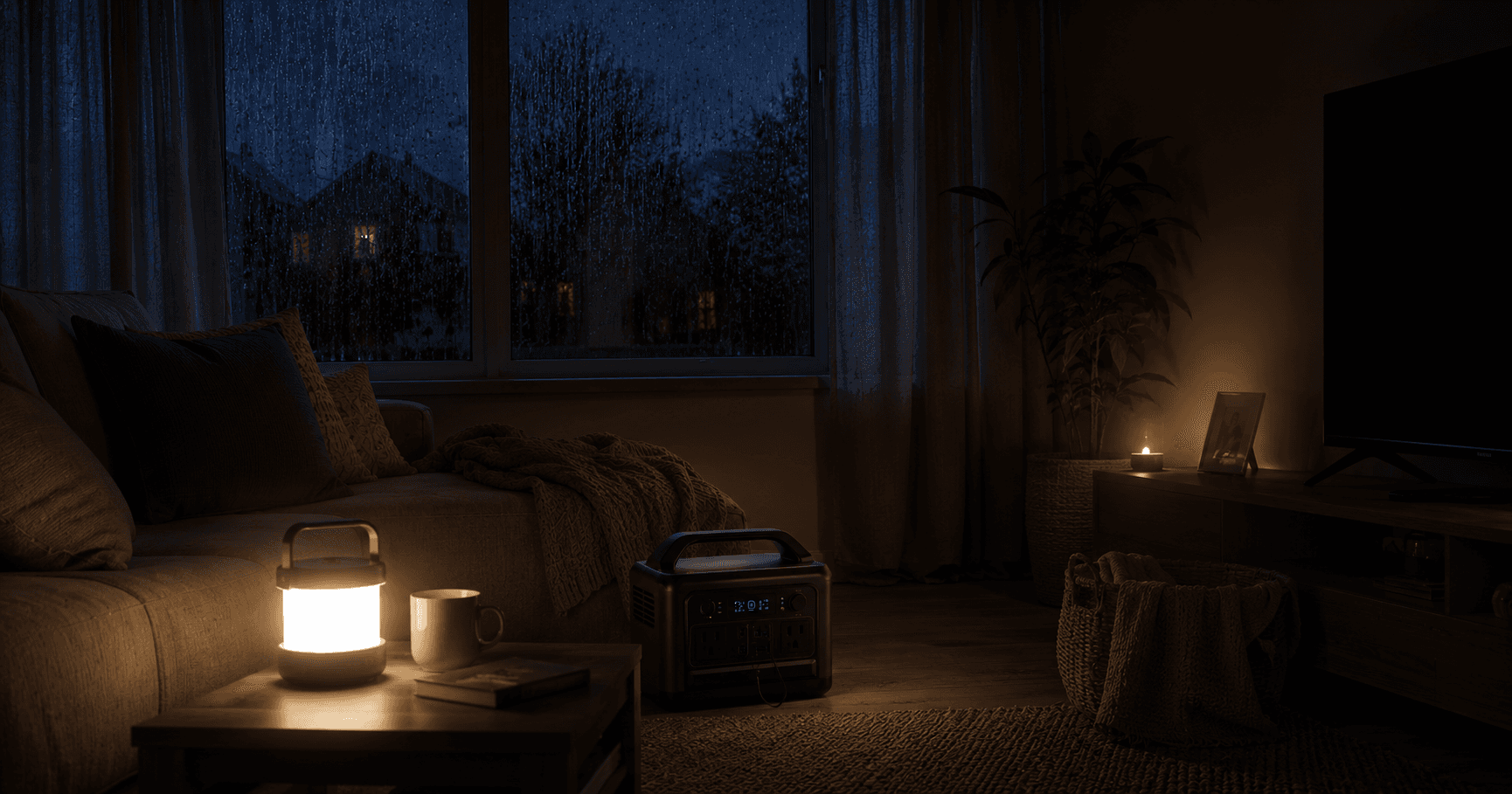
This is the tier to buy if you have severe apnea, live in a storm- or wildfire-prone area, or face multi-day outages. Why 1000Wh+ matters here: a unit this size runs a CPAP with its heated humidifier for multiple nights on a single charge, and between nights it doubles as a whole-house lifeline — keeping your phone, a lamp, a fan, and the CPAP itself powered through a days-long grid failure. It is the difference between "I made it through one night" and "I never have to think about this again."
Best value: the EcoFlow DELTA 3 (1024Wh LiFePO4, 1800W, UPS switchover under 10 ms, 27.6 lb, about $599, 4.7★) — a fast-switching, highly rated pick with enough capacity for about two nights with the humidifier on high, or five-plus dry nights.

Premium / expandable: the EcoFlow DELTA 3 Plus (1024Wh, expandable with add-on batteries, 140W USB-C, about $669) is the one to buy if you want to grow capacity later or fast-charge devices during a long outage.

Also excellent in this tier: the Bluetti AC180 (1152Wh, $449–499) for the most raw capacity per dollar, the Jackery Explorer 1000 v2 (1070Wh, $469–799), and the Anker SOLIX C1000 (1056Wh, $399–499) — any of the three is a solid whole-night anchor if you find a better price than the picks above.

Bluetti AC180 Portable Power Station (1152Wh, 1800W LiFePO4)
$449.00
Check price on AmazonCommon questions
Can I sleep on my back without CPAP?
Your apnea will be worse on your back. If you must sleep without CPAP for a night, try sleeping on your side with an extra pillow to elevate your head. This doesn't replace CPAP therapy but reduces the number of apnea events.
Will my machine be damaged by a power outage?
No. CPAP machines are designed to handle abrupt power loss. Your settings, therapy data, and clock (on most modern machines) are preserved in non-volatile memory. When power returns, just turn it back on.
Should I keep a travel CPAP as a backup?
If you have a battery-friendly travel CPAP like the ResMed AirMini, keeping it charged and ready is an excellent backup plan. Travel CPAPs typically draw less power (10–15W) and can run much longer on a small battery.
How long can I safely go without CPAP?
One night without CPAP is uncomfortable but not medically dangerous for most people. However, sleep quality will suffer, and you may feel the effects the next day (drowsiness, headache, irritability). If your sleep apnea is severe, talk to your doctor about an emergency plan.
The bottom line
Your CPAP losing power is inconvenient, not life-threatening. Modern masks are designed to let you breathe with the machine off. The real risk is chronic sleep loss from repeated nights without therapy — not a single outage.
That said, a backup battery eliminates the problem entirely — anywhere from $200 for a bedside UPS up to ~$600–900 for a whole-house unit that carries you through multi-day outages. If you've experienced the panic of waking up to a dead CPAP, you already know the peace of mind is worth every penny.
Related reading
- CPAP Power Outage Guide — full outage prep playbook
- CPAP Power Outage Prep Guide — UPS vs battery vs power station
- UPS vs CPAP Battery vs Power Station — pick the right backup type
- CPAP Hurricane Preparedness — multi-day outage planning
- Best CPAP Backup Batteries — top picks reviewed
What to do next
If you've already lived through one scary outage, don't wait for the next one. A UPS-mode power station ends the problem permanently — you sleep through the switchover and never notice power was out. Match the tier to your situation:
- Short, common outages, one machine: the bedside Bluetti Elite 30 V2 ($199–249) — plug in and forget it
- Longer outages or a heated humidifier: the Bluetti Elite 100 V2 (1024Wh, $499) for about two humidified nights
- Severe apnea, storms, or multi-day outages: a 1000Wh+ anchor like the EcoFlow DELTA 3 ($549–699) that runs your CPAP for nights and powers the rest of the house too
- Then run a live test: unplug from the wall and sleep a full night on battery
- Still deciding on size? Review our best CPAP backup batteries roundup
Affiliate disclosure
This site may include affiliate links. If you buy through links, we may earn a commission at no extra cost to you. We only recommend products we've researched and believe are genuinely useful for CPAP users.