The short answer
Divide your battery's watt-hour (Wh) rating by your CPAP's average power draw in watts. That gives you the maximum runtime in hours. In practice, you will get about 70 to 80% of that number through an AC outlet (roughly 85 to 90% on a direct DC cable) due to inverter, power-brick, and other losses.
Example: A 256 Wh battery powering a CPAP that draws 25 watts will last roughly 256 / 25 = 10.2 hours in theory, or about 8 to 8.5 hours in real-world use.
That is the formula. The rest of this guide helps you plug in the right numbers for your specific machine and figure out which battery to buy.
Step 1: Find your CPAP's power draw
Every CPAP machine has a power rating, but the number on the label is the maximum draw, not what it actually uses during normal operation. Real-world power draw depends on your prescribed pressure, whether you use a humidifier, and how much mask leak your machine has to compensate for.
Here are the typical ranges for the most popular CPAP machines:
ResMed AirSense 11
- Without humidifier: 15 to 30 watts
- With heated humidifier and tube: 30 to 70 watts
- Average overnight draw (no humidifier): ~18 watts (we measured 18.6 W at the CPAP input)
Philips DreamStation 2
- Without humidifier: 10 to 20 watts (estimate; Philips doesn't publish typical draw)
- With heated humidifier: 20 to 55 watts
- Average overnight draw (no humidifier): ~15 watts
ResMed AirMini
- All conditions (no heated humidifier): about 6 watts typical, up to 27 watts peak (ResMed spec)
- Average overnight draw: ~6 to 15 watts depending on pressure
If your machine is not listed, check the power supply brick. It will show maximum wattage. Your actual average draw without humidification is often only 20 to 40% of that maximum. You can also plug your CPAP into a kill-a-watt meter overnight to get an exact measurement. Our CPAP battery sizing guide has detailed instructions for measuring your specific setup.
Step 2: Understand the math
The runtime formula is straightforward:
Runtime (hours) = Battery capacity (Wh) x Efficiency / CPAP power draw (watts)
Efficiency accounts for energy lost in the inverter (converting DC battery power to AC for your CPAP). If you are using the battery's AC outlet, efficiency is typically 70 to 80%. If your CPAP accepts DC input and you use a direct DC cable, efficiency rises to roughly 85 to 90%.
For the calculations below, we use 75% efficiency to represent typical AC outlet use. If you use a DC cable, your actual runtime will be roughly 10 to 20% longer than shown.
Runtime table: how long your CPAP will last
This table shows estimated runtime for popular CPAP machines across four common battery sizes. All figures assume AC outlet use at 75% efficiency and no heated humidifier.
| CPAP Model | Avg Watts | 100 Wh Battery | 256 Wh Battery | 500 Wh Battery | 1000 Wh Battery |
|---|---|---|---|---|---|
| ResMed AirSense 11 | 15 to 30 W | 2.5 to 5 hrs | 6 to 13 hrs | 12 to 25 hrs | 25 to 50 hrs |
| Philips DreamStation 2 | 10 to 20 W | 4 to 7.5 hrs | 10 to 19 hrs | 19 to 37 hrs | 37 to 75 hrs |
| ResMed AirMini | 6 to 15 W | 5 to 12 hrs | 13 to 32 hrs | 25 to 62 hrs | 50 to 125 hrs |
The ranges are wide because power draw varies significantly with pressure settings. A user prescribed 8 cm of pressure draws far less than someone at 20 cm. The low end of each range represents high-pressure settings; the high end represents low-pressure settings.
What about humidifier use?
Running a heated humidifier roughly doubles your CPAP's power draw. Here is what that looks like:
| CPAP Model | Avg Watts (with humidifier) | 256 Wh Battery | 500 Wh Battery | 1000 Wh Battery |
|---|---|---|---|---|
| ResMed AirSense 11 | 30 to 70 W | 3 to 6 hrs | 5 to 12 hrs | 11 to 25 hrs |
| Philips DreamStation 2 | 20 to 55 W | 3.5 to 10 hrs | 7 to 19 hrs | 14 to 37 hrs |
The ResMed AirMini does not have a built-in heated humidifier, which is one reason it is so efficient on battery power.
As the table shows, running a humidifier on a 256 Wh battery gives you roughly 3 to 10 hours depending on your machine and settings. At higher humidifier and heated-tube settings, that is not a full night. If you need full humidification during a power outage, you need a 500 Wh battery or larger.
Step 3: Pick the right battery for your situation
Budget pick: EcoFlow RIVER 2 ($179 – $239)
The EcoFlow RIVER 2 packs 256 Wh into a 7.7-pound unit. For most CPAP users running without a humidifier, that is enough for one full night. It charges from empty to full in about one hour, so if power comes back during the day, you can be ready for the next night quickly.
Best for: Single-night outages without humidification. This is the entry point for CPAP power outage protection. If you live in an area where outages rarely last more than 12 hours, this covers you.
Mid-range: Jackery Explorer 500 v2 (~$359)
The Jackery Explorer 500 v2 offers 512 Wh of LiFePO4 at about 14 pounds. That is double the capacity of the RIVER 2 for roughly $120 more. That extra capacity makes it viable for running a humidifier through a full night on low settings, or powering your CPAP without humidification for two nights.
Best for: Users who want a safety margin, anyone who uses a humidifier, or situations where outages might last 24 to 36 hours.
Extended outages: EcoFlow DELTA 3 (~$599)
The EcoFlow DELTA 3 brings 1024 Wh of LiFePO4 and weighs about 27.6 pounds. This is the unit for hurricane season, ice storms, or any scenario where power might be out for multiple days. It will run a ResMed AirSense 11 without humidification for 25 to 50 hours. With humidification, you still get 11 to 25 hours, easily a full night.
Best for: Multi-night outages, users who need heated humidification on battery, and households where the power station also needs to charge phones and run other small devices.
If you expect outages that run a week or longer, a 2–4 kWh station roughly doubles to quadruples the DELTA 3's runtime, and pairing it with panels lets you refill it each day. We compare those stations and solar bundles in our best solar generator for CPAP guide.


For a full comparison of these and other options, see our best CPAP backup batteries guide.
Real-world factors that affect runtime
The table above gives you a solid estimate, but several factors can push your actual runtime higher or lower.
Inverter efficiency
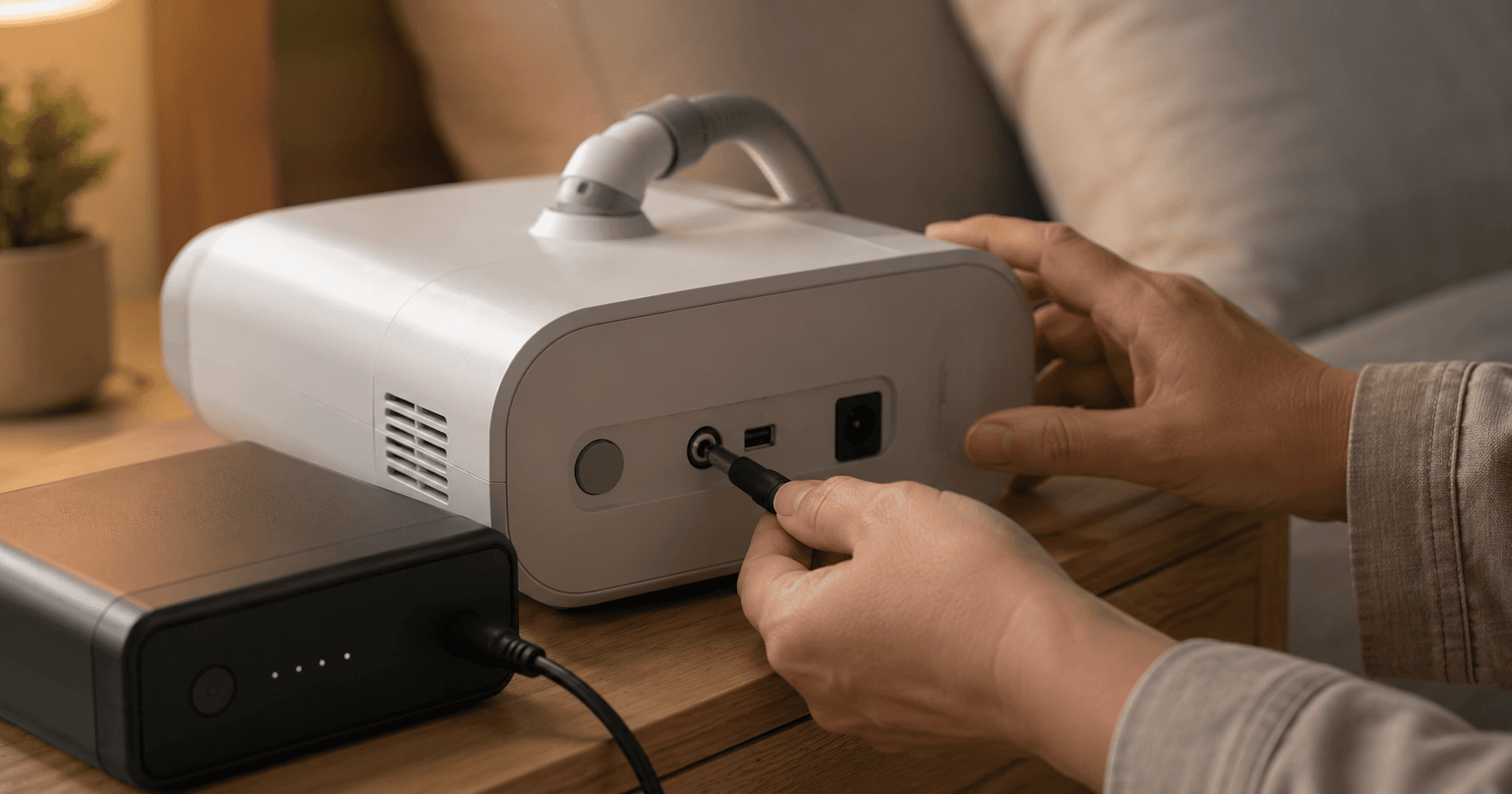
If you run your CPAP through the power station's AC outlet, the inverter converts DC to AC, then your CPAP's power supply converts it back to DC. This typically wastes 20 to 30% of stored energy as heat. Bypass most of this loss with a DC cable that connects your CPAP directly to the battery's 12V or 24V output. Not every CPAP supports this, so check your model's compatibility. Our DC power adapter guide lists compatible cables for each machine.
Temperature
Lithium-ion batteries perform best between 50 and 85 degrees Fahrenheit. In cold weather (below 40 degrees), battery capacity can drop by 10 to 20%. If you are using your power station in an unheated room during a winter outage, plan for reduced runtime.
Battery age
All lithium-ion batteries degrade over time. After 500 charge cycles, most power stations retain 80% of their original capacity. A 256 Wh battery that is two years old and has been cycled regularly might only deliver 200 to 220 Wh in practice. Keep this in mind when buying used or if your power station is a few years old.
Mask leak
When your mask leaks, the CPAP motor speeds up to maintain prescribed pressure. More motor speed means more power draw. A well-fitted mask that minimizes leak will extend your battery runtime. This is a good reason to check your mask fit regularly, but especially before you know you will be running on battery.
Auto-titrating pressure (APAP)
If your machine is set to APAP mode, the pressure varies throughout the night based on detected events. Power draw fluctuates with it. During periods of low pressure, draw is minimal. During high-pressure events, it spikes. The runtime estimates above account for this variation, but your actual draw depends on your specific apnea patterns.
What about a UPS or car battery?
Two alternatives people often consider:
UPS (uninterruptible power supply): Most consumer UPS units are designed to give you 5 to 15 minutes to save your work and shut down a computer. They are not built for overnight use. A typical 600 VA UPS has about 60 to 80 Wh of usable capacity, which means maybe 1 to 2 hours of CPAP runtime. Some larger UPS models can work, but they are heavier, louder, and more expensive than a purpose-built power station. For a detailed comparison, see our UPS vs battery vs power station guide.
Car battery with inverter: In a true emergency, you can run your CPAP from your car's 12V outlet with an inverter. But car batteries are not designed for deep discharge. Drawing them below 50% can permanently damage them or leave you unable to start your car. A 12V car battery typically has 500 to 700 Wh, but you can only safely use about 250 to 350 Wh before risking damage. It works in a pinch, but a portable power station is safer and more practical.
How to prepare before the next outage
-
Measure your actual power draw. Plug a kill-a-watt meter between your CPAP and the wall for a full night. Note the total watt-hours used. That is your real number.
-
Buy the right battery. Use the runtime table above to pick a size that covers your needs with at least a 20% margin. If you need 200 Wh for a night, get a battery rated for at least 250 Wh.
-
Test it. Charge the battery, unplug from the wall, and sleep a full night on battery power. Check the remaining charge in the morning. Now you know exactly what to expect.
-
Keep it charged. Most lithium-ion batteries hold their charge for months, but check the level monthly. Some power stations support "emergency mode" or trickle charging that keeps them topped up automatically.
-
Practice without the humidifier. If you normally use heated humidification, spend a few nights with it off. Use a heat moisture exchanger (HME) filter instead. Get comfortable with it before you are forced into it during an outage.
For a complete preparation checklist, see our CPAP power outage guide.
Bottom line
A CPAP battery will last anywhere from about 3 hours to several days during a power outage, depending on your machine, settings, and battery size. The math is simple: divide your battery's Wh by your CPAP's average watt draw, then multiply by about 0.75 (AC outlet) or 0.85 to 0.90 (direct DC cable) to account for real-world efficiency.
For most people, a 256 Wh battery in the $200 range handles a single night without humidification. If you need humidification or multi-night coverage, step up to 500 Wh or 1000 Wh.
The worst time to figure this out is at 2 AM with no power. Do the math now, buy the battery, and test it before storm season.
Related reading
- CPAP Battery Sizing Guide — calculate your exact watt-hour needs
- CPAP Power Consumption in Watts — what your machine actually draws
- CPAP Battery Runtime Calculator — plug in numbers and get estimates
- CPAP Power Outage Guide — full outage prep playbook
- Best CPAP Backup Batteries — top picks reviewed
- Best Solar Generator for CPAP — 2–4 kWh stations and solar bundles for multi-day outages
What to do next
Now that you know how long a battery will actually last, the next step is picking one that covers your specific machine and settings with a comfortable margin. Measure your real power draw, pick a capacity 20% larger than your worst-case need, and test it before you need it.
- Run through our CPAP battery sizing guide with your kill-a-watt readings
- Compare our best CPAP backup batteries shortlist against your budget
- Build a full power outage prep plan so the battery is just one part of your readiness