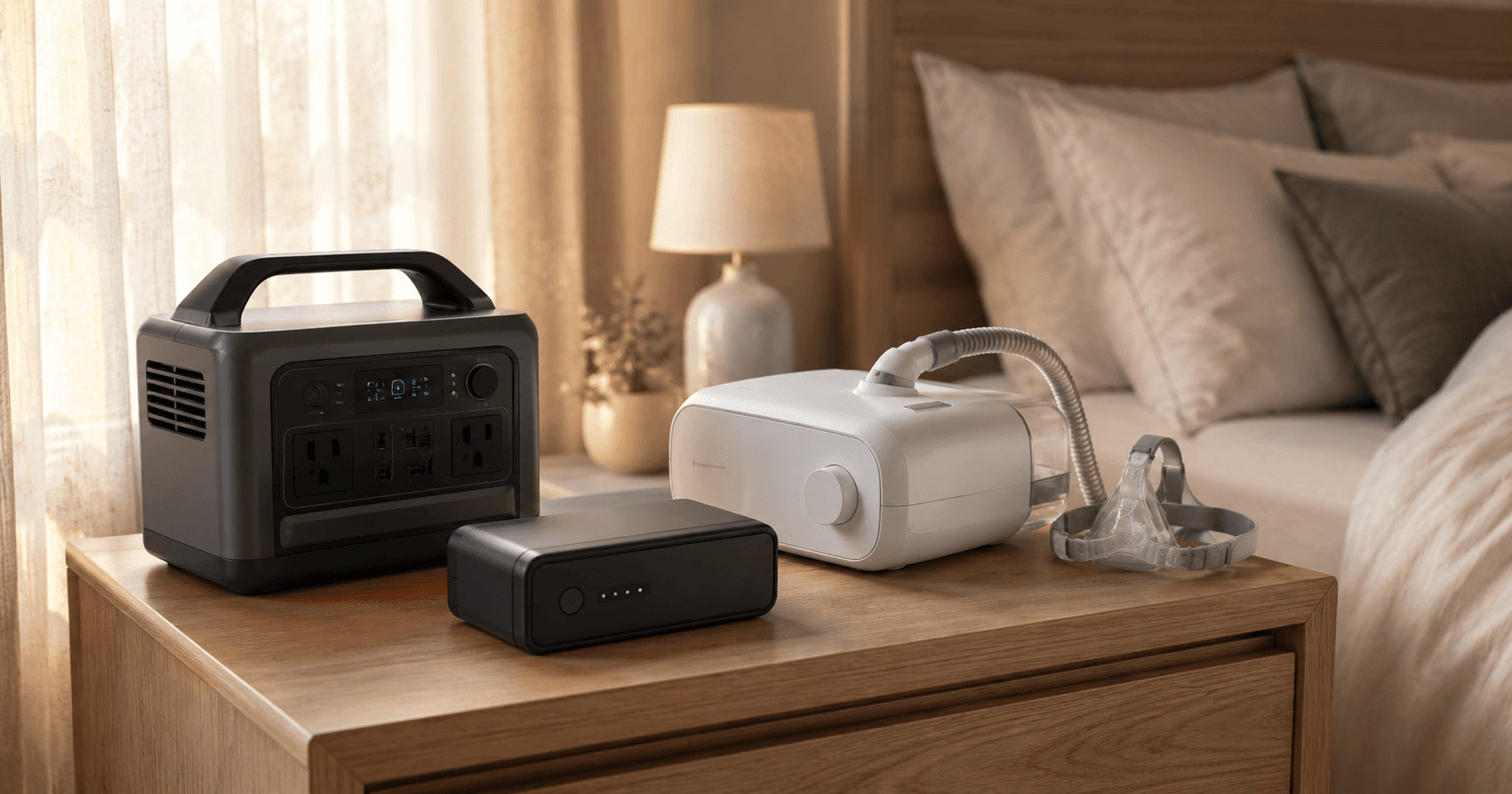
If you are sizing a backup battery, the single most important number you need is your CPAP's power consumption in watts. Most CPAP machines draw 15-30 watts without humidification and 40-70 watts once a heated humidifier and tube kick in — but the exact figure depends on your model, your pressure setting, and which comfort features you leave switched on. Get this number wrong and you will either overspend on a power station you do not need or, worse, wake up at 3 a.m. to a dead battery. This reference breaks down CPAP wattage by model and setting, gives you the watt-hour math, and shows you how to measure your own machine.
Why CPAP wattage matters for battery sizing
CPAP wattage is the foundation of every battery decision you will make, because runtime is simply stored energy divided by power draw. A battery's capacity is rated in watt-hours (Wh), and your machine's appetite is rated in watts (W). Divide one by the other and you get hours of runtime. Everything else — brand, lithium chemistry, price — is secondary to getting these two numbers right.
Here is why the watt figure is so decisive: the difference between a CPAP running at 20W and the same machine at 60W is the difference between a single battery lasting all night and dying before sunrise. On a typical 300Wh power station, 20W gives you roughly 12-13 hours, while 60W gives you barely 4 hours. Same battery, same machine — only the settings changed.
The bottom line: before you spend a dollar on a battery, you need two numbers — your machine's real-world watts and the battery's usable watt-hours. Quoting an "average" wattage from a spec sheet is not enough, because averages hide the peaks. A machine that averages 30W might spike to 90W during an inhale at high pressure, and an undersized battery or inverter can stumble on those peaks.
This post gives you defensible, spec-derived wattage figures for the most common machines so you can size with confidence. If you would rather plug numbers into a tool, our CPAP battery runtime calculator does the division for you. But understanding why the numbers move is what keeps you from buying the wrong battery twice.
Power consumption by model
Below is a comparison of approximate power draw for the most common CPAP and BiPAP machines, measured from manufacturer DC specifications and real-world wattmeter readings. The first column shows draw with the humidifier and heated tube off (or absent); the second shows a typical "comfort on" configuration with heated humidification and a climate-controlled tube running.
| Machine | Without humidifier (W) | With heated humidifier + tube (W) | Notes |
|---|---|---|---|
| ResMed AirSense 10 | 20-30W | 50-65W | Industry workhorse; 24V/90W power supply |
| ResMed AirSense 11 | 20-30W | 53-65W | Slightly higher peak than the 10 |
| ResMed AirMini | 7-20W | N/A | No water tank; uses waterless HumidX |
| ResMed AirCurve 10/11 (BiPAP) | 25-40W | 60-80W | Two-pressure cycling raises average draw |
| Philips DreamStation | 20-35W | 55-70W | 80W power supply standard |
| Philips DreamStation 2 | 20-35W | 55-75W | Integrated humidifier, similar profile |
| Fisher & Paykel SleepStyle | 25-40W | 60-85W | Higher humidifier draw than ResMed |
A few patterns stand out. The ResMed AirMini is the clear efficiency champion at 7-20W, because it ships without a heated water chamber — it humidifies with a disposable waterless cartridge, eliminating the biggest power sink entirely. That makes it the go-to travel machine when battery weight matters.
BiPAP machines like the ResMed AirCurve draw more than fixed-pressure CPAPs because they cycle between a higher inhale pressure (IPAP) and a lower exhale pressure (EPAP), and the blower works harder to switch quickly. Budget 10-20% more wattage than a comparable CPAP. If you run a bilevel machine, our BiPAP battery backup guide covers sizing for that extra demand.
Your actual number also rises with your prescribed pressure. A machine set to 5 cmH₂O sits near the bottom of these ranges; the same machine at 15-20 cmH₂O sits at the top, because the blower motor spins faster to hit the target pressure. If you do not know your pressure, check your machine's clinical menu or ask your DME provider.
How pressure setting changes wattage
CPAP power draw scales with pressure because the blower is a centrifugal fan, and fan power rises sharply with the airflow and pressure it must produce. As a rough rule of thumb for a fixed-pressure ResMed AirSense, blower-only draw climbs about 1-1.5W for every 1 cmH₂O of added pressure. A patient at 6 cmH₂O might pull 12W from the blower; the same machine at 16 cmH₂O can pull 25-30W from the blower alone, before any humidifier load.
Two comfort features pull in the opposite direction and save power. Ramp starts you at a low pressure and climbs slowly, so your first 20-45 minutes draw less. EPR (Expiratory Pressure Relief) or Flex drops pressure on exhale, shaving a few watts off the average. Neither is large enough to change your battery choice, but they do nudge real-world averages below the spec-sheet peak — another reason to measure your own machine rather than trust a single headline number.
How humidifiers and heated tubes change the numbers
The heated humidifier is, by a wide margin, the largest power consumer in your CPAP setup — it routinely doubles or triples total draw. A resistive heating element warms a water reservoir to body temperature, and that element can add roughly 10-30W on its own, on top of the 15-25W the blower already uses. This is why the same ResMed AirSense 11 draws about 18W with humidification off and closer to 50W with it on full.
The heated tube (ClimateLineAir on ResMed, heated tubing on Philips) adds another 5-15W. It keeps the warmed air from condensing into "rainout" before it reaches your mask, using a thin heating wire along the hose. Useful for comfort, but it is pure additional load when you are running on a battery.
Here is the strategic insight that saves the most battery: heating is duty-cycled, not constant. The humidifier and tube cycle on and off to hold a target temperature, so your average draw over a full night is lower than the peak. A machine that peaks at 65W might average 40-45W across eight hours. That difference matters enormously for runtime math — but you should always size for the higher figure to keep a safety margin.
There is also a hidden cost most people miss: the humidifier draws a small amount of power even in standby, and the warm-up surge when it first heats can briefly spike well above the steady-state figure. That cold-start surge is why an inverter rated only slightly above your average draw can trip or shut down in the first minute. Always pick a battery and inverter with headroom above the peak, not the average.
In short: if your battery is marginal, turning the humidifier off (or switching to a waterless option) is the single biggest lever you have. Many users drop from 60W to 25W instantly, nearly tripling runtime. We cover the full trade-off, including dry-airway tips, in our CPAP humidifier battery drain guide and in running CPAP without water.
How to measure your own CPAP power draw
The most accurate way to know your CPAP's wattage is to measure it directly with a plug-in power meter, because spec-sheet figures assume settings that may not match yours. A consumer wattmeter such as a Kill A Watt costs about $25 and reads real-time watts at the wall outlet. Plug the meter into the wall, plug your CPAP into the meter, and run the machine exactly as you do overnight — same pressure, same humidifier level, same heated tube setting.
Follow these steps for a reliable reading:
- Warm it up first. Let the humidifier reach temperature for 10-15 minutes before recording, since cold-start draw is higher than steady state.
- Read the watts, not the volt-amps. Power stations and batteries are rated in real watts; record the W figure.
- Note both peak and average. Watch the display for a few minutes — peaks happen on inhale and during heater cycles. Size your battery to the peak; estimate runtime from the average.
- Test with humidifier on and off. This tells you exactly how much runtime you buy back by running dry.
Once you have your watts, the runtime formula is straightforward. Batteries lose energy to inverter inefficiency and voltage conversion, so multiply rated capacity by about 0.85 to get usable watt-hours, then divide by your watts:
Runtime (hours) ≈ (battery Wh × 0.85) ÷ CPAP watts
For example, a 300Wh power station running a 35W CPAP gives roughly (300 × 0.85) ÷ 35 ≈ 7.3 hours — about one full night. Run that same machine at 60W with full humidification and you get only (300 × 0.85) ÷ 60 ≈ 4.3 hours. Using a DC-to-DC connection instead of the AC inverter pushes efficiency closer to 0.90-0.95, stretching runtime further — see our CPAP DC power adapter guide for that wiring. For a deeper sizing walkthrough, our CPAP battery sizing guide maps watts to nights of backup.
What this means for battery shopping
Once you know your CPAP draws, say, 30-40W in your real configuration, battery shopping becomes simple arithmetic: pick a unit whose usable watt-hours cover the number of nights you need. For a single night at 35W, a 250-300Wh battery is the sweet spot. For two nights or a humidifier-on setup, step up to 400-500Wh.
The two power stations below are popular 250-300Wh options for single-night CPAP backup, and both run a typical 30-35W machine through most or all of a night.

Anker SOLIX C300 Portable Power Station (288Wh LiFePO4, 300W AC)
$329.99
Check price on Amazon
Both deliver roughly 250-300Wh of capacity (288Wh LiFePO4 for the Anker SOLIX C300, which costs more at $329.99 but adds three AC outlets, 140W USB-C, and a sub-10ms UPS mode). At a 30W draw (humidifier off) through the AC outlet, each will cover roughly 6.5-8 hours; at 60W with full humidification, expect closer to 4 hours, so plan to run dry if you need the whole night. Look for pure sine wave AC output if you will use the inverter, since some machines run noisy or inefficient on modified sine — details in our pure sine vs modified sine for CPAP explainer.
If you need two or more nights of backup, or you refuse to give up full humidification, scale up rather than stretch. A 500Wh station running a 40W humidified setup yields about (500 × 0.85) ÷ 40 ≈ 10.6 hours — comfortably one long night with margin, or two nights run dry at 25W. The math always comes back to the same two inputs: your measured watts and the battery's usable watt-hours. Lock those down and every product comparison becomes a quick division rather than a guess.
If you want a smaller, CPAP-specific battery designed to clip onto the machine rather than a general power station, a dedicated medical battery is often the lighter choice for travel:

One number trips up many shoppers: the gap between a battery's rated watt-hours and its usable watt-hours. Manufacturers advertise the cell capacity, but inverter losses, the low-battery cutoff, and cold-weather voltage sag all eat into what you actually get. That is why the 0.85 multiplier in the runtime formula matters — a "300Wh" station realistically delivers about 255Wh to your CPAP through the AC inverter. Treat the advertised number as a ceiling, not a guarantee, and you will never be caught short.
The most reliable way to maximize any battery is to lower the load. Choosing an efficient machine, running waterless humidification, and using a DC cord instead of the AC inverter can together cut your draw in half. Our most battery-efficient CPAP machines roundup ranks models by exactly this metric, and how long a CPAP battery lasts in a power outage translates watts into real emergency runtime.
Related reading
- CPAP Battery Backup Guide
- CPAP Battery Sizing Guide
- CPAP Humidifier Battery Drain Explained
- Most Battery-Efficient CPAP Machines
- CPAP Battery Runtime Calculator
- Best Battery for the ResMed AirSense 11
What to do next
Start by measuring your own machine: spend 15 minutes with a $25 wattmeter and record your real draw with the humidifier both on and off. That single number tells you exactly how many watt-hours of battery you need and how much runtime you buy back by running dry. Then match it to a battery using the formula above — usable Wh ÷ watts.
If you're ready to pick a battery, check our best CPAP backup batteries guide for side-by-side comparisons.