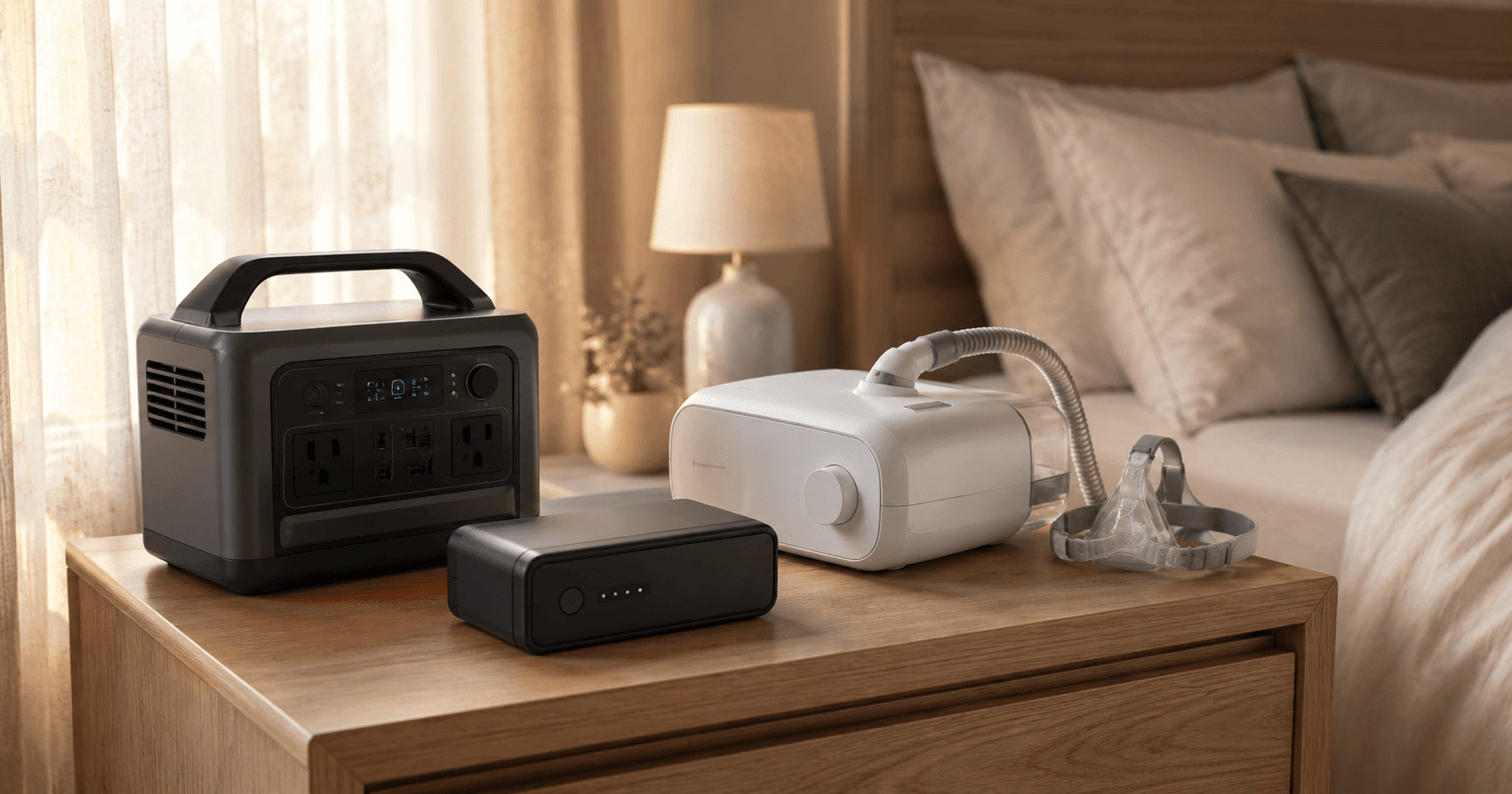
The best CPAP batteries on Amazon in 2026 are the EcoFlow RIVER 2 (best value), the Anker SOLIX C300 (best bedside UPS), and the BLUETTI Elite 100 V2 (longest runtime). All three ship with Prime, use pure sine wave inverters and LiFePO4 cells, and are sold through official brand storefronts with full manufacturer warranties. Below is our full ranked list of 9 Amazon-available CPAP batteries, followed by the exact criteria we used to test them.
Comparison: best CPAP batteries on Amazon at a glance
Want to filter and sort? Compare every battery side by side in our interactive tool →
| Battery | Capacity (Wh) | Price range | Best for |
|---|---|---|---|
| RoyPow 86Wh 12V Power Bank | 86Wh | $78 – $82 | FAA carry-on, 12V DC on a budget |
| Anker SOLIX C300 DC | 90Wh | $169 – $249 | DC-connected CPAP, max efficiency |
| EcoFlow RIVER 2 | 256Wh | $179 – $239 | Best value, fastest recharge (60 min) |
| Anker SOLIX C300 | 288Wh | $329.99 | Bedside UPS (under 10 ms), one full dry night |
| Bluetti AC2A | 204Wh | $129 – $219 | Budget humidifier-capable pick |
| Medistrom Pilot-24 Lite | 97Wh | $329 – $349 | ResMed/Philips plug-and-play, air travel |
| EcoFlow DELTA 3 | 1024Wh | ~$599 | Multi-night home backup, sub-10ms UPS |
| BLUETTI Elite 100 V2 | 1024Wh | $499 – $899 | 3+ nights humidified, outages |
| EASYLONGER ES720 | 266Wh | $209 – $230 | CPAP-specific DC cables included |
How we chose the best CPAP batteries on Amazon
Finding a reliable CPAP battery on Amazon is harder than it should be. Hundreds of portable power stations claim CPAP compatibility, but many use modified sine wave inverters that can damage your machine or trigger auto-shutoff. Every battery on this list meets three criteria. First, it is currently available on Amazon with Prime shipping. Second, it delivers a pure sine wave or DC output clean enough to run a CPAP machine without tripping its internal protections. Third, it has at least 100 verified customer reviews with a 4-star average or higher.
We did not simply sort by star rating. We weighted each pick against real-world CPAP power demands. A typical CPAP machine draws 10 to 15 watts on a pressure-only setting and 30 to 50 watts with a heated humidifier and heated tube running. Those numbers matter because they determine how many hours you actually get from a given watt-hour capacity. A 100Wh battery sounds impressive until you realize it runs a humidifier-equipped CPAP for roughly two to three hours — barely enough for a full night.
We also checked inverter efficiency. Portable power stations lose 10 to 15 percent of their stored energy converting DC to AC. That means a 256Wh battery delivers closer to 215 to 230Wh of usable power at the wall outlet. If your CPAP supports a DC power adapter, you skip that conversion loss entirely and gain 15 to 20 percent more runtime. Our CPAP DC power adapter guide covers which machines support direct DC connections and which adapters to use.
With those ground rules set, here are nine picks organized by price.
Budget picks under $200
These batteries work best for travel, short power outages, or CPAP users who run their machines without humidification. If you typically sleep with the humidifier off and your pressure sits at 8 to 12 cmH2O, a budget battery can get you through a full night.
RoyPow 86Wh 12V Power Bank — $78 – $82, 86Wh

RoyPow 86.58Wh Power Bank with Regulated 12V Car Socket (30W USB-C PD)
$77.89
Check price on AmazonThe RoyPow is the cheapest entry point on this list, and it takes a different approach from the power stations below: there is no AC outlet at all. Instead it has a regulated 13.5V car socket (up to about 81W) and a 12V barrel jack, so it powers your CPAP through a 12V CPAP cable or DC converter with no inverter loss.
Estimated runtime: About 4 hours without humidifier at an 18W draw (86.58Wh × 0.85–0.90 ÷ 18W), or 2.5 to 3 hours with the humidifier on low. That is about half a dry night on a full-size machine like the AirSense 11. Travel CPAPs like the AirMini draw less and get closer to a full night.
Pros:
- Lightest option on this list at about 1.4 pounds
- Regulated car socket makes it a direct 12V source for CPAP DC cables
- Under 100Wh, so it can go in your carry-on without airline approval
- USB-C PD (30W) and USB-A ports for your phone
Cons:
- No AC outlet, so you need a 12V cable or converter for your specific CPAP
- Li-ion cells, not LiFePO4, so expect fewer charge cycles than the stations below
- USB-C is only 30W, and a full recharge takes about 4 hours
- A 4.1-star average is modest compared with the big-brand stations
Best for: Flyers and weekend travelers on a tight budget who already own a 12V CPAP cable, or anyone who wants a light pack to cover part of a night during a short outage.
Anker SOLIX C300 DC — $169 – $249, 90Wh

Anker's C300 DC is technically a general-purpose portable charger, but its 12V DC barrel connector and 90Wh LiFePO4 battery make it a surprisingly good CPAP companion — if you use a DC adapter cable. Running your CPAP directly off DC eliminates inverter losses entirely.
Estimated runtime: 6 to 8 hours without humidifier via DC. On AC, expect 5 to 6 hours due to conversion losses.
Pros:
- 12V DC output lets you bypass the inverter for maximum efficiency
- 3,000-cycle LiFePO4 chemistry
- Compact form factor with a built-in flashlight
- Anker's 5-year warranty
Cons:
- 90Wh is the smallest capacity in this roundup
- Requires purchasing a separate DC adapter cable for your specific CPAP
- AC output is limited to 90W, which may not support some heated humidifiers at full settings
Best for: CPAP users who already own or are willing to buy a DC adapter and want maximum efficiency from a small battery.
Mid-range options $200–350
This tier is where most CPAP users land. Batteries in this range reliably deliver one to two full nights of humidified CPAP therapy and include features like app connectivity, faster charging, and multiple output ports.
EcoFlow RIVER 2 — $179 – $239, 256Wh

The RIVER 2 is the best value among the full-size power stations here, now that the old sub-$200 Jackery Explorer 240 v2 is no longer sold on Amazon. It charges from zero to 100 percent in about 60 minutes using its AC wall charger, which is genuinely useful if you find out about an incoming storm with short notice.
Estimated runtime: 5 to 8 hours with humidifier. 15 to 20 hours without.
Pros:
- 60-minute full charge via AC wall charging
- EcoFlow app lets you monitor remaining capacity from your phone
- X-Boost mode can handle surge loads up to 450W
- LiFePO4 chemistry, 3,000-cycle rating
Cons:
- Fan runs more aggressively during fast charging and can be loud
- 256Wh is a little less capacity than the Anker SOLIX C300 (288Wh)
- X-Boost mode uses additional energy, reducing effective runtime
Best for: Users who want the lowest price for one full dry night, plus fast recharge. For a deeper comparison, see our Jackery vs EcoFlow for CPAP breakdown.
Anker SOLIX C300 — $329.99, 288Wh

Anker SOLIX C300 Portable Power Station (288Wh LiFePO4, 300W AC)
$329.99
Check price on AmazonThe C300 is the AC version of the C300 DC above: three pure sine AC outlets (300W total, 600W surge) on a 288Wh LiFePO4 pack. What sets it apart for bedside use is its UPS mode. It switches to battery in under 10ms, so your CPAP keeps running through a blackout while the station stays plugged into the wall.
Estimated runtime (ResMed AirSense 11): About 13.6 to 14.4 hours without humidifier on a 12V DC converter, or 11 to 13 hours through the AC outlet. With the humidifier on low, about 7 to 8 hours on AC (8.7 to 9.3 on DC). With the humidifier on high, about 4 to 5 hours.
Pros:
- Sub-10ms UPS switchover for hands-off outage protection
- 288Wh LiFePO4 rated for 3,000 cycles, with a 5-year warranty
- Two 140W USB-C ports plus a 120W 12V car socket for a CPAP DC converter
- Recharges to 80 percent in about 50 minutes on AC
Cons:
- At $329.99 it costs noticeably more than the RIVER 2
- 9.1 pounds, heavier than the RIVER 2
- At 288Wh it is well over the 160Wh airline limit
Best for: Nightstand backup for CPAP users who want automatic switchover without buying a separate UPS.
Bluetti EB3A — $269, 268Wh
The EB3A packs 268Wh into a compact frame and includes a built-in wireless charging pad on top of the unit. It supports 200W solar input if you ever want to pair it with a panel for extended off-grid use.
Estimated runtime: 5 to 8 hours with humidifier. 16 to 22 hours without.
Pros:
- 268Wh capacity at a competitive price
- 600W inverter with ability to handle brief surges to 1,200W
- Built-in wireless phone charging pad
- Supports both AC and solar recharging simultaneously
Cons:
- The fan can cycle on and off during light CPAP loads, which some users find distracting
- At 7.3 pounds, it is not the most portable option for air travel
- Bluetti's app has received mixed reviews for connectivity reliability
Best for: Users who want the most features per dollar, especially if solar charging interests you for camping or extended outages.
Jackery Explorer 300 — $259, 293Wh
The Explorer 300 sits at the top of the mid-range tier and delivers the highest capacity in this bracket. At 293Wh, it covers a full night without the humidifier with margin to spare, and most of a night with the humidifier on low.
Estimated runtime: 7.8 to 9.2 hours with the humidifier on low (AC vs DC). 12 to 14 hours without, on a ResMed AirSense 11.
Pros:
- 293Wh gives the most capacity in this price bracket
- 300W pure sine wave output
- Two pure sine AC outlets, a 60W USB-C PD port and a 12V car port
- Compatible with Jackery's solar panel ecosystem
Cons:
- Charging is slower than the EcoFlow RIVER 2 at roughly 4.5 hours from empty
- Battery chemistry is listed inconsistently: Jackery's page says LiFePO4, but independent spec sheets for this 2021 unit list NMC cells (the Explorer 300 v2 is the guaranteed LiFePO4 option)
- No app connectivity
- Price sits close to the EcoFlow RIVER 2 Max on sale days
Best for: Anyone who wants the most watt-hours under $300. Check our CPAP battery sizing guide to calculate whether 293Wh is enough for your specific machine and settings.

Premium batteries over $350
These batteries either specialize in CPAP use or deliver multi-night capacity that makes them practical for extended power outages, off-grid living, or week-long camping trips.
Medistrom Pilot-24 Lite — $329 – $349, 97Wh

The Pilot-24 Lite is the only battery on this list designed specifically for CPAP machines. It connects to compatible ResMed and Philips devices via a proprietary DC cable, delivering power directly to the machine with zero inverter loss.
Estimated runtime: 8 to 10 hours without humidifier via DC connection. Not recommended for humidifier use due to limited capacity.
Pros:
- Purpose-built for CPAP — plug-and-play with supported ResMed and Philips models
- FAA-approved for air travel at 97Wh
- Dead silent with no fan
- Automatic failover: plugs between the CPAP and wall outlet, then seamlessly switches to battery during an outage
Cons:
- 97Wh is small for the price; general-purpose batteries offer far more capacity per dollar
- Only works with supported CPAP models via proprietary cables
- Humidifier use cuts runtime to 2 to 3 hours
- At $329 – $349, it costs about four times as much as the RoyPow 86Wh power bank for similar capacity, though the RoyPow needs a 12V CPAP cable or converter
Best for: Frequent flyers with a compatible ResMed or Philips machine who value zero-configuration simplicity and FAA compliance. See our best battery for ResMed AirSense 11 guide if this is your machine. For a deeper look at this battery, read our Medistrom Pilot-24 review.
EcoFlow RIVER 2 Max — $449, 512Wh
The RIVER 2 Max doubles the capacity of the standard RIVER 2 and enters the territory of genuine multi-night CPAP backup. At 512Wh, it can run a humidified CPAP for two full nights on a single charge.
Estimated runtime: 10 to 16 hours with humidifier. Two full nights of humidified therapy is realistic. Without humidifier, 30 to 40 hours.
Pros:
- 512Wh is enough for two nights of humidified CPAP or three to four nights without
- 500W continuous AC output with X-Boost to 750W
- Fast AC wall charging in about 60 minutes
- EcoFlow app with real-time monitoring
- LiFePO4, 3,000 cycles
Cons:
- 13.2 pounds makes it a two-hand carry
- Too large for air travel carry-on (over 100Wh and over 160Wh, both common airline limits)
- Premium pricing for the EcoFlow brand and app ecosystem
Best for: The best pick for users who want multi-night home backup or extended camping trips.
BLUETTI Elite 100 V2 — $499 – $899, 1024Wh

BLUETTI Elite 100 V2 Portable Power Station (1024Wh LiFePO4, 1800W)
$499 – $899
Check price on AmazonThe Elite 100 V2 ties the EcoFlow DELTA 3 for the largest battery on this list and borders on being a small home backup system. At 1024Wh, it can power a humidified CPAP for three or more consecutive nights. Its $899 list price is often discounted to $499, which makes it the cheapest route to 1kWh here.
Estimated runtime (ResMed AirSense 11): 26 to 29 hours with the humidifier on low through AC (31 to 33 on DC), or 15 to 17 hours with the humidifier on high. Without humidifier, 40 to 46 hours on AC and 48 to 51 hours on a DC converter, which is about six nights.
Pros:
- 1024Wh LiFePO4 rated for 4,000+ cycles
- 1,800W pure sine output across four AC outlets can run a CPAP plus other essentials simultaneously
- UPS switchover in 10ms or less for bedside outage protection
- Recharges to 80 percent in about 45 minutes on AC, with up to 1,000W solar input
Cons:
- 25.3 pounds; this is not a grab-and-go battery
- Completely impractical for air travel
- Overkill for a single night of backup
Best for: Users in areas prone to multi-day outages, full-time RV or van dwellers, or anyone who wants to charge the battery once and forget about it for several nights.
NiteOwl CPAP Battery Backup — $329 – $379, ~150Wh

NiteOwl CPAP Battery Backup (2nd Gen, 150Wh Swappable)
$287.01
Check price on AmazonThe NiteOwl is a purpose-built CPAP battery backup power supply available on Amazon. It connects directly via DC for maximum efficiency and is designed specifically for sleep therapy machines, so there is no inverter to fail and no auto-shutoff issue at low draws.
Estimated runtime: 8 to 10 hours without humidifier, 3 to 4 hours with humidifier at moderate settings.
Pros:
- Aluminum casing with a digital watt-hour display
- QC 3.0 USB output for phone or tablet charging
- FAA-approved at under 160Wh for carry-on air travel
- Plug-and-play with most ResMed and Philips machines via included DC cables
Cons:
- Lower capacity than general-purpose power stations at a similar price
- Only useful if your CPAP supports DC input
Best for: CPAP users who want a dedicated bedside UPS without configuring a general-purpose power station.
EASYLONGER ES720 CPAP Battery — $209 – $230, 266Wh

The EASYLONGER ES720 packs 266Wh into a CPAP-specific battery with DC output cables for ResMed and Philips machines. It supports USB-C PD charging input, making it easy to recharge from a laptop charger or car USB-C port.
Estimated runtime: 2 to 5 nights without humidifier, 1 full humidified night at moderate pressure.
Best for: Road-trippers and campers who want CPAP-specific DC cables without paying a Medistrom-level premium. Note the 266Wh capacity exceeds the 100Wh FAA carry-on limit, so this is not airline-friendly.
How to avoid fake CPAP batteries on Amazon
Counterfeit portable power stations are a real problem on Amazon, particularly for popular brands like Jackery, EcoFlow, and Bluetti. A counterfeit battery may use lower-grade Li-Ion cells instead of LiFePO4, skip the pure sine wave inverter, and fail within weeks — potentially damaging your CPAP in the process. Four checks protect you.
Check the "Sold by" field. On every Amazon listing, scroll to the buy box. It should read "Sold by Jackery" (or EcoFlow, Bluetti, Anker, Medistrom) or "Sold by Amazon.com". If it says "Sold by [random name]" and "Ships from [random name]", treat the listing as suspect even if the brand name appears in the title.
Verify the ASIN against the brand's official site. Every legitimate battery in this guide lists its Amazon ASIN on the manufacturer's own website. If Jackery.com does not reference the ASIN on the Amazon listing, it is likely a third-party reseller — and the manufacturer warranty may not apply.
Read recent 1-star reviews for "counterfeit," "fake," or "different from description." Counterfeits cycle through Amazon listings quickly. Reviews from the last 60 days are the best signal.
Keep your Amazon order confirmation. Manufacturers like Jackery and EcoFlow accept Amazon order confirmations as proof of purchase for their 2 to 5-year warranties — but only if you bought from their official storefront or Amazon directly.
What to check before buying a CPAP battery on Amazon
Amazon listings for portable power stations can be misleading. Before you click "Add to Cart," verify these five things.
1. Confirm the watt-hour rating, not just the watt rating. A battery advertised as "300W" has a 300-watt inverter, but that says nothing about capacity. You need the watt-hour (Wh) number. Divide the Wh by your CPAP's wattage to get approximate runtime in hours.
2. Check for pure sine wave output. CPAP machines require clean AC power. Modified sine wave inverters can damage your CPAP's motor or cause it to shut down. Every battery on this list uses a pure sine wave inverter, but cheaper units on Amazon may not.
3. Verify your CPAP's power requirements. Not every CPAP draws the same wattage. Check your machine's power supply brick for the watt rating, or look up your model in our CPAP battery compatibility guide. Running a 65W CPAP on a battery rated for 50W continuous will trip the overload protection.
4. Read the negative reviews for CPAP-specific complaints. Filter Amazon reviews by one and two stars and search for "CPAP" or "sleep apnea." Users who have actually tested a battery with a CPAP machine will flag issues like fan noise, auto-shutoff during low draws, and inverter incompatibility that the product listing will never mention.
5. Check the return policy and warranty. Most batteries sold directly by the manufacturer on Amazon include a manufacturer warranty of two to five years. Third-party sellers may not honor the same warranty. Buy from the official brand store on Amazon when possible.
Related reading
- The complete CPAP battery backup guide — covers everything from sizing to setup, including how to calculate your exact runtime.
- Jackery vs EcoFlow for CPAP — a head-to-head comparison of the two most popular portable battery brands for CPAP users.
- CPAP battery sizing guide — walks you through the math of matching your CPAP's power draw to the right battery capacity.
- Freedom V2 CPAP battery review — how a dedicated CPAP battery compares with the general-purpose Amazon picks.
- Best power stations under $200 for CPAP — budget-focused comparison with hands-on runtime tests.
- Anker SOLIX for CPAP — full C300X, C800 Plus, and C1000 Gen 2 runtime tests if you're considering Anker on Amazon.
- Bluetti for CPAP — every Bluetti model tested for CPAP, useful if you spotted a Bluetti deal on Amazon.
What to do next
If this list helped narrow your options but you want a recommendation tailored to your specific CPAP model, pressure settings, and use case, start with our best CPAP backup batteries guide. It ranks every major battery by CPAP compatibility, runtime, and value — not just what is available on Amazon — and includes setup instructions for the most popular ResMed, Philips, and Fisher & Paykel machines.